Cocoa: Why a Record Price Does Not Predict the Future

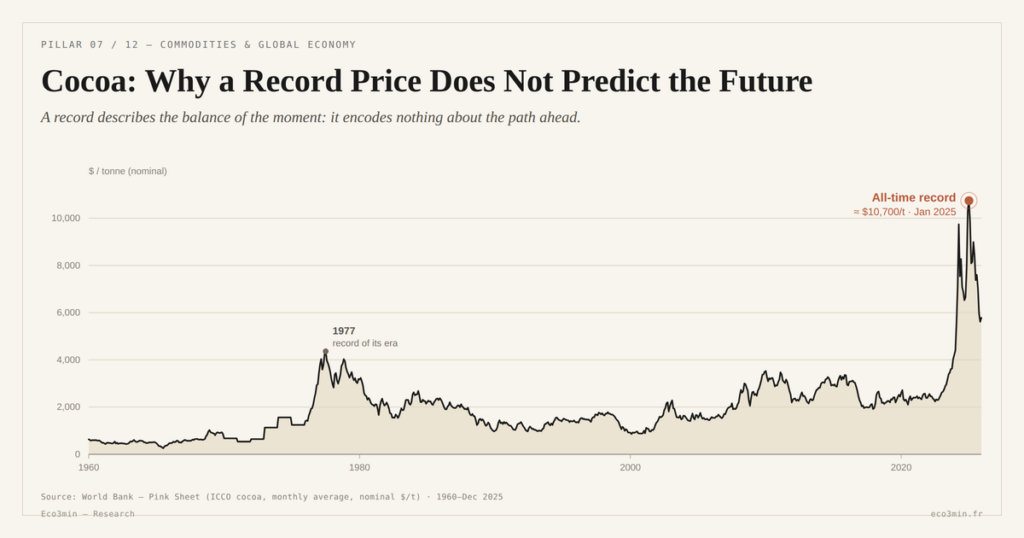
A record price marks a past imbalance, not a forecast. Extrapolating it — upward at the peak, downward at the trough — is the recurring error that the boom-and-bust pattern punishes.
TL;DR
Cocoa's structure all but guarantees more large swings, yet says nothing about their direction or timing; the honest reading names that limit instead of filling it with a confident call.
- A price record sums up one moment's supply-demand balance; it encodes nothing about future harvests, weather, disease or demand, which reveal themselves only in their own time.
- Across inelastic-supply commodities, from energy to metals, past records that looked like a new era of scarcity were repeatedly followed by sharp retreats, none of which foretold the next.
This article examines why a cocoa price record carries no information about the future, why both bullish and bearish extrapolation are cognitive errors, and what a disciplined reading looks like.
Faced with a price hitting records, the temptation is strong to treat it as a signal: if cocoa has never been this expensive, the thinking goes, something must have changed for good. The reverse reasoning takes hold just as easily after a fall. Yet the history of cocoa, like that of most rigid-supply commodities, teaches that a price extreme announces nothing: it describes a present state, saying nothing about the path ahead. Understanding this distinction is arguably the most useful lesson of the whole episode.
What a record says, and does not say
A price, at any moment, sums up the current balance between supply and demand. A record therefore indicates that this balance has become extremely tight: demand far exceeded available supply, and the price had to rise until it rationed consumption. That is valuable information about the present — the market was, at that moment, in acute shortage. But it is information about the present only.
What the record does not contain is information about what will determine tomorrow’s price: future harvests, the course of disease, the weather of coming seasons, demand adjustments. None of these variables is encoded in the level the quote has reached. Today’s price is the product of past and present conditions; it has no predictive power over factors that, by nature, have not yet occurred. To read a record as an arrow pointing to the future is to credit it with a capacity it does not have.
This absence of predictive content is reinforced by the market’s very structure. As we analysed regarding the structural rigidity of supply, cocoa circles an equilibrium rather than settling at it, because supply responds to price with a lag of several years. This rigidity makes cycles recurrent: it ensures that phases of tightness and ease will keep succeeding one another. But it says neither when the next reversal will occur, nor how far it will go. The structure produces cycles; it does not provide a calendar.
This observation is in no way specific to cocoa. Most commodities with inelastic supply — from energy to metals to other perennial crops — have seen records that, at the time, seemed to inaugurate a new era, before being followed by equally marked retreats. Each time, the peak appeared to announce a lasting scarcity, and each time the sequel contradicted that reading. The history of these markets is a succession of extremes, none of which, taken in isolation, informed about the next. Cocoa fits this regularity rather than forming an exception to it.
The two symmetric errors
The error of extrapolation takes two opposite forms, depending on the phase of the cycle, and the boom-and-bust pattern punishes both alike. The first appears at the peak. When the price reaches a record, narratives emerge to justify and prolong it: the shortage is said to be structural, the scarcity settled for good, the high level the new normal. At the height of the tension, these narratives seem convincing, because they rest on real facts — supply concentration, disease, climate. They nonetheless confuse a cause of present tightness with a guarantee of future tightness.
The second error is the mirror image of the first and arises at the trough. After a marked fall, the narrative inverts: the crisis is said to be over, abundance returned, cocoa cheap again for good. This reading commits exactly the same fault as the previous one, in the other direction: it extrapolates the recent trend as if it were bound to continue. The bias at work is identical — the projection of the recent past onto the future — and it is just as misleading at the trough as at the peak.
The cocoa market offers a direct demonstration of this double trap. The 2024 peak did not announce a durably high plateau; it preceded a retreat. But that retreat, in turn, in no way guarantees a lasting return to low prices. As the sequence of rise and fall in cocoa illustrates, each extreme generated its narrative, and each narrative was contradicted by the events that followed. The reversal itself, largely driven by the correction driven by demand, had been anticipated by none of the certainties displayed at the peak.
What makes these errors so persistent is that they come dressed as analysis. A narrative linking a record price to real structural causes has the appearance of rigorous reasoning; it is no less an extrapolation. Discipline consists precisely in distinguishing a valid explanation of the present state — why the market is tight — from a prediction about the future state, which the same facts do not support.
The persuasive force of these narratives stems from a particular trait of rigid-supply markets: the causes of tension are genuinely real and easily told. When one can point to a disease, a dominant region or adverse weather, the explanation seems solid, and it becomes tempting to extend it into a prediction. It is precisely this quality of the causes — their reality and legibility — that makes extrapolation so convincing at the peak. But a real cause of present tension does not turn into a guarantee of future tension simply because it can be named; the future depends on how those same factors evolve, which is not written.
A disciplined reading
What, then, can be honestly asserted from a record? That, at the moment considered, the market was in an extreme situation. Nothing more. What follows depends on variables — harvests, weather, disease, demand — that are not contained in the current price and that will reveal themselves in their own time. Any assertion about the direction or the timing of the next move exceeds what the available information allows.
What can legitimately be asserted concerns structure, not level. A market with concentrated and biologically rigid supply is, by construction, predisposed to large amplitudes: imbalances can be absorbed neither by another region nor by a quick supply response, so that price alone takes the adjustment. This structural property makes the continuation of marked cycles highly likely — that is, the return, sooner or later, of phases of both tightness and ease. But to recognise that the market will remain volatile is not to predict the direction of the next move: it is exactly the opposite, the admission that amplitude is expected while direction stays undetermined.
This intellectual hygiene has a concrete application for anyone commenting on or following this market. It invites separating two types of statement that are often conflated: claims about structure, which are defensible — a concentrated, rigid market will remain volatile — and claims about trajectory, which are not — that a given level is a lasting peak or floor. The first category describes permanent properties of the market; the second purports to know future events. Recognising this border is to guard against the trap of dressing a projection up as analysis.
There is a deeper asymmetry here worth naming. The honest position states clearly what can be known — that the market is structurally prone to large swings — and declines, just as clearly, to state what cannot — where the price goes from here, and when it turns. Humility about the second is not a failure of analysis but its completion; the temptation to fill that silence with a confident call is exactly what the record-reading error exploits.
The disciplined reading therefore holds in two propositions kept together. On one hand, the market’s structure ensures that surges and corrections will keep occurring, because the underlying causes — concentration, rigidity, sensitivity to climate and disease — remain. On the other, neither the current level nor the recent trend allows the future path to be deduced, since it depends on events that have not yet happened. Placing cocoa among resource markets and their cycles helps adopt this view. The only robust lesson of the round-trip is not a forecast: it is a caution against the temptation to make one. It is a less satisfying position than a clear-cut forecast, but it is the only one that survives the test of events. The discomfort of saying that the structure all but guarantees more swings, yet their direction and timing cannot be known, is precisely the discipline this market demands of anyone who reads it.
A record price is readily read as the indication of what is to come — scarcity forever at the peak, cheapness forever at the trough. A price only describes the balance of the moment; it contains no information about future harvests, weather or demand. Extrapolating an extreme, in either direction, projects the recent past onto a future it does not determine.
Last updated — 28 June 2026
Disclaimer – Financial Information: The analyses, commentary, and content published on eco3min.fr are provided for informational and educational purposes only. They do not constitute investment advice or a solicitation to buy or sell financial instruments. Past performance is not indicative of future results. All investment decisions involve risk and are the sole responsibility of the reader.
Read next
Full pillar →Reading the refinery utilisation rate: the threshold, the season, the turnarounds
A refinery runs full near ninety percent, not a hundred: the last slice of nameplate capacity is a…
IMO 2020: the regulatory shock that rewrote product spreads
An environmental rule on marine sulfur can move a refining spread more than a swing in crude. IMO…
The 2022–2023 refining golden age: anatomy of an episode
In 2022, refined fuel prices climbed faster than crude. That gap, measured by the 3-2-1 crack spread, reached…