The Cocoa Tree Cycle, Replanting Lag and Supply Rigidity

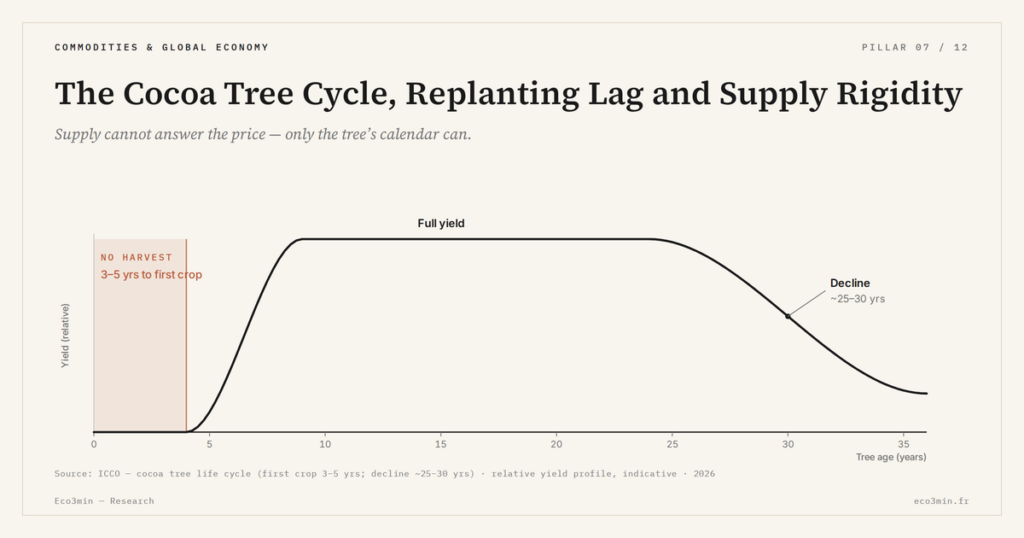
A cocoa tree takes several years to bear fruit, and an orchard renews itself slowly. Cocoa supply therefore cannot react quickly to a price signal: it falls to price, and price alone, to absorb any imbalance.
TL;DR
Cocoa's short-run supply elasticity is near zero, since a seedling needs three to five years to bear fruit, so the price overshoots in both directions instead of settling at equilibrium.
- Unlike a mine that can add shifts or an oil field pumped harder, an orchard's yearly output is fixed by trees planted long ago, leaving price as the only adjusting force.
- The fragility exposed in 2024 built up earlier: years of low prices cut orchard upkeep and renewal, so no harvest increase could close the deficit once a shock hit.
This article explains the biological rigidity of cocoa supply — the tree’s life cycle, the replanting lag, and why no price can speed up production.
To understand why the cocoa price moves so violently, you have to look at what happens before the market: in the plantations, at the pace of living things. Where other commodities can lift output within months, cocoa obeys the calendar of a tropical tree indifferent to the quote. This physical rigidity is one of the two great causes of the amplitude of cocoa’s cycles, the other being the geographic concentration of supply.
The tree’s timescale
The cocoa tree, or Theobroma cacao, is a perennial whose production cycle is measured in decades, not seasons. A seedling put in the ground yields no significant harvest for several years — generally three to five, depending on variety and growing conditions. It then reaches full yield over a long mature phase, before its productivity gradually declines from around twenty-five to thirty years, until it becomes economically marginal. To decide to plant cocoa today is therefore to bet on income that will only fully materialise much later.
This timescale has a decisive economic consequence: in the short run, cocoa supply is almost insensitive to price. When the quote soars, no farmer can make trees grow faster; when it collapses, the trees already in the ground keep producing. The short-run supply curve is, so to speak, vertical: it does not shift in response to the price signal. The contrast with annual crops is striking. A farmer growing wheat or soya can, from one season to the next, adjust the acreage sown according to prices; the cocoa grower, by contrast, is committed for years by past decisions.
Economists measure this difference through the price elasticity of supply, the sensitivity of quantities produced to a change in price. For cocoa, this elasticity is almost nil in the short run: a rise in the quote, however spectacular, changes nothing about the year’s harvest, already determined by the trees in place. It becomes significant only over a horizon of several years, the time for a new orchard planted in response to price to come into production. This temporal asymmetry — a near-absent response at first, then a delayed and potentially massive one — is precisely what predisposes a market to surges followed by reversals, where an elastic supply would cushion shocks as they come. The cocoa price, in this respect, behaves less like the price of a manufactured good than like that of a slow-growing natural asset.
This sets cocoa apart even from other constrained commodities. A mine facing high prices can, within limits, add shifts or accelerate extraction; an oil field can be pumped harder for a time. A cocoa orchard offers no such margin: its output this year is fixed by trees planted long ago, and the only way to raise it is to wait for new ones to mature. The modest lever that exists in extractive commodities is simply absent here, which leaves price as the sole adjusting force.
This gap between the moment of decision and the moment of production is the heart of the problem. The price signal takes years to translate into productive trees, and by the time it does, the context that justified it has often changed. This rigidity belongs to a family of constraints we place within physical markets and their constraints, where the responsiveness of supply largely determines how the price behaves.
Ageing orchards
Cocoa’s rigidity is not only about the growth time of a new tree: it is also about the state of the existing stock. A large share of the West African orchard was planted several decades ago, and many trees have entered their decline phase. Add to this soil exhaustion, disease pressure and chronic under-investment in renewal. The result is an ageing productive base, whose yields tend to erode slowly, regardless of short-term swings.
To these agronomic factors is added a human dimension that is often overlooked. The West African farming population is ageing, and younger generations frequently turn away from an activity seen as poorly paid and physically demanding. This gradual disengagement of labour weakens the daily upkeep of plots — pruning, treatment, replacement of dead trees — on which future yield nonetheless depends. Supply rigidity is therefore not only biological: it is also social and economic, sustained by the conditions imposed on the producer. A price that does not reward the effort of renewal is paid for, years later, in lost productive capacity.
Rejuvenating an orchard poses a cruel dilemma for the farmer. Replanting means uprooting still-productive trees, or leaving a plot unproductive while young plants reach maturity — that is, several years with no income on the area concerned. For a family farm living off its harvest, this temporary loss is hard to bear, and the incentive to defer replanting is strong. The administered price system worsens this bias: as long as the farmgate price reflects rises in the world quote only with a lag, the producer does not capture enough of the gain to fund the investment that would regenerate his productive tool.
Disease adds a further and brutal constraint. Some afflictions, such as the swollen shoot virus circulating in West Africa, cannot be cured: the only remedy is to uproot infected trees and replant, with the delay and lost income that entails. Faced with this immediate cost, many farmers delay uprooting, which lets the disease spread and further degrades productive capacity. These diseases that force uprooting thus turn a health problem into a lasting supply constraint. The fragility accumulated during the years of low prices, which discouraged maintenance, did not dissipate at once with the surge: it was revealed by it.
This mechanism sheds light on a point often misunderstood: the supply fragility revealed in 2024 was not created that year. It built up during the long period of low prices that preceded it, when orchard upkeep and renewal were cut back for lack of means. A market can thus accumulate years of invisible under-investment as long as demand stays covered, then tip abruptly when a shock lays bare the weakness of the accumulated productive potential.
The rigidity that makes the cycle
From this inertia comes a characteristic dynamic, one economists have long modelled. When supply responds to price with a substantial lag, the market does not converge calmly toward an equilibrium: it overshoots it alternately. A high price eventually triggers replanting, whose output will only arrive years later, at a point when the initial deficit will often have disappeared; this late supply then creates a surplus that depresses the price, discourages orchard maintenance and sets up the next deficit. Cocoa does not rest at an equilibrium price: it circles it, in cycles whose length matches that of the tree’s biological cycle.
It is this mechanism that made the 2024 episode inevitably violent. Faced with a deficit deepened by poor harvests, the market had no quantity lever to rebalance supply in the short term: no price, however high, could ripen trees faster. Only the price remained to ration demand, which explains the scale of the rise. Then, once harvests recovered and demand had contracted, the same mechanism worked in reverse. Supply rigidity did not merely amplify the move: it made it structurally inevitable.
This reading carries a practical implication for anyone watching the market. Supply rigidity makes the shape of the cycle relatively intelligible — an alternation of tightness and surplus — but says nothing about its precise timing or the amplitude of each phase, which depend on harvests, climate and replanting decisions. Understanding the mechanism helps avoid mistaking a price peak for a lasting trend, without allowing its end to be anticipated. Knowing that the market overshoots is not the same as knowing when it will turn.
Combined with the dependence on West Africa, this rigidity draws a market stripped of any valve. Concentration prevents another region from offsetting a shock; biological inertia prevents supply from responding quickly to price. When neither geography nor time can adjust quantities, it falls to price to do everything. The screen quote, on this market, is not the outcome of a flexible adjustment but the only variable left free to move — which is precisely why it moves so far.
- A cocoa tree takes three to five years to produce and declines after twenty-five to thirty: cocoa supply cannot respond quickly to a price signal.
- In the short run the supply curve is near-vertical — unlike annual crops, the grower is committed for years by past decisions.
- The ageing of West African orchards and the cost of replanting (years with no income) sustain this rigidity, which disease worsens further.
- This lag between decision and production generates a cycle of swings: high price, late replanting, surplus, low price, under-investment, deficit.
- No price could speed up production in 2024: with no quantity lever, price had to do all the adjusting, hence the scale of the move.
Last updated — 28 June 2026
Disclaimer – Financial Information: The analyses, commentary, and content published on eco3min.fr are provided for informational and educational purposes only. They do not constitute investment advice or a solicitation to buy or sell financial instruments. Past performance is not indicative of future results. All investment decisions involve risk and are the sole responsibility of the reader.
Read next
Full pillar →Reading the refinery utilisation rate: the threshold, the season, the turnarounds
A refinery runs full near ninety percent, not a hundred: the last slice of nameplate capacity is a…
IMO 2020: the regulatory shock that rewrote product spreads
An environmental rule on marine sulfur can move a refining spread more than a swing in crude. IMO…
The 2022–2023 refining golden age: anatomy of an episode
In 2022, refined fuel prices climbed faster than crude. That gap, measured by the 3-2-1 crack spread, reached…