Cocoa Demand Destruction, Chocolate Reformulation and Retail Prices

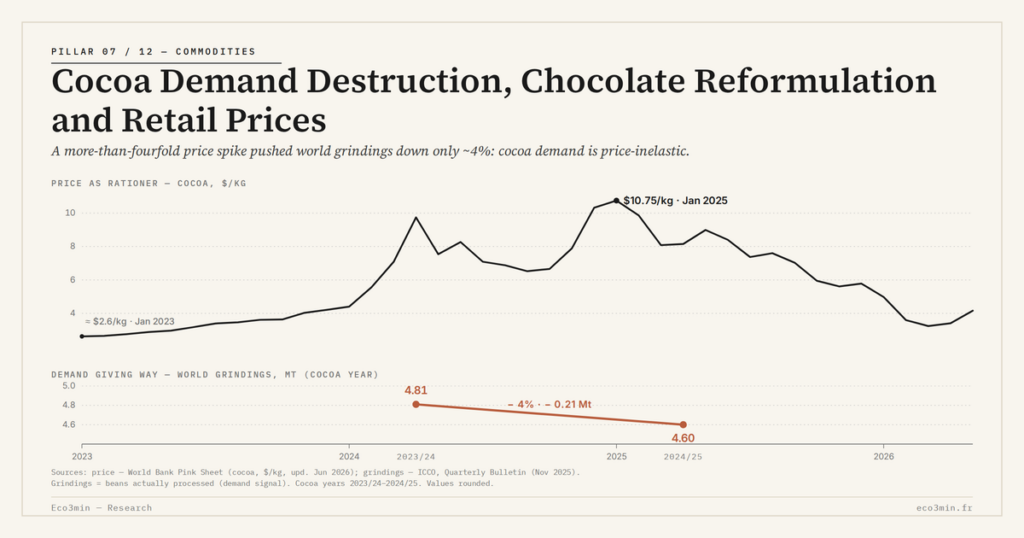
Unable to lift supply quickly, the cocoa market had only one lever to rebalance itself: rationing demand through price. Reformulation, smaller formats and shelf increases pushed grindings down — the demand side of the round-trip.
TL;DR
Record prices forced cocoa demand to give way, and the consumption that retreated came mainly from wealthy importers, far from the growers who captured little of the boom.
- World grindings, the count of beans actually processed, slipped from roughly 4.8 to 4.6 million tonnes (ICCO) as record prices bit, a modest percentage fall but real on a market used to growth.
- Makers cut cocoa content, used vegetable-fat substitutes within the limits of the legal 'chocolate' definition, shrank bar sizes at unchanged prices ('shrinkflation'), and shifted some uses to cheaper substitutes.
- Part of this demand loss may prove structural rather than cyclical, and combined with recovering harvests it helped pull prices down from 2025, meaning demand, not supply alone, drove the reversal.
This article examines how cocoa demand actually contracted under record prices, through reformulation, shrinking portions and retail increases, and why this was the only rebalancing mechanism available.
A market where supply cannot respond quickly to rising prices leaves the entire burden of adjustment on demand. That is what played out for cocoa in 2024 and 2025: since the trees could not produce more in the short run, the price had to rise until consumption gave way. Understanding this side is essential to grasping why the peak eventually reversed, and it completes the analysis of the rigid supply that made up the whole first half of the story.
Price as the rationer of demand
On a typical market, an imbalance corrects from both sides: supply rises and demand falls until the price finds an equilibrium point. Cocoa is deprived of the first of these two springs. As we detailed regarding a supply unable to react quickly, a given year’s harvest is largely determined by the trees already in the ground, and no price can inflate it immediately. Only one short-run rebalancing lever remains: cutting demand.
That is precisely the function the surge performed. A very high price is not only the symptom of a shortage; it is also its remedy, by discouraging the least essential uses and forcing buyers to consume less. For cocoa, this demand comes from processors and chocolate makers, who grind the beans into liquor, butter and powder. When the cost of the raw material explodes, these players adjust their purchases, and it is through this adjustment that the market eventually rebalances. This price-rationing mechanism sheds light on how resource markets work in general, of which cocoa offers a particularly stark version, lacking any cushion on the supply side.
The grinding figures, which measure the quantity of beans actually processed, registered this move. After years of growth, world grinding volumes fell under the weight of record prices, a sign of genuine demand destruction. According to data from the International Cocoa Organization, grindings slipped from a level close to 4.8 million tonnes to around 4.6 million over the period of tension, a modest drop in percentage terms but significant on a market used to growing. The price had done its rationing work.
The scale of the rise needed to achieve this result reflects a feature of cocoa demand: it is relatively insensitive to price in the short run. Chocolate is, for the consumer, a modest-value treat purchase whose spending weighs little in a budget; even a sharp rise does not make them give it up immediately. Likewise, manufacturers cannot reformulate their ranges overnight without risking degrading their products. This inertia in demand means it takes a large price move to obtain even a moderate reduction in consumption. On a market where supply is frozen and demand is inelastic, the price must travel a considerable distance to restore balance — which sheds light on why the surge was so violent before producing its effects.
Reformulation, reduction, deferral
The contraction in demand did not happen all at once, but through a series of concrete adjustments by manufacturers. The first, and most discreet, is reformulation. Faced with an ingredient that had become prohibitively expensive, many makers reduced the cocoa content of their products, increased the share of sugar or other cheaper ingredients, and resorted, within the limits allowed by regulation, to vegetable fats as a partial substitute for cocoa butter. The room for manoeuvre is constrained, however: the rules defining what may be called “chocolate” impose minimum contents, so that a product that is too thinned loses the right to the name.
The second adjustment is the reduction of formats, often called “shrinkflation”. Rather than display a head-on price increase, liable to alienate the consumer, many makers cut the size of bars or the weight of packs at an unchanged price. The effect is the same as a price rise per unit of cocoa, but it is less visible on the shelf. This technique was widely used during the episode, helping to reduce the quantity of cocoa consumed without triggering immediate rejection by buyers.
The third adjustment is substitution and deferral. Where it was possible, certain uses turned to substitute coatings, lower-grade cocoa powders or cheaper origins, and the market segmented. Premium chocolate, whose buyers are less price-sensitive and which claims a high cocoa content, absorbed more of the shock in its margins or prices; mass-market chocolate, more constrained by selling prices, reformulated and cut back more aggressively. Between the two, chocolate makers saw their margins squeezed, caught between a soaring raw-material cost and a consumer reluctant to pay much more.
This demand destruction is not necessarily reversible. When a consumer gets used to a smaller bar or a recipe containing less cocoa, nothing guarantees they return to their old volumes once prices fall back; reduced formats and thinned recipes tend to settle in for good. Likewise, industrial uses that switched to substitutes do not always return to cocoa. Part of the fall in demand could therefore be structural rather than cyclical, which would change the market’s long-run balance: the surge will not only have rationed consumption for the length of a cycle, it may have durably shifted cocoa’s place in food.
Transmission to retail prices
The rise in cocoa did show up on the shelves, but partially and with a delay. The reason lies in the cost structure of a chocolate bar, which we break down regarding the cocoa share of a chocolate bar: the bean represents only a fraction of the final price, the rest split between sugar, milk, packaging, processing, logistics, marketing and the retailer’s margin. A doubling of the bean price therefore does not double the price of the bar, far from it, and the transmission is dampened by all these other items.
To this dampening is added a time lag. Manufacturers often buy their cocoa in advance, through forward contracts, and sell down stocks of products already made. The rise in the quote therefore takes months to feed through to retail prices, the time for old supplies to run out and for new, more expensive contracts to feed production. This inertia explains why chocolate prices kept climbing on the shelf even as the bean quote had begun to recede: retail reacts with a lag to what happens on the wholesale market.
This lag makes the grinding figures a closely watched indicator: published regularly by region, they offer one of the few near-real-time signals of demand health, where retail prices tell the story only months later. A fall in grindings confirms that rationing is working; their stabilisation signals that demand has found a floor. It is partly on this data that operators anticipated the reversal, well before the shelves reflected the easing, and well before the headlines proclaimed the crisis over.
A further irony runs through this episode. The demand that gave way was largely that of wealthy consuming countries, where chocolate is an everyday indulgence, while the producers who grow the beans saw little of the record price. The adjustment that finally rebalanced the market thus fell on consumers far from the plantations, even as the value of the boom lodged in the trading and manufacturing links rather than at the farm.
The rise in chocolate was nonetheless visible enough to become a noted item of food inflation, and it is through this channel that the cocoa shock reached household budgets. Above all, the combination of this retail transmission and reformulation eventually produced the intended effect: falling demand. Combined with the gradual recovery of harvests, this demand destruction helped bring prices back down from 2025. The great reversal in cocoa prices is therefore not explained by an improvement in supply alone: it owes just as much to demand that gave way under the weight of price. Each phase of this market looks self-contained, yet the surge and its unwinding were two parts of a single adjustment in which, with supply frozen, price did all the work. What looked like two separate events — a surge and then a slump — was in truth one continuous process of rationing and release, governed from start to finish by the rigidity of the supply behind it.
- With no possible short-run supply response, the cocoa market’s only rebalancing lever is cutting demand through price.
- World grindings fell under record prices — from around 4.8 to 4.6 million tonnes per the ICCO — a sign of genuine demand destruction.
- Makers adjusted through reformulation (less cocoa), smaller formats (“shrinkflation”) and substitution, with premium absorbing the shock better than the mass market.
- Transmission to retail prices is partial and delayed, since cocoa is only a fraction of a bar’s cost and stocks and forward contracts slow the effect.
- The reversal in prices owes as much to demand that gave way as to the recovery of harvests.
Last updated — 28 June 2026
Disclaimer – Financial Information: The analyses, commentary, and content published on eco3min.fr are provided for informational and educational purposes only. They do not constitute investment advice or a solicitation to buy or sell financial instruments. Past performance is not indicative of future results. All investment decisions involve risk and are the sole responsibility of the reader.
Read next
Full pillar →Reading the refinery utilisation rate: the threshold, the season, the turnarounds
A refinery runs full near ninety percent, not a hundred: the last slice of nameplate capacity is a…
IMO 2020: the regulatory shock that rewrote product spreads
An environmental rule on marine sulfur can move a refining spread more than a swing in crude. IMO…
The 2022–2023 refining golden age: anatomy of an episode
In 2022, refined fuel prices climbed faster than crude. That gap, measured by the 3-2-1 crack spread, reached…