From Bean to Bar: Where the Cocoa Price Actually Forms

The world price of cocoa is not set in the plantations of West Africa, but on two futures markets in London and New York. Understanding the chain that separates the pod from the bar is the precondition for reading the price.
TL;DR
The West African farmer is a price-taker on an administered quote, while cocoa's benchmark price forms thousands of kilometres away on London and New York futures screens.
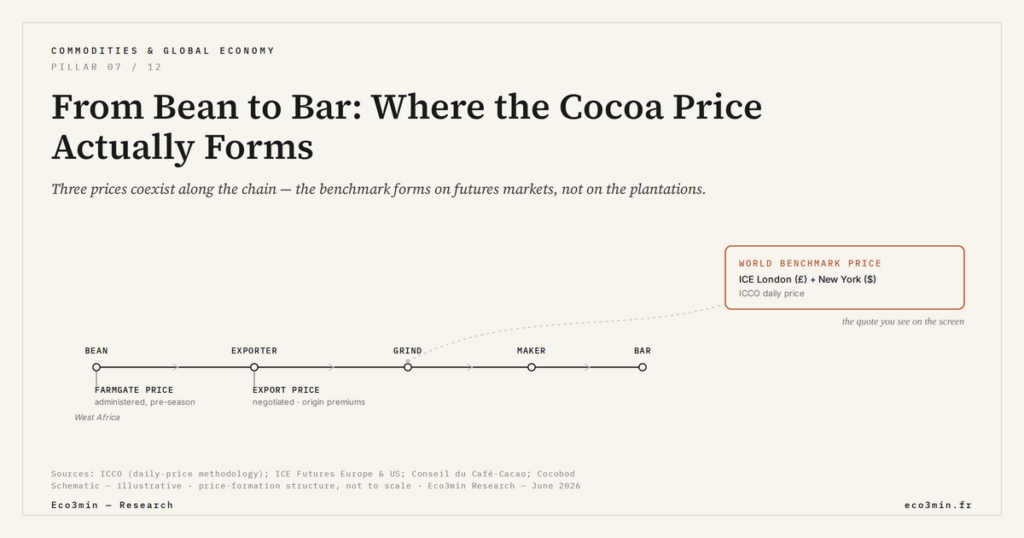
- Three price levels coexist and move at different speeds: an administered farmgate price set by the Conseil du Café-Cacao and Cocobod, an export price carrying origin premiums, and the world futures quote on ICE in London and New York.
- Certified warehouses tether the paper price to physical reality: beans graded at approved delivery points back the contracts, and a build-up of these certified stocks can itself weigh on the quote.
This article maps the bean’s physical journey and the three price levels hidden behind the single quote on the screen — a distinction essential to interpreting the market’s moves.
Behind a chocolate bar lies one of the longest and most fragmented commodity chains in the world. The bean changes hands, form and price several times before reaching the consumer, and at each stage value forms under different rules. It is this architecture, more than the news, that explains why the price can soar or collapse — a subject we develop in relation to the structural fragility of the cocoa market.
From pod to warehouse: the physical cocoa chain
It all begins on small farms. Most of the world’s cocoa is grown by millions of farmers working plots often smaller than five hectares, mainly in Côte d’Ivoire, Ghana and a handful of other tropical countries. This extreme fragmentation upstream contrasts with the concentration downstream, where a few large traders and processors dominate. This is the chain’s first asymmetry: a multitude of loosely organised producers facing a handful of powerful buyers.
After the pods are harvested, the farmer carries out two operations decisive for quality: fermentation, lasting about a week and developing the aroma precursors, then sun-drying. These steps, done at the farm, set the bean’s market value. The dried cocoa is then sold to local buyers or cooperatives, which channel it to licensed exporters.
Then comes industrial processing, the grind. The beans are roasted and ground into a paste called cocoa liquor, which is itself pressed to separate two components: cocoa butter, a sought-after fat, and the cake, milled into powder. The volume of beans ground, the grindings, is in fact the most closely watched indicator of global industrial demand. These intermediate products finally feed the chocolate manufacturers, who combine them with sugar, milk and other ingredients, before retailers place the finished product on the shelf.
At each link, a different actor takes a margin and bears a distinct risk. The farmer receives a price set ahead of the season; the trader manages the price risk between the physical purchase and the resale; the processor arbitrages between the cost of the bean and the price of its derivatives; the manufacturer and the retailer, for their part, think in terms of final selling price and positioning. This dispersion of roles is why a single price move does not mean the same thing depending on where one stands in the chain.
Between the farmer and the exporter sits a layer of intermediaries whose role has grown more complex. Cooperatives, private buyers and field agents collect the bean across thousands of villages, before consolidating it toward the ports. Recent traceability requirements, driven notably by the European Union’s deforestation regulation, add a constraint: the plot-level origin of beans must increasingly be documented, which weighs on the least formalised circuits and may, over time, segment supply between compliant and non-compliant cocoa. This intermediary layer, largely invisible to the consumer, nonetheless shapes the quality and availability of the product that will reach world markets.
Three prices, not one: where value actually forms
The most widespread error is to speak of “the cocoa price” as if there were only one. In reality, there are at least three distinct price levels, which move neither at the same speed nor with the same amplitude.
The first is the farmgate price, the one the grower receives. In Côte d’Ivoire and Ghana, this price is not the world quote: it is set administratively by a public body — the Conseil du Café-Cacao on one side, Cocobod on the other — often fixed before the season opens. In the late 2010s, the two countries jointly added a living income differential, a premium meant to better remunerate the producer. This mechanism partly insulates the grower’s income from international volatility, but it also disconnects it: when the world price soars, the producer captures only a delayed fraction of it. This the administered farmgate price is one of the keys to how the market works.
The second level is the export price, negotiated between exporters and international buyers, which incorporates quality, logistics and origin premiums. The third, finally, is the world benchmark price, and it is the one that makes the news. It forms on two futures markets operated by ICE: in London, where the contract is denominated in sterling and historically prices West African grades, and in New York, denominated in dollars and serving as a more global reference. The International Cocoa Organization publishes a daily price built as the average of the three nearest active contracts on these two venues. It is on these markets, through the matching of buy and sell orders, that price discovery takes place — a process we set out in relation to the role of cocoa futures markets.
The spreads between these three levels are not noise: they carry information. A widening export premium signals strain on available beans; an unusual gap between the London and New York contracts speaks to regional supply imbalances, one pricing West African grades more heavily, the other a broader reference. As for the gap between the world quote and the farmgate price, it measures the share of the rise that does not reach the grower. Reading the cocoa market is therefore less about tracking a single figure than about comparing these levels against one another.
The futures contracts are anchored to physical reality through certified warehouses: beans graded and stored at approved delivery points back the contracts, and the level of these certified stocks is itself a closely watched gauge of physical tightness. This link between paper and warehouse keeps the financial price tethered to the physical market, even when speculative flows dominate day-to-day moves. It also explains why a build-up of certified inventories can weigh on the quote: the deliverable supply behind the contract has grown.
This geography of price has a major consequence: the benchmark quote is not set where cocoa is grown, but where it is traded financially. The West African farmer is a price-taker on an administered quote, while the world signal is built thousands of kilometres away, on London and New York screens. This separation between the physical site of production and the financial site of price formation explains most of the misunderstandings about this market, and fits a logic common to the broader physical commodities complex.
It is often believed that the world price of cocoa is set in the producing countries, where the bean grows. The reverse is true: the benchmark price forms on the London and New York futures markets. The farmer receives an administered farmgate price, largely disconnected in the short run from the peaks and troughs of the world quote.
From bean to bar: why the quote does not dictate the price of chocolate
If the bean price can quintuple, why does the price of a bar not follow the same path? The answer lies in the cost structure of the finished product and in the transformation the bean undergoes along the way.
A chocolate bar is not made of cocoa alone. For a mass-market milk chocolate, the bean is only a limited and variable share of total cost: sugar, milk, packaging, energy, logistics, marketing and the retail margin often weigh more. Mechanically, even a spectacular rise in the bean’s quote feeds through only in muted form to the selling price — all the more so since the most exposed chocolate makers are those whose recipe contains the most cocoa, premium dark chocolate, while the mass segment absorbs the shock better.
Transformation also plays its part. The grind splits the bean into butter and powder, whose prices move separately according to their respective outlets; butter, prized in cosmetics and fine chocolate, follows its own dynamic. The cost that reaches the manufacturer is therefore not the raw bean quote, but that of derivatives with distinct markets. Add to this hedging: manufacturers buy forward months in advance, so the price on the screen on a given day does not match the cost actually borne at that moment. We examine this price transmission to the chocolate bar and its asymmetries in a dedicated analysis.
Quality adds a final layer that the single quote conceals. Cocoa is not homogeneous: the bulk West African beans that dominate the futures contracts differ from the fine, flavour cocoas of parts of Latin America and the Caribbean, and the origin premium reflects both quality and scarcity. The benchmark contract prices the standard grades; around it orbit premiums and discounts specific to each origin. The ‘cocoa price’ therefore covers a family of prices, of which the world quote is only the most visible anchor point.
This architecture finally illuminates the heart of the matter. The insulation of the farmgate price explains why a record world quote does not immediately trigger the wave of investment and replanting that would rebalance supply: the price signal takes time, and many filters, before reaching the grower. Price formation on futures markets, for its part, explains why the quote can overreact to supply fears. To understand the chain is to understand why the price behaves as it does — an indispensable preliminary before examining, in the rest of this study, the concentration of supply, its biological rigidity and the shocks that strike it.
Last updated — 28 June 2026
Disclaimer – Financial Information: The analyses, commentary, and content published on eco3min.fr are provided for informational and educational purposes only. They do not constitute investment advice or a solicitation to buy or sell financial instruments. Past performance is not indicative of future results. All investment decisions involve risk and are the sole responsibility of the reader.
Read next
Full pillar →Reading the refinery utilisation rate: the threshold, the season, the turnarounds
A refinery runs full near ninety percent, not a hundred: the last slice of nameplate capacity is a…
IMO 2020: the regulatory shock that rewrote product spreads
An environmental rule on marine sulfur can move a refining spread more than a swing in crude. IMO…
The 2022–2023 refining golden age: anatomy of an episode
In 2022, refined fuel prices climbed faster than crude. That gap, measured by the 3-2-1 crack spread, reached…