Cocoa Futures: ICE, Certified Stocks and Financialization

The world cocoa price forms on the ICE futures markets. In 2024, collapsing certified stocks, financial inflows and a margin-call spiral amplified the physical shortage into an extreme move — financialization magnified the shock, it did not create it.
TL;DR
The 2024 cocoa surge was a real shortage magnified by market mechanics: collapsing certified stocks, billions in financial inflows and a margin-call spiral on ICE futures.
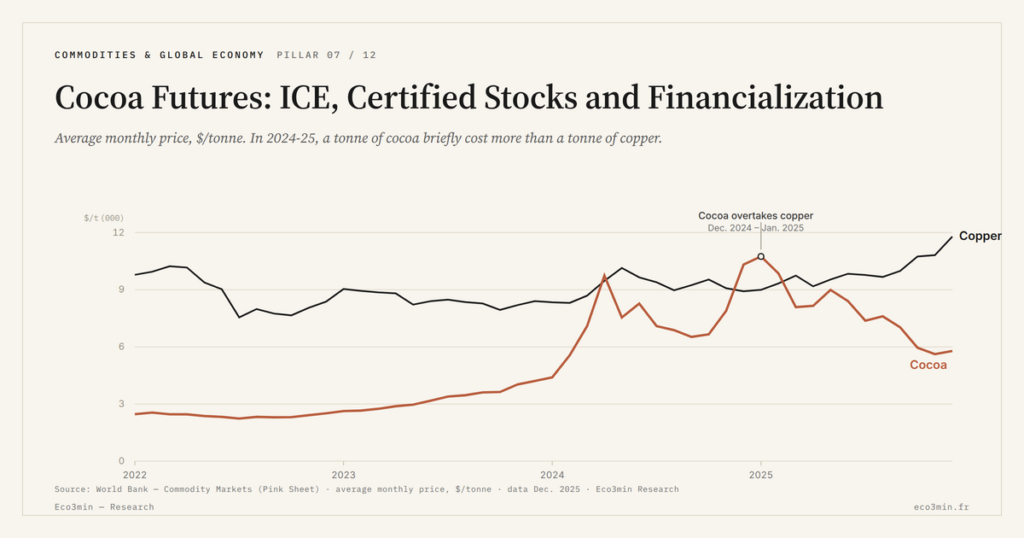
- At the height of the episode, a tonne of cocoa briefly traded richer than a tonne of copper, an unprecedented reversal between an agricultural commodity and an industrial metal.
- Delivery at expiry ties the futures quote to physical reality, yet in the short run a specific physical lot can diverge from it, and that gap, the basis, is where much of the market's tension sits.
- Hedgers short futures faced immediate cash margin calls as prices rose while their physical gains lagged, forcing buybacks that fed the squeeze: a cash mismatch, not a misjudgement.
This article examines how the cocoa futures market, certified stocks and speculative positioning interacted with the physical deficit, and why financial dynamics amplified the surge without being its cause.
The price the media refer to when they mention a cocoa record is neither the one paid to the farmer nor the one on the shelf: it is the price that forms on the futures markets, where contracts on the bean are traded. Understanding how this market works, and how purely financial flows can graft themselves onto it, is essential to correctly interpreting the scale of the 2024 move and to avoiding two symmetric errors: attributing everything to speculation, or attributing everything to fundamentals alone.
Where the world price forms: the futures market
The world benchmark for cocoa is set on two main futures markets, operated by the Intercontinental Exchange: one in New York, denominated in dollars per tonne, the other in London, in pounds sterling. It is on these markets that standardised contracts on future deliveries of beans are traded, and it is their quote that serves as the reference for the whole chain. It is precisely this level that constitutes the cocoa benchmark price, from which physical prices are then derived.
Two types of participant with opposing logics coexist on this market. Commercial players — traders, processors, chocolate makers — take positions to hedge: a manufacturer who will have to buy cocoa in six months can lock in a price today, protecting against a rise. Financial players — hedge funds, asset managers, index funds — take positions instead to bet on the price’s direction or to gain exposure to the asset class. The meeting of these two populations, hedgers and speculators, is the normal functioning of a futures market; it becomes problematic when physical imbalances and financial flows reinforce one another.
One particular indicator is closely watched on this market: certified stocks. These are the quantities of cocoa stored in exchange-approved warehouses and deemed deliverable against the futures contracts. These stocks act as a thermometer of physical tightness: when they empty, they signal that available beans are becoming scarce. During the 2024 episode, certified stocks fell sharply, dropping to very low levels, which confirmed and sharpened the shortage signal sent by prices. A market that sees its deliverable stocks shrink becomes nervous, as the ability to honour physical deliveries appears threatened.
The futures price and the physical market are bound together by the mechanism of delivery: at a contract’s expiry, the holder can in principle take or make physical delivery of beans against it, which ties the paper price to physical reality. This link is what makes the futures quote a meaningful benchmark rather than a detached number. But the connection is not rigid in the short run: the price of a specific physical lot can diverge from the futures quote, and it is in the space of this divergence — the basis — that much of the tension and opportunity of a commodity market lives.
Financial amplification: flows and the margin spiral
Onto this ground, already strained by the physical deficit, considerable financial flows grafted themselves. According to the financial press, capital running into billions of dollars flowed toward cocoa futures in early 2024, drawn by a sharply rising market. This inflow of money, seeking exposure to the upward momentum, added a purely financial buying demand to the pre-existing physical tightness, helping to push prices higher still.
But the most powerful mechanism of the amplification was the margin-call spiral. Commercial players who hedge generally sell futures contracts — they are “short” on paper, against the physical cocoa they hold or will produce. When the price soars, these short positions accumulate paper losses, and the exchange demands rising collateral deposits, the margin calls, to cover the risk. Faced with margin calls that had become unsustainable, some of these players were forced to buy back their short contracts to limit cash outflows — that is, to buy cocoa futures at the worst moment. Yet each buyback of a short position is an additional purchase that pushes the price up, triggering fresh margin calls for others: the rise fed on itself.
It is worth stressing that this spiral is nothing like a speculative manoeuvre: it follows from the structural position of commercial players. A trader or processor is, by nature, holding physical cocoa or committed to buying it; to hedge against a fall, they sell futures. This sale is not a bearish bet, but the other leg of a perfectly orthodox hedge. The problem arises when the price rises sharply: the physical leg gains in value, but the short futures leg generates immediate cash margin calls, while the gain on the physical will only materialise at the future sale. This cash mismatch, not an error of judgement, is what forced some hedgers to unwind their positions at the worst moment, feeding a genuine squeeze on short contracts.
To this spiral was added a thinning of liquidity. As the price climbed and volatility exploded, the cost of taking a position rose, and some participants withdrew from the market, reducing the number of counterparties willing to trade. A less liquid market amplifies moves, since each order shifts the price more. The combination of bullish financial flows, a margin-call spiral and receding liquidity produced a spectacular dislocation — at the height of the episode, a tonne of cocoa briefly traded richer than a tonne of copper, an unprecedented reversal of hierarchy between an agricultural commodity and an industrial metal. Later, the inclusion of cocoa in a major commodity index in early 2026 added a further layer of flows, this time passive ones, tied to the funds replicating that index.
Amplified, not caused: the right attribution
The temptation, faced with such a frenzy, is strong to name a single culprit: speculation. This reading is as widespread as it is inaccurate. The initial driver of the move was not financial but physical: without the physical harvest deficit deepened by disease and climate, no inflow of capital could have durably propelled the quote to such heights. Financial flows do not create a shortage of beans; they merely amplify a scarcity signal already sent by fundamentals.
But the symmetric error — attributing everything to fundamentals alone — is just as misleading. The scale and violence of the move, as well as the speed of its swings, owe much to the positioning, margin and liquidity dynamics described above. The deficit explains why the price had to rise; it does not, on its own, explain why it reached such extreme levels or why it reversed so abruptly. The right reading superimposes the two layers: a real physical shock, magnified by a financial mechanism. One provides the direction, the other part of the amplitude.
This distinction also helps set aside an overly simple reading: that of a pure bubble. A bubble implies a price disconnected from any reality, inflated by euphoria alone; cocoa, by contrast, rested on a genuine physical shortage. The move was not detached from fundamentals but anchored to them and amplified by the market’s mechanics. The episode nonetheless revived legitimate questions about the resilience of commodity futures markets — about the calibration of margin calls, the depth of liquidity under stress, the ability of physical players to hedge without being swept up by price moves. These questions, which go beyond cocoa alone, touch the very architecture of the markets where resource prices form, and they outlast the episode that raised them.
This superimposition also sheds light on the retreat. When physical conditions eased and leveraged positions unwound, financial amplification worked in reverse: forced buybacks ceased, speculative flows withdrew, and the fall was accelerated by the same springs that had fed the rise. Financialization thus makes a record even less informative about fundamentals, since the level reached reflects participants’ positioning as much as the real state of supply and demand. Placed among the physical and financial markets for resources, cocoa illustrates a dynamic common to many financialized commodities, and the dislocation seen during the 2024 cocoa price peak is a stark reminder that the screen quote and the physical balance, though linked, are not the same thing.
- The world cocoa benchmark forms on the ICE futures markets in New York and London, where commercial hedgers and financial players meet.
- Certified stocks, deliverable quantities held in approved warehouses, act as a thermometer of physical tightness; they fell sharply in 2024.
- Financial inflows and above all a margin-call spiral, combined with receding liquidity, amplified the surge — a tonne of cocoa briefly exceeded a tonne of copper.
- Financialization amplified the move without causing it: the physical deficit was the driver, the financial dynamics the multiplier.
- On the retreat, the unwinding of positions accelerated the fall, and a financialized price tells you even less about fundamentals.
Last updated — 28 June 2026
Disclaimer – Financial Information: The analyses, commentary, and content published on eco3min.fr are provided for informational and educational purposes only. They do not constitute investment advice or a solicitation to buy or sell financial instruments. Past performance is not indicative of future results. All investment decisions involve risk and are the sole responsibility of the reader.
Read next
Full pillar →Reading the refinery utilisation rate: the threshold, the season, the turnarounds
A refinery runs full near ninety percent, not a hundred: the last slice of nameplate capacity is a…
IMO 2020: the regulatory shock that rewrote product spreads
An environmental rule on marine sulfur can move a refining spread more than a swing in crude. IMO…
The 2022–2023 refining golden age: anatomy of an episode
In 2022, refined fuel prices climbed faster than crude. That gap, measured by the 3-2-1 crack spread, reached…