Cocoa Climate, Disease and Yields: the Shocks Behind the Deficit

Endemic disease and adverse weather cut West African cocoa yields in 2023 and 2024. Grafted onto a rigid, concentrated supply, this physical shock turned into a price shock of unprecedented scale.
TL;DR
Incurable swollen-shoot virus, black-pod fungi and an El Niño-hit 2023/24 season cut West African cocoa yields, turning chronic plantation fragility into one of the market's largest recorded deficits.
- Swollen-shoot virus, endemic in Côte d'Ivoire and Ghana and spread by mealybugs, is incurable: infected trees must be uprooted and replanted, imposing years of lost output before a new orchard bears.
- Black-pod disease (Phytophthora fungi) rots pods in warm, humid seasons without killing the tree, while mirid insects weaken young shoots, compounding the slow erosion of yields.
- An El Niño-disrupted 2023/24 season layered heavy rains, then dry Harmattan winds onto this base, opening an ICCO-reported deficit of several hundred thousand tonnes, among the largest on record.
- With no second producing region to fill the gap, trees that take years to mature, and stocks already drawn down to a low share of grindings, price was the only lever left to ration demand, amplifying the move.
This article examines the proximate causes of the deficit — the diseases and climate stresses that hit yields — and why they revealed structural rather than passing fragility.
Behind the 2024 surge lies a simple agronomic fact: the trees produced less. Before being a market phenomenon, the deficit was a plantation event, caused by long-established diseases and a run of difficult seasons. Understanding these physical triggers is essential to grasping why the 2024 surge in cocoa prices is not a mere weather accident.
The cocoa tree’s diseases
The West African cocoa tree lives under the constant pressure of several diseases, two of which weigh particularly on yields. The first is the swollen shoot virus, endemic in Côte d’Ivoire and Ghana. It is spread by mealybugs and cannot be cured: an infected tree sees its production fall and then wither, and the only remedy is to uproot it and replant. This disease has destroyed considerable acreage in both countries, and its spread continuously eats into the region’s productive potential.
The fight against swollen shoot illustrates the scale of the challenge. Control programmes rely on identifying and uprooting infected trees, sometimes in entire bands around outbreaks, followed by replanting with more tolerant planting material. But these operations, costly and unpopular with farmers who watch their trees disappear, struggle to keep pace with the virus’s spread. Decades of successive campaigns have failed to eradicate the disease, which remains one of the main long-term threats to West African supply.
The second is black pod disease, caused by fungi of the Phytophthora genus. It develops in warm, humid conditions, rots the pods on the tree and can wipe out a large share of the harvest in the wettest seasons. Unlike swollen shoot, it does not kill the tree, but it cuts the year’s yield, sometimes heavily, and recurs with every favourable cycle.
To these two diseases are added pests that worsen the picture further, foremost among them mirids, small sucking insects that attack young shoots and pods. By piercing the tissue, they open the way to infection and durably weaken the tree, creating a loop in which pests and diseases reinforce one another. Fighting this set of threats requires regular treatment, careful pruning and the methodical replacement of affected trees — operations demanding in labour and inputs, which farmers cannot fully carry out when the prices they receive do not cover the cost of upkeep. The decline in orchard health is therefore not a purely biological fate: it also reflects the level of investment that the chain’s economics allow, and feeds on the years when that level collapsed.
These afflictions share a feature: they erode the productive base year after year, and strike all the harder where orchards are old and poorly maintained. The case of swollen shoot directly illustrates the link with the rigidity of the tree’s cycle: since the only response is to uproot and replant, every disease outbreak imposes years of lost production before a new orchard takes over. Disease does not merely reduce supply temporarily; it deepens the long-run constraint that prevents supply from rebuilding quickly.
Climate and the 2023/24 harvest
To this chronic disease pressure was added, in 2023 and 2024, an unfavourable climatic conjunction. The season was marked by heavy rains conducive to black pod, followed by drier episodes linked to the Harmattan winds, against the backdrop of an El Niño event that disrupted rainfall patterns in West Africa. This alternation of stress — too much water, then not enough — penalised flowering and pod formation, and translated into a harvest noticeably below expectations.
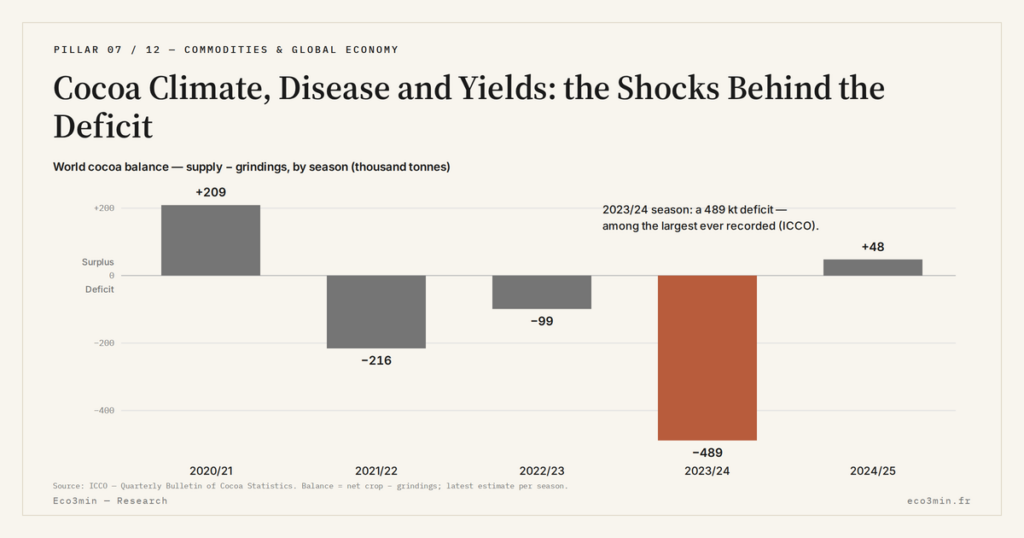
The combined effect of disease and climate opened a marked deficit between world production and grindings. According to the International Cocoa Organization, the 2023/24 season saw production fall sharply, opening a deficit of several hundred thousand tonnes relative to grinding demand — one of the largest on record. It is this physical shortfall, and the uncertainty surrounding it, that fed the tension on markets.
The season’s climatic sequence is worth detailing, for it illustrates the crop’s vulnerability to extremes. Above-normal rainfall early in the cycle favoured the fungi responsible for pod rot, before a drier phase and dust-laden winds stressed the trees just as the fruit was ripening. This double penalty — excess moisture first, then deficit — weighed on both the number and the size of the beans harvested. Far from being confined to a single season, the weakness in yields extended into the following one, the time it took for disease pressure to ease and conditions to normalise, sustaining market tension well beyond the initial shock. Markets read such a sequence as a sign that the deficit may persist, which feeds expectations as much as physical balances.
Beyond the 2023/24 season alone, a structural risk looms. The West African cocoa belt occupies a climatically narrow zone, where the tree requires a relatively precise range of temperatures and rainfall. Warming and the growing irregularity of rains threaten, over decades, the extent of land suitable for the crop. What the 2023/24 harvest showed is therefore not merely a bad year: it is the sensitivity of an already weakened productive base to shocks set to become more frequent. This dependence on physical constraints places cocoa within the family of markets we study through the physical dimension of commodities.
Why a yield shock becomes a price shock
A fall in the harvest does not mechanically translate into a price surge on every market. For many commodities, a drop in production in one region is offset by a rise elsewhere, or absorbed by ample stocks. For cocoa, those cushions are missing. The systemic risk of concentrated supply means that a shock in West Africa has no geographic counterweight: no other region can quickly fill the gap.
To this absence of geographic counterweight is added the impossibility of a quick supply response. Since trees take years to produce, the 2023/24 deficit could not be filled by raising the following year’s harvest. Deprived of a quantity lever, the market had only one instrument left to rebalance supply and demand: the price. This is why a yield shock, limited in percentage terms, could produce a price rise of such magnitude — the price alone had to ration a demand that exceeded available supply.
A third factor worsened the transmission of the shock: the low level of stocks. When world bean reserves are ample, they act as a buffer and allow demand to be met despite a poor harvest. But stocks had eroded over successive deficit seasons, so that the 2023/24 shortfall struck an already depleted market, with no cushion to absorb it. The ratio of available stocks to world grindings fell to particularly low levels, sharpening the price’s sensitivity to the slightest sign of shortage. The same deficit, on a richly supplied market, would have had a far more contained impact. Stocks, in this sense, are the memory of past surpluses — and that memory had run thin.
The combination of these forces — concentration, rigidity, disease, weather and thin stocks — explains why the market reacted so violently rather than gradually. None of these factors alone would have sufficed; together, they removed every shock absorber at once. The 2023/24 deficit did not create the fragility, it found a market in which nothing was left to dampen it. It is this convergence, more than any single cause, that the price ultimately reflected.
This asymmetry between deficit and surplus is worth emphasising. On a rigid-supply market, an excess always eventually clears: demand gradually absorbs the surplus and low prices discourage upkeep, which reduces future output. A deficit, by contrast, cannot be filled quickly by any supply mechanism; only demand destruction through price remains. This is why episodes of shortage tend to produce sharper rises than the falls that follow them, even when the cycle’s final amplitude turns out to be symmetric.
This mechanism sheds light on the deep nature of the episode. Disease and climate provided the trigger, but it is the market’s structure — concentration and rigidity — that turned that trigger into an extreme move. An identical shock to an annual crop, widely spread across the world and richly stocked, would have been absorbed without drama. On cocoa, it amplified. To set this shock within the long history of the market’s swings, one need only note that harvest-driven tensions recur on cocoa without ever erasing the slow drift imposed by the state of the orchards. Each surge looks unique in the moment, yet the pattern of harvest-driven spikes against a declining productive base is a recurring feature of this market.
The 2023/24 deficit is often reduced to a simple weather accident, set to correct quickly. That is a misleading reading: the shock combined chronic, incurable diseases, an increasingly marginal climate for the crop, and ageing orchards. It was not an isolated fluke, but the surfacing of a structural fragility that is taking hold.
Last updated — 9 July 2026
Disclaimer – Financial Information: The analyses, commentary, and content published on eco3min.fr are provided for informational and educational purposes only. They do not constitute investment advice or a solicitation to buy or sell financial instruments. Past performance is not indicative of future results. All investment decisions involve risk and are the sole responsibility of the reader.
Read next
Full pillar →Reading the refinery utilisation rate: the threshold, the season, the turnarounds
A refinery runs full near ninety percent, not a hundred: the last slice of nameplate capacity is a…
IMO 2020: the regulatory shock that rewrote product spreads
An environmental rule on marine sulfur can move a refining spread more than a swing in crude. IMO…
The 2022–2023 refining golden age: anatomy of an episode
In 2022, refined fuel prices climbed faster than crude. That gap, measured by the 3-2-1 crack spread, reached…