Cocoa’s Ghana–Ivory Coast Price War, Smuggling and the Farmgate Differential

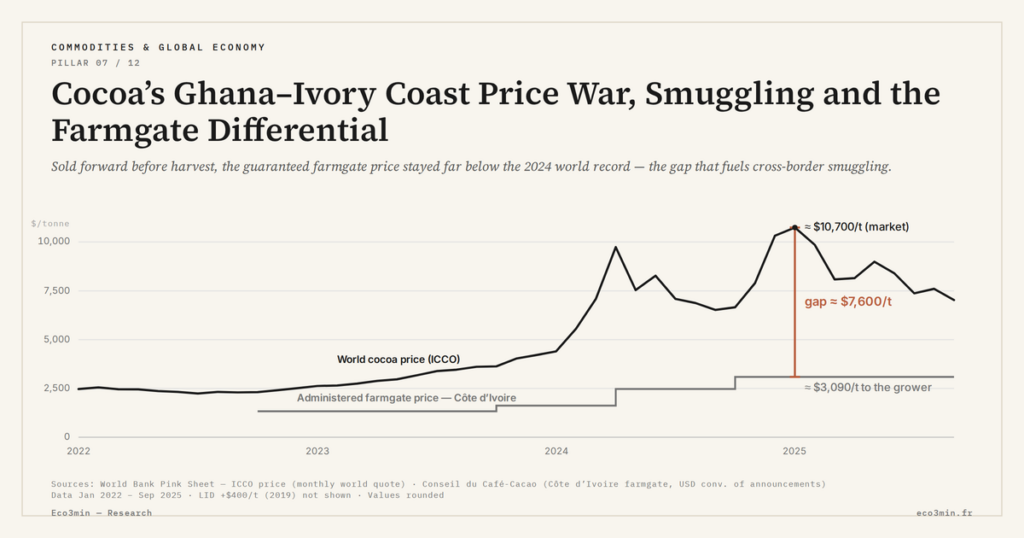
Côte d’Ivoire and Ghana each set an administered price paid to the farmer, sold forward on the futures markets. The gap between these two prices, and between them and the world quote, fuels cross-border smuggling and distorts harvest statistics.
TL;DR
Millions of West African households grow the beans, yet a state-set farmgate price sold forward each season meant the 2024 record above $10,000 a tonne barely lifted producer income.
- The Conseil du Cafe-Cacao and Cocobod set a guaranteed farmgate price and sell most of the crop forward, so the grower's income reflects earlier sales rather than the current quote.
- A living income differential announced in 2019 added a $400-per-tonne premium, but buyers discount it when prices fall and it shrinks to a token when prices soar.
- Price gaps between the two countries push beans across a porous border, distorting official harvest and port-arrival figures and blurring genuine shortage against smuggling leakage.
- With a record world price barely reaching farms, ageing trees and disease go unfunded, perpetuating the supply fragility that drives cocoa's violent cycles.
This article examines the pricing rivalry between the two cocoa giants, the living income differential they introduced, and why the 2024 surge barely reached growers.
On most markets, the price paid to the producer tracks the world quote, give or take a lag. For West African cocoa, that link is broken by a price-administration system unique in the world, run by two rival states. Understanding this institutional mechanism is essential to grasping how a world record can coexist with struggling farmers and unreliable production figures — a paradox that marked the surge and slump in cocoa.
Two administered systems, one market
In Côte d’Ivoire and Ghana, the price paid to the farmer is not freely negotiated: it is set administratively by a public body. The Conseil du Café-Cacao on the Ivorian side, Cocobod on the Ghanaian side, fix a guaranteed farmgate price, generally before the season opens. To secure it, the two countries sell most of their crop forward on the futures markets, months before it is physically available. The price guaranteed to the producer therefore largely reflects the prices at which the crop was sold in advance — not the price of the moment.
This model serves a legitimate aim: to protect the farmer’s income from international volatility. But it has a flip side: it disconnects that income from the world market. When the quote soars after the crop has been sold forward, the producer sees almost none of it; when it collapses, he is by contrast partly protected. This asymmetry sits at the heart of the mechanism we describe in relation to the three price levels of cocoa, where the farmgate price is the link furthest from the benchmark quote.
Aware of their combined weight, the two countries sought to coordinate their policies. In 2019, they jointly announced a living income differential, a premium of $400 per tonne added to the world price, meant to better remunerate producers of both origins. This initiative, sometimes likened to an “OPEC of cocoa”, illustrates the temptation to use the weight of the top two producers to lean on the price. But to coordinate is not to merge: each country keeps its own body, calendar and selling strategy, which leaves gaps between the two administered prices in place. And it is precisely from those gaps that the difficulties arise.
This coordination has shown its limits. The living income differential, conceived as a price floor for the producer, loses force depending on conditions: when the world quote collapses, buyers balk at paying the premium and negotiate discounts on other components of the price, partly neutralising it; when the quote soars, the $400 premium becomes trivial against beans worth several thousand dollars more. The attempt to lean collectively on the price, attractive on paper, thus runs into the reality of a market where both states remain, in the last resort, takers of the world quote they have themselves sold forward.
The differential and smuggling
Because Côte d’Ivoire and Ghana do not set their farmgate price at the same time or at the same level, a differential regularly appears between the two. Yet the two main production basins adjoin, and the border is long and porous. When one of the two countries pays noticeably more than the other, part of the beans crosses the border clandestinely toward the more generous country, through informal channels. The phenomenon is not new: it has accompanied the administered system for decades, intensifying each time the price gap widens.
This smuggling has a direct consequence for reading the market: it distorts official production statistics. A bean harvested in one country but exported by the other is recorded in the wrong place, or escapes official tallies entirely when it leaves the chain through parallel channels, including toward neighbouring countries with no administered price. Harvest and port-arrival figures, already hard to establish across millions of small farms, then become a noisy signal. For anyone following the market, telling a genuine fall in production apart from a mere leak into a parallel circuit is a delicate exercise.
The differential does not only operate between the two giants. When the world quote far exceeds the administered prices, the incentive to divert beans toward buyers willing to pay the spot price, inside and outside the region, becomes considerable. The administered system, designed to stabilise, then begins to leak on all sides, and the authorities are forced to react — by raising the farmgate price mid-season, for instance, to try to keep the crop in official channels. We place this case within the geoeconomic frame of commodities, where it stands as a textbook case of tension between price administration and market reality.
Ghana’s case illustrates the fragility of this arrangement. Cocobod traditionally finances the season through an international syndicated loan, secured on the crop’s forward sales; this mechanism obliges it to honour deliveries at prices fixed in advance, even when the market has since soared. Faced in 2024 with a massive leak of beans toward buyers paying the high price, the country had to raise its farmgate price mid-season to try to retain the crop — a defensive adjustment that underlines how far price administration can be caught out by a brutal market move.
2024: the surge that did not reach the farmer
The 2024 episode pushed this mechanism to its extreme. The two countries had, as usual, sold most of their crop forward before the quote soared. When the world price passed $10,000 per tonne, their farmgate prices, anchored to far lower earlier sales, stayed well below. The gap between what the bean was worth on international markets and what the farmer received reached unprecedented proportions.
That gap triggered a wave of diversion. With a world quote several times the guaranteed price, the incentive to take beans out of official channels and sell them at the high price became irresistible. Part of the crop thus left the regular chain, swelling the impression of shortage at the very moment the market most feared a deficit. Official port arrivals fell, feeding the upward spiral, while part of the beans kept circulating by other routes. The world record, the collapse in declared volumes and farmer distress coexisted within a single movement.
This mechanism has a direct implication for anyone trying to read the market. When an unknown share of the crop circulates outside official channels, arrival and production statistics cease to be a reliable thermometer: a fall in declared volumes may reflect a genuine shortage, a leak into smuggling, or a mix of the two. The administered price differential thus turns an already hard-to-establish figure into a frankly ambiguous signal, and adds to the uncertainty that amplifies price moves.
The paradox is striking. At the height of the surge, those who grow cocoa captured only a small share of it, with most of the value lodging in the intermediary and financial links. The administered system, meant to protect the producer, in practice deprived him of the record’s benefit, while complicating the reading of an already opaque market. This institutional dimension is added to the physical causes of cycle amplitude: onto the concentration and rigidity of supply is layered a data opacity sustained by the divergence of administered prices. It is one more reason why the screen quote, on this market, says so little about what reaches the farm.
More broadly, the cocoa case shows that on a concentrated, administered market, policy can matter as much as weather. A farmgate decision, a coordination attempt or a financing constraint in two capitals shapes the world price alongside rainfall and disease. Anyone reading this market has to watch the institutions of the producing countries as closely as their skies — a dimension that distinguishes cocoa from a purely market-driven commodity.
The stakes reach beyond price analysis. Millions of West African households depend on cocoa, and a system in which a record world price barely lifts farm incomes raises hard questions about how the value of the crop is shared along the chain. It also feeds a longer-run risk for the market itself: if growers cannot capture enough of the upside to invest in their orchards, the ageing trees and disease that already weigh on West African yields will persist, perpetuating the very supply fragility that drives the violent cycles. Farmer income and market stability, on this market, are not separate problems but two faces of the same structural question. The institutional layer is therefore not a footnote to the cocoa story; it is part of its core, alongside the geography and biology that the rest of this study examines.
It is assumed that West African growers grew rich on the 2024 surge. The reverse is true: the administered farmgate price, set before the season on forward sales predating the rise, reflected only a delayed fraction of the world quote. The record mainly benefited the intermediary and financial links, not the producer.
Last updated — 28 June 2026
Disclaimer – Financial Information: The analyses, commentary, and content published on eco3min.fr are provided for informational and educational purposes only. They do not constitute investment advice or a solicitation to buy or sell financial instruments. Past performance is not indicative of future results. All investment decisions involve risk and are the sole responsibility of the reader.
Read next
Full pillar →Reading the refinery utilisation rate: the threshold, the season, the turnarounds
A refinery runs full near ninety percent, not a hundred: the last slice of nameplate capacity is a…
IMO 2020: the regulatory shock that rewrote product spreads
An environmental rule on marine sulfur can move a refining spread more than a swing in crude. IMO…
The 2022–2023 refining golden age: anatomy of an episode
In 2022, refined fuel prices climbed faster than crude. That gap, measured by the 3-2-1 crack spread, reached…