Cocoa’s West African Supply Concentration and Its Systemic Risk

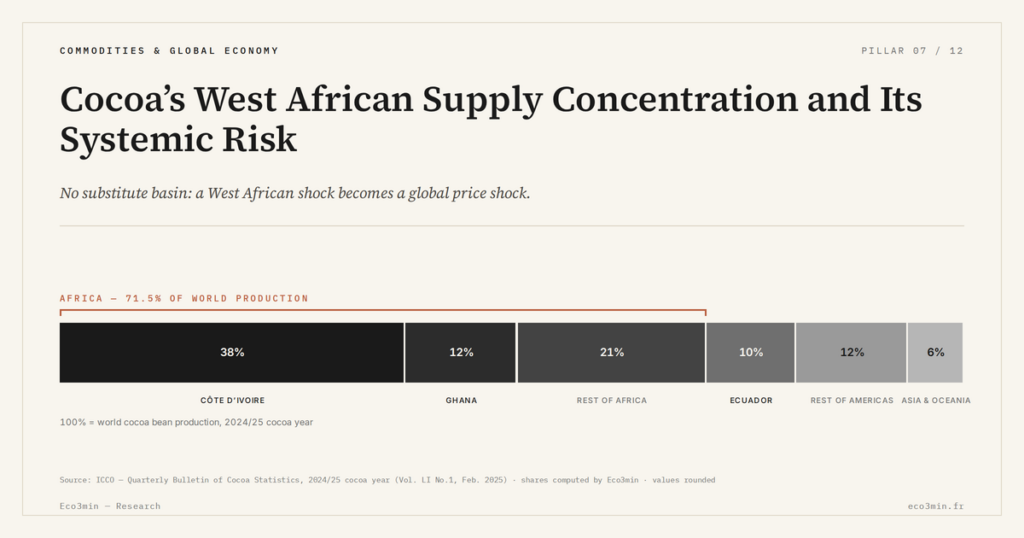
Close to 70% of the world’s cocoa comes from West Africa, and two countries — Côte d’Ivoire and Ghana — supply more than 60% on their own. This extreme concentration turns any local incident into a planet-wide price event.
TL;DR
A few West African countries hold the bulk of cocoa supply, a physical vulnerability no financial sophistication can hedge away, rooted in the narrow band where the tree will grow.
- Other commodities spread risk across continents, with oil pumped everywhere and copper mined from Chile to Congo, but cocoa has no substitute basin able to step in within a season.
- Diversification is slow by construction: new trees take years to bear fruit, so by the time fresh production matters, the deficit that justified high prices has often already vanished.
This article examines why cocoa supply is so concentrated, why that concentration does not unwind quickly, and how it elevates a regional vulnerability into a systemic risk for the world market.
Most major commodities are mined or grown across several continents, which dilutes risk: a failure somewhere can be offset elsewhere. Cocoa is the exception. Its production is concentrated on a narrow geographic band and, within it, on a handful of countries. Understanding this singularity is essential to grasping why the cocoa market experiences cycles of an amplitude few other products reach, as shown by the cocoa round-trip between 2024 and 2026.
Two countries, sixty percent: the anatomy of concentration
The numbers speak for themselves. Côte d’Ivoire is by far the world’s leading producer, with a share on the order of 40 to 45% of supply, followed by Ghana, around 15 to 20%. Between them, these neighbouring countries provide more than 60% of the planet’s cocoa. Adding Nigeria and Cameroon, West Africa reaches close to 70% of world production. The remainder is split between Ecuador, Brazil, Indonesia and a few marginal producers. No other region individually approaches the weight of this West African bloc.
This geography is no accident. The cocoa tree is a demanding plant, thriving only in a narrow equatorial band, under precise conditions of temperature, humidity and rainfall, sheltered from frost and prolonged dry seasons. This agronomic constraint drastically limits where the crop is possible, and West Africa brings together, over vast areas, all of these conditions. To this natural determinant is added path dependence: the crop was massively developed there over the twentieth century, collection and export infrastructure took shape, and millions of families made it their main activity. Concentration thus reinforced itself, the initial advantage drawing in the investments that followed.
The production structure further sharpens the model’s specificity. Unlike a commodity extracted by a few large industrial groups, West African cocoa rests on a multitude of small family farms, often smaller than five hectares. This atomisation upstream, combined with geographic concentration, draws a system in which millions of dispersed producers feed a world market whose price is set elsewhere — a separation we detail in the geoeconomics of commodities. The result is a productive apparatus both fragmented at the base and hyper-concentrated at the regional scale.
A historical paradox is worth noting. The cocoa tree is native to Central and South America, where it was cultivated long before its introduction to Africa. Yet it is West Africa that, over the twentieth century, became the heart of world production, thanks to ideal climatic conditions and a large workforce. This concentration of production is matched by a symmetric concentration of demand: chocolate is consumed mainly in the global North, in Europe and North America. The cocoa market thus links two distinct zones — a tropical belt that produces, developed economies that consume — which heightens the world price’s sensitivity to anything affecting the handful of producing countries.
Why this concentration does not unwind quickly
Faced with record prices, one question recurs: why do other regions not start producing cocoa en masse to seize the windfall and diversify world supply? The answer lies first in the agronomic constraint already noted: cocoa cannot be grown where the climate does not allow it, and the favourable zones are limited. The price signal, however high, does not create new equatorial land.
Then comes the time factor. Establishing a new producing region is not decided in a single season: trees must be planted, several years awaited for them to bear fruit, collection, drying and export chains developed, and a workforce trained. This the inertia of cocoa supply means that by the time new production becomes significant, the deficit that justified high prices has often already vanished. Geographic diversification is therefore a long-haul process, poorly suited to price shocks that resolve within a few years.
A trend nonetheless exists. Ecuador has emerged as a growing producer, drawing notably on high-yield varieties and a model closer to the industrial plantation than to the smallholding. This rise is the main diversifying force in world supply, but it remains, at this stage, minor against the West African bloc. To this is added a political dimension specific to the region: Côte d’Ivoire and Ghana partly coordinate their price and quality policies, but also maintain the price rivalry between the two giants that influences flows and statistics. Concentration is therefore not only geographic: it is also institutional, two states weighing decisively on world supply.
Concentration also creates its own agronomic fragility. Production massed on a restricted territory and resting largely on ageing planting material is more exposed to the spread of disease and soil exhaustion than dispersed production. Swollen shoot virus, circulating in West Africa, is the illustration: on a concentrated orchard, a disease can spread at scale and durably degrade productive capacity. Diversifying would take years and expose new regions to their own sanitary risks; not diversifying maintains the dependence.
Grower income levels also work against internal diversification. As long as the administered farmgate price reflects the peaks of the world quote only with a lag, producers have neither the means nor the incentive to replant en masse or rejuvenate their orchards. The rise in the world price, captured mostly downstream, does not reach far enough upstream to trigger the investment that would rebalance supply. Concentration thus perpetuates itself, for lack of the economic signals that would push to dilute it.
From local shock to global shock: the systemic risk
This is where concentration ceases to be a mere statistical fact and becomes a risk. When most of supply depends on a single region, any event that strikes that region feeds directly into the price paid everywhere else, with no buffer. A drought, excessive rainfall, the spread of a disease or a regulatory decision in Côte d’Ivoire and Ghana are not local incidents: they are global shocks. Shocks such as swollen shoot disease or climate setbacks thus take on a systemic reach they would not have on a diversified market.
The contrast with other commodities is illuminating. Oil is produced on every continent; if one basin fails, others can adjust their output. Copper is mined from Chile to Congo. This diversity acts as an implicit insurance: it spreads the risk. Cocoa is deprived of it. There is no substitute basin able to step in within a season, which means no other zone can absorb a West African shock. Concentration is, in a sense, the flip side of a protective diversification.
The political dimension worsens the risk. Because two states — Côte d’Ivoire and Ghana — together account for more than 60% of supply, their decisions on prices, stocks or regulation carry a global reach no private actor matches. A reform of the farmgate price, a change in harvest management or a new traceability requirement feeds through immediately to the market. To this is added demand-side risk, also concentrated: a few large processors and a small number of consuming markets are enough to steer flows. Cocoa is thus caught in a vice between supply and demand, both tightly concentrated, a configuration that amplifies every imbalance.
The 2024 episode offered the clearest demonstration. Successively disappointing West African harvests, under the combined effect of climate and disease, were enough to open a global deficit and propel the price toward historic highs, for lack of any replacement production. It was not speculation alone that carried the quote so high: it was the structural impossibility of offsetting a regional deficit on a market dependent for 70% on a single region. Concentration explains why, on this market, a localised problem immediately becomes a problem for the entire global chocolate industry. It is a vulnerability that no amount of financial sophistication can hedge away, because it is rooted in the physical geography of the crop itself.
This is why understanding concentration matters before anything else on this market. It is the deep cause behind the price behaviour that supply rigidity and weather shocks then amplify: a market that leans on one region has no quantity valve, so price must do all the adjusting. Every analysis of cocoa’s violent cycles, including the 2024-2026 round-trip, ultimately traces back to this single structural fact — that the world depends, for the bean in its chocolate, on the orchards of a handful of West African countries.
- Côte d’Ivoire and Ghana supply more than 60% of the world’s cocoa on their own, and West Africa close to 70% — a concentration without equal among major commodities.
- This concentration stems from an agronomic constraint (the cocoa tree favours only a narrow equatorial band) reinforced by historical path dependence.
- It does not unwind quickly: favourable land is limited and establishing a new producing region takes years.
- For lack of a substitute basin, any regional shock — climate, disease, political decision — becomes a global price shock, with no geographic buffer.
- It is this systemic risk, more than speculation, that explains the amplitude of cocoa’s cycles.
Last updated — 30 June 2026
Disclaimer – Financial Information: The analyses, commentary, and content published on eco3min.fr are provided for informational and educational purposes only. They do not constitute investment advice or a solicitation to buy or sell financial instruments. Past performance is not indicative of future results. All investment decisions involve risk and are the sole responsibility of the reader.
Read next
Full pillar →Reading the refinery utilisation rate: the threshold, the season, the turnarounds
A refinery runs full near ninety percent, not a hundred: the last slice of nameplate capacity is a…
IMO 2020: the regulatory shock that rewrote product spreads
An environmental rule on marine sulfur can move a refining spread more than a swing in crude. IMO…
The 2022–2023 refining golden age: anatomy of an episode
In 2022, refined fuel prices climbed faster than crude. That gap, measured by the 3-2-1 crack spread, reached…