Commodities as Instruments of Indirect Economic Policy
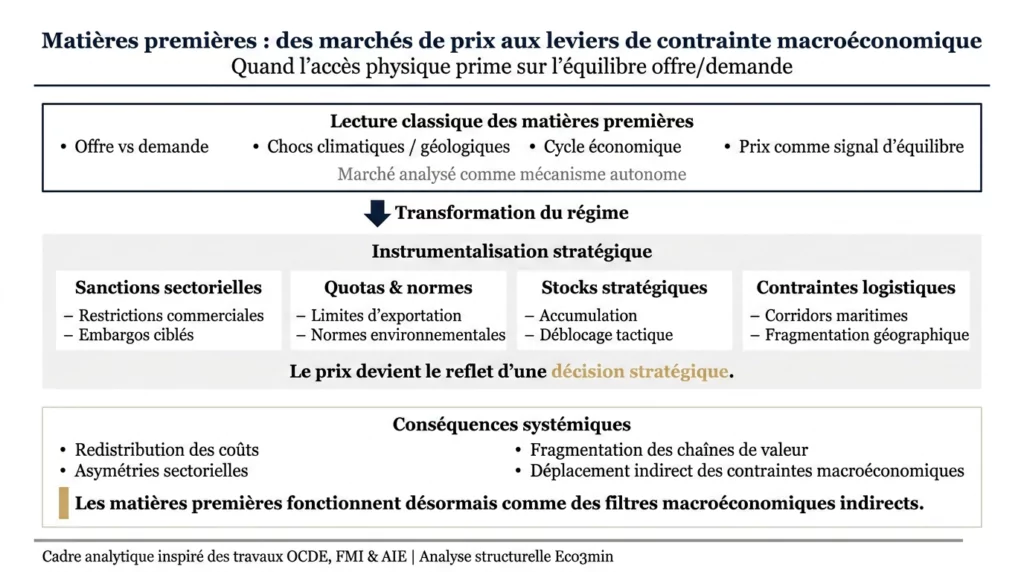
Commodities are no longer simple supply/demand markets. Sanctions, quotas, strategic stockpiles and logistical filters have turned them into instruments of indirect economic policy that redistribute constraints across global value chains.

Commodities are no longer mere goods exchanged on global markets. They have become silent economic weapons. Targeted sanctions, export quotas, discriminatory environmental standards, strategic stockpiles: a series of mechanisms that allow states to shift economic constraints and redistribute costs without ever activating the traditional levers of monetary or fiscal policy. Reducing the analysis of these markets to a simple confrontation between supply and demand means ignoring their deep transformation. This page decodes the conditions under which commodities have become full-fledged instruments of economic and geopolitical steering.
TL;DR
States increasingly wield commodities as indirect policy levers, using sanctions, quotas and strategic stockpiles to redistribute economic constraints without activating monetary or fiscal channels.
- The IEA (Global Critical Minerals Outlook 2025) puts the top three producing countries at an average 77% of mining and 86% of refining of critical minerals in 2024, up from 73% and 82% in 2020, structurally amplifying their use as strategic leverage.
- The strategic use intensifies late in the macro cycle: as growth slows and the cost of capital turns discriminating again, conventional-policy room narrows and indirect levers like restricting access or slowing logistics gain weight.
- It fragments market microstructure: large vertically integrated groups absorb restrictions through long-term contracts and direct deposit access, while mid-sized and niche players bear the full brunt, so aggregate sectoral indicators lose relevance.
This reading aligns with the analyses developed by the OECD, the International Energy Agency (IEA) and the IMF on the rising weight of geopolitical, logistical and administrative constraints in commodity markets since 2020.
This analysis draws on recent work from international institutions (OECD, IMF, IEA) and on the observation of sanctions regimes, quotas and strategic stockpiles, in order to interpret commodities as instruments of macroeconomic constraint rather than as simple price markets.
The Era When Commodities Were Just Markets Is Over
For decades, commodity analysis rested on a well-established triptych: supply fundamentals, demand dynamics and climatic or geological hazards. This framework, inherited from a globalisation then perceived as irreversible, retains some relevance. But it no longer suffices to decode how these markets actually function.
Behind price fluctuations, a structural shift is taking shape: commodities are now instrumentalised as tools of indirect economic policy. Not in the sense of explicit steering comparable to central bank policy rates, but as levers of pressure, adjustment and constraint serving long-term state strategies.
This transformation remains largely invisible in macroeconomic dashboards. Commodity indices, average prices and discourse on inflation aggregate disparate realities without revealing their strategic dimension. Yet this shift constitutes a major signal: economic policy no longer transits exclusively through monetary and fiscal channels.
This analysis extends the work developed on commodities and the global economy, moving beyond the purely cyclical reading to explore their geopolitical and macroeconomic uses.
The Mirage of Indices and Aggregated Prices
Commodity markets are generally read through the prism of global indices and nominal price changes. Yet the asymmetry between slow physical supply and fast financial demand — which structures volatility — is analysed in our study on price formation through temporal asymmetry. These tools, convenient for a synthetic view, mask growing heterogeneity. Not all price moves reflect a classic imbalance between production and consumption.
In a growing number of situations, the variations observed result from deliberate administrative decisions: trade restrictions, sectoral sanctions, stockpiling strategies. These moves, once aggregated, can give the illusion of a chaotic market when they actually reflect a deliberate reallocation of economic constraints by states.
Anatomy of the Indirect Political Role of Commodities
The notion of indirect economic policy designates the set of mechanisms through which a state or regional bloc influences activity, competitiveness or industrial trade-offs without resorting to conventional macroeconomic instruments. Commodities lend themselves remarkably well to this use: indispensable, hard to substitute in the short run, they constitute an ideal pressure lever.
According to the International Energy Agency (IEA, Global Critical Minerals Outlook 2025), the top three producing countries account on average for 77% of mining and 86% of refining of critical minerals in 2024, up from 73% and 82% in 2020, and China is the leading refiner for 19 of the 20 minerals analysed with an average share of around 70%, structurally reinforcing their potential to be instrumentalised as a strategic lever.
Unlike monetary or fiscal policy, these interventions are not always explicitly announced. They take the form of export quotas, logistical barriers, sectoral sanctions, environmental standards with variable geometry or the build-up of strategic reserves. Their impact is diffuse, gradual and fundamentally asymmetric.
This political role does not eliminate market mechanisms — it frames them, bends them or diverts them. Prices keep oscillating, but they become as much the product of political arbitrage as of an economic equilibrium.
- Analyse access constraints before price levels.
- Identify the political decisions behind physical flows.
- Reason in sectoral asymmetries rather than averages.
This analytical grid gains depth when placed within the broader context of real cycles and the macroeconomic transmission mechanisms of commodities, where the central issue is no longer the level of prices but how physical, investment and geopolitical constraints redefine the underlying economic regime.
- Reading commodities solely as supply/demand equilibrium markets.
- Equating any price move with an exogenous or cyclical shock.
- Ignoring the strategic and administrative dimension of access constraints.
Scope and Limits of This Signal
The use of commodities as indirect instruments does not reflect a desire for absolute price control. It reveals a capacity to shift constraints, redistribute costs and weigh on global value chains. By contrast, it does not allow precise prediction of short-term price moves nor anticipation of a new stable equilibrium.
Acceleration in Late Cycle
The strategic use of commodities tends to intensify in the late phases of the macroeconomic cycle. This cyclical dynamic is framed in our sub-pillar on cycles and macroeconomic transmission. When growth slows, margins compress and the cost of capital becomes discriminating again, the room for manoeuvre of conventional policies narrows.
In this context, indirect levers take on crucial importance. Restricting access to a strategic resource, slowing logistical flows or modifying supply conditions allows states to act on the real economy without immediately bearing the political cost of an explicit measure.
Real rates, the cost of capital and liquidity remain central variables, but they now combine with these physical constraints — a framework developed in depth in the Eco3min monetary policy and rates pillar. This superposition of levers complicates cycle reading and accentuates asymmetries between sectors and geographies.
Sanctions, Quotas and Logistics: The New Economic Filters
Trade sanctions, export quotas and logistical disruptions are no longer the exception. They have become recurring tools of economic filtering. The analysis of tensions around maritime corridors, developed in the article on the Red Sea corridor, illustrates this logic perfectly: physical access to commodities has become a top-tier strategic parameter.
- This mechanism does not concern commodities alone.
- It is part of a broader regime of global economic fragmentation.
- Prices become secondary to physical constraints.
Companies and Microstructure: Diverging Trajectories
Companies do not absorb this creeping politicisation of commodities uniformly. Size, geographic footprint, supply diversification, storage capacity: as many parameters that create a growing dispersion of economic trajectories.
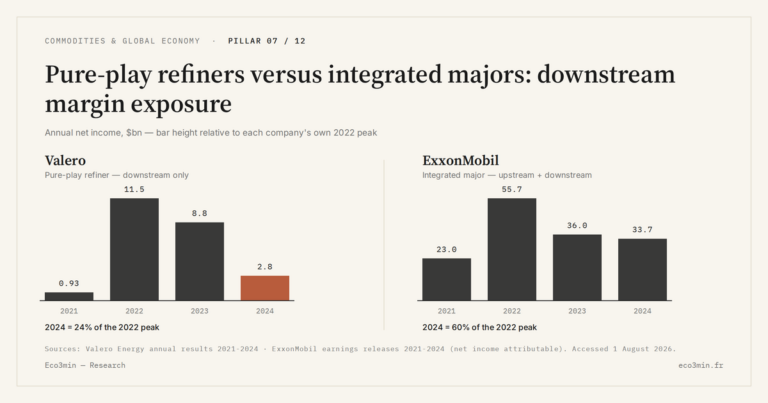
Large vertically integrated groups generally have a stronger absorption capacity: long-term contracts, direct access to deposits, regulatory influence. Conversely, mid-sized players or niche specialists bear the full brunt of restrictions and supply disruptions.
This heterogeneity translates into a fragmented market microstructure. Aggregate sectoral indicators lose relevance because they pool fundamentally divergent realities.
Strategic Stockpiles, Signal Disruptors
The build-up or release of strategic stockpiles plays a determining role in this dynamic. These interventions temporarily alter available supply on the market, smoothing some shocks while amplifying others. They blur the reading of fundamentals by creating artificial signals of scarcity or abundance. The US Strategic Petroleum Reserve is the most visible case: its stocks fell from 593 million barrels in early 2022 to 347 million in July 2023, climbed back to 415 million in March 2026, then dropped to 285 million by mid-September 2026 (EIA weekly series).
Decoding the Regime Rather Than Tracking Prices
Approaching commodities as instruments of indirect economic policy allows neither the prediction of a precise price move nor the anticipation of a turning point. This approach offers, however, an analytical grid for the economic regime in which markets operate.
In this regime, prices cease to be equilibrium signals and become reflections of political, logistical and strategic constraints. Aggregate indicators lose their relevance while the analysis of supply chains, state decisions and sectoral asymmetries becomes central.
This regime can persist. As long as geopolitical fragmentation continues and the room for manoeuvre of traditional policies remains constrained, commodities will continue to be mobilised as indirect levers of economic steering.
Commodities now function as indirect macroeconomic filters: physical and administrative access redistributes constraints far more than price adjustments do.
- Commodities have become indirect economic levers.
- Aggregate prices mask political and logistical constraints.
- Reading the regime matters more than tracking price cycles.
Conclusion — The Real Meaning of Commodities
Commodities have ceased to be simple cyclical assets or inflation barometers. They have morphed into instruments of indirect economic policy, mobilised to redistribute constraints, steer value chains and shape global macroeconomic balances.
Analysing these markets solely through the prism of prices means ignoring their growing strategic function. A fine understanding of contemporary cycles now requires the study of these indirect uses — often discreet, but profoundly structuring for the global economy.
Last updated — 20 September 2026
Disclaimer – Financial Information: The analyses, commentary, and content published on eco3min.fr are provided for informational and educational purposes only. They do not constitute investment advice or a solicitation to buy or sell financial instruments. Past performance is not indicative of future results. All investment decisions involve risk and are the sole responsibility of the reader.
Read next
Full pillar →IMO 2020: the regulatory shock that rewrote product spreads
An environmental rule on marine sulfur can move a refining spread more than a swing in crude. IMO…
The 2022–2023 refining golden age: anatomy of an episode
In 2022, refined fuel prices climbed faster than crude. That gap, measured by the 3-2-1 crack spread, reached…
Diesel versus gasoline: why the two crack spreads diverge
The 3-2-1 crack blends gasoline and distillate into a single number, and that convenience hides something the market…