Compound Interest: The Underused Mechanism to Build €100,000
Compound interest: how €200 per month can compound to €100,000 over time, while avoiding the classic mistakes of the average saver.

Compound interest: how €200 per month can compound to €100,000 over time, while avoiding the classic mistakes of the average saver.
TL;DR
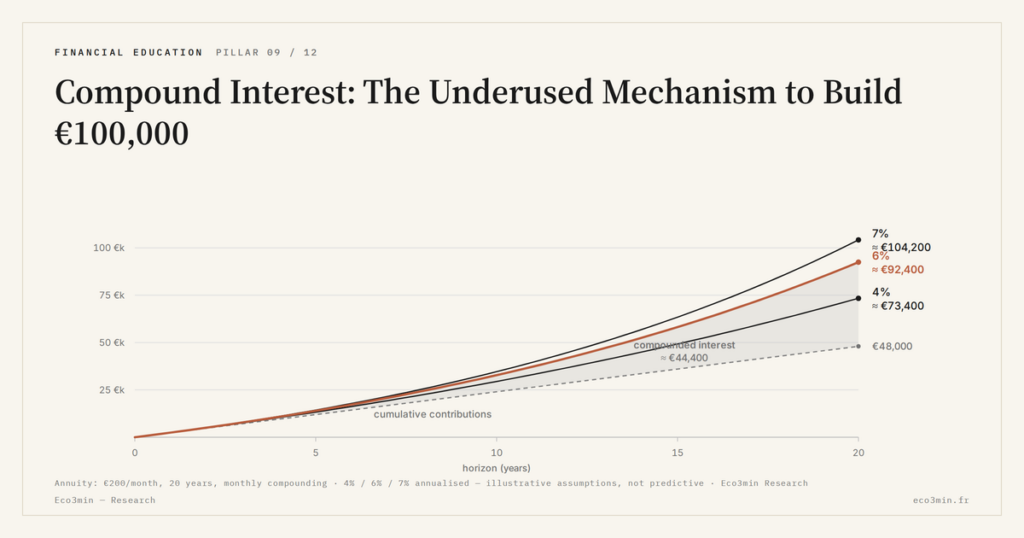
€200 a month at 6% compounds to roughly €100,000 over twenty years, where time in the market outweighs product selection and market timing.
- Starting five years later forgoes ≈30-35% of final capital, since the high-compounding final years are lost rather than the contributions themselves.
- €10,000 left at 2% for fifteen years grows to ≈€13,500, against ≈€24,000 at 6%; the ≈€10,000 gap is return on return, not extra yield.
- Central banks lifted policy rates from ≈0% to ≈3-4% over 2022-2024, yet average inflation of ≈4-6% kept remunerated cash often below realised inflation (Fed, ECB, OECD).
Earning a decent income while saving ‘a little’ often produces a familiar paradox: capital that fails to grow meaningfully. The decisive gap is rarely the financial product chosen — it is the understanding of compound interest. Properly applied, this mechanism turns €200 per month into a substantial pool of capital. Poorly understood, it leaves money idle while inflation erodes it. In other words: long-term outcomes depend less on market timing than on saving discipline.
One shift remains under-discussed: with real rates back in positive territory since 2023, the relative weight of cash, bonds and equities for long-term savings has shifted materially. The implications for wealth strategies warrant a serious recalibration.
To explore the allocation logic behind these choices, the analysis on the 60-30-10 framework offers a useful complement.
The compounding mechanism cannot be fully exploited without a solid foundation of financial understanding: navigating the trade-offs between time, risk, real return and saving discipline falls within financial education, which structures wealth decisions over time rather than reacting to short-term market moves.
Key takeaways
- Compound interest is return on return: time becomes the primary asset, with an explosive effect after 10–15 years.
- At 6% per year, €200 per month compounds to ≈€100,000 over 20 years (simple assumption, before tax).
- The savings consensus favours short-term safety (regulated savings accounts, euro funds), while the real lever operates on the long horizon.
- A clear framework (monthly amount, horizon, allocation, rebalancing) outperforms a ‘good product’ picked at random.
Detailed analysis: what compound interest actually shows
Central banks raised rates between 2022 and 2024: policy rates moved from ≈0% to ≈3–4% in advanced economies (aggregated figures from major central banks). Regulated savings products yield more than in 2020, but average inflation over 2022–2024 ran around 4–6% depending on the region, according to major macro institutions (Fed, ECB, OECD). The observation: remunerated cash provides better protection than before, but often remains below realised inflation. Below-inflation cash compounds into a negative real path once the nominal rate is divided by the price level rather than netted against it, the operation at the centre of the exact Fisher relation behind a real return.
Mainstream projections expect inflation to drift back toward 2–3% over 2025–2027, with nominal rates slightly higher than pre-2020. The central scenario for many participants is that holding more cash on low-risk vehicles becomes ‘sufficient’. This reading misses one key point: compound interest only works fully when net returns durably exceed inflation.
One useful comparison: between 2010 and 2019, a global equity portfolio produced ≈7–8% per year on average (gross of fees, based on major equity indices). By contrast, a 2% savings account over the same period barely offset cumulative inflation. Over 10 years, the gap looks tolerable. Over 25 years, the two trajectories represent fundamentally different wealth outcomes.
Concrete impacts: what changes now
Many readers ask whether it is ‘too late’ to benefit from compound interest. The relevant question is not the precise age, but the time horizon remaining before major needs (retirement, life transition, professional independence).
The compounding mechanism never operates in isolation. As detailed in the analysis on structuring financial decisions over time, long-term return depends less on the headline rate than on the order in which decisions are made: securing the base, stabilising cash flows, then letting time and capitalisation play their full role.
- Simple scenario: €200 per month for 20 years at 6%/year ≈ €91,000. At 7%/year ≈ €104,000. The formula used is that of an annuity: constant monthly contribution with annual capitalisation.
- Effect of delay: waiting five years to start, all else equal, foregoes ≈30–35% of final capital. Not because less money was contributed, but because the ‘turbo’ phase of compounding was shortened.
- Cash vs investment: leaving €10,000 on a 2% vehicle for 15 years yields ≈€13,500. At 6%, ≈€24,000. The ≈€10,000 difference is not ‘extra return’ — it is essentially return on return.
For a professional starting to think about retirement, combining this capitalisation logic with the mechanics of disciplined allocation is materially more powerful than chasing the best yield available at any given moment.
Micro-trends that matter
- Higher risk-free yields: since 2023, some European money market funds have offered ≈3–3.5% net of fees. This improves the base, but does not replace growth assets over a 20-year horizon.
- Savings shortfalls: several retirement studies published in 2024–2025 show a 20–30% savings ‘gap’ for the 25–40 cohort relative to projected needs.
- Automation: the spread of programmed transfers and robo-advisors lowers the entry barrier for disciplined dollar-cost averaging (regular monthly contributions).
- Tax pressure: 2025 debates on taxation of capital and wealth income make the use of tax-efficient vehicles (PEA, life insurance, local equivalents) all the more strategic for maximising net compounded returns.
What is reshaping in the background is a polarisation: those who automate and let time work for them, versus those caught in a short-term logic of ‘I save what is left’. The first group genuinely exploits compound interest; the second is exposed to it through debt or inflation.
Practical implications for individual investors
1. Defining a simple allocation framework
One documented operational framework is the 50/30/20 split for monthly investment savings:
- 50% on global equity ETFs or diversified index funds (long-term real growth).
- 30% on bond or money-market vehicles to absorb shocks.
- 20% on precaution cash or short/medium-term projects.
This structure remains compatible with the more advanced barbell strategy analysed in the barbell strategy, but it already captures most of the compounding effect.
2. Position sizing and discipline
- Minimum contribution: households allocating 10–15% of net income to invested savings have historically observed meaningful compounded outcomes over 20-year horizons. Below that threshold, the effect becomes marginal.
- Continuity of contributions: investors who maintained monthly contributions through volatility — provided their precautionary cash (3–6 months of expenses) remained intact — observed superior outcomes versus those who paused during drawdowns. Interrupting DCA at every market wobble breaks the mechanism.
- Rebalancing: every 12 to 24 months, returning to the 50/30/20 baseline by trimming what has run and adding to what has lagged is a documented form of disciplined rebalancing, even without perfect timing.
What could shift soon
- More restrictive monetary policy: if core inflation drifts durably above 3%, central banks could keep real rates higher than expected, making cash more attractive in the short term but compressing equity valuations.
- Tax shocks: targeted tightening on capital taxation could reduce net returns from traditional vehicles and force a re-optimisation of structures.
- Macro volatility: a ‘soft stagflation’ scenario, already discussed in the analysis on stagflation risk, could make the early years of capitalisation more turbulent. The challenge becomes holding the plan rather than trying to anticipate every cycle.
Conversely, faster-than-expected disinflation combined with a productivity recovery via AI could support real returns above those embedded in current scenarios, further reinforcing the case for long-horizon capitalisation.
Three plausible 3–12 month trajectories
- Scenario 1 — Soft normalisation (current central scenario): inflation receding slowly, rates declining gradually by 50–100 basis points over 2026. Risk assets remain volatile but trending higher. Compound interest works well for a regular 50/30/20 portfolio.
- Scenario 2 — Persistently high rates: sticky inflation, tense yield curve. Bonds underperform in the short term, equities re-rate more slowly. In this configuration, slightly raising the equity weighting (for example toward 60/25/15) for a >15-year horizon can remain rational.
- Scenario 3 — Recession shock: sharp decline in long rates, equities drawing down 20–30%. The extreme case where compound interest becomes an ally: continuing contributions allows accumulation at lower prices, accelerating subsequent recovery.
One simple KPI to track: the expected real return of the portfolio (target nominal return minus expected inflation). As long as it remains durably above 2% over the long term, compound interest works strongly in the saver’s favour.
Frequently asked questions on compound interest
- Is it still useful to rely on compound interest after 40?
Yes, but the horizon matters: at 45, targeting 15–20 years of capitalisation remains relevant. The key is then to raise the monthly saving rate and calibrate the risk/cash allocation according to the target retirement date. - Should one stop investing during market drops if relying on compound interest?
No, unless the precautionary base is at risk. Drawdowns are precisely what allow accumulation of more units of assets for the same contribution, reinforcing the compounding effect during the rebound. - Is debt repayment preferable to investment-driven compounding?
Compare the real interest rate on debt (after tax considerations) with the expected net return on investment. If the loan costs 5% and expected long-term net return is 6%, the optimal mix often combines both, while prioritising the elimination of high-rate debt. - Does compound interest really work with modest amounts, like €50 per month?
Yes, but the quantitative effect will obviously be smaller. At 6% over 25 years, €50 monthly still compounds to ≈€35,000. The key is gradually raising the contribution as income grows. - How can one measure whether compound interest is ‘working enough’?
Track the annualised growth rate over five years (CAGR) and compare it with average inflation over the same period. If long-term CAGR exceeds inflation by at least 2 points, the mechanism is being exploited correctly.
Reading across these elements, three implications emerge: for investors, formalising an allocation rule and automating contributions matters more than seeking the ‘right call’. For companies, the same capitalisation logic applies to surplus treasury and employee savings plans. For individuals, the key variable is not finding the miracle product, but starting early, staying consistent, and letting time work for them. It is not the most spectacular scenario, but it is the one markets do not yet fully price in actual behaviour. A parallel read: our study on how households weigh financial decisions through the cycle.
- Three takeaways
- With €200 per month over 20 years at 6%, the compounded total approaches €100,000: time and regularity matter more than perfect timing.
- Inflation and taxation determine whether compound interest enriches the saver’s future or only the State and creditors.
- A simple allocation rule (50/30/20) and an automated DCA outperform a brilliant but unsustainable portfolio.
Last updated — 13 August 2026
Disclaimer – Financial Information: The analyses, commentary, and content published on eco3min.fr are provided for informational and educational purposes only. They do not constitute investment advice or a solicitation to buy or sell financial instruments. Past performance is not indicative of future results. All investment decisions involve risk and are the sole responsibility of the reader.
Read next
Full pillar →Series I and EE Savings Bonds: Locked Formulas in a Moving Rate World
US savings bonds lock a rate formula at the moment you buy them, for the life of the…
Where the Livret A’s Money Goes: The Caisse des Dépôts Circuit and Social-Housing Finance
The savings held on Livret A accounts do not sit idle. A regulation-set share is centralised at the…
France’s LEP vs the Livret A: A Means-Tested Higher Rate, Explained
France’s Livret d’épargne populaire is often described as "the Livret A, only better". The description misleads: the LEP…