Early 401(k) and IRA Withdrawals: The Penalty, the Tax, and the Exceptions

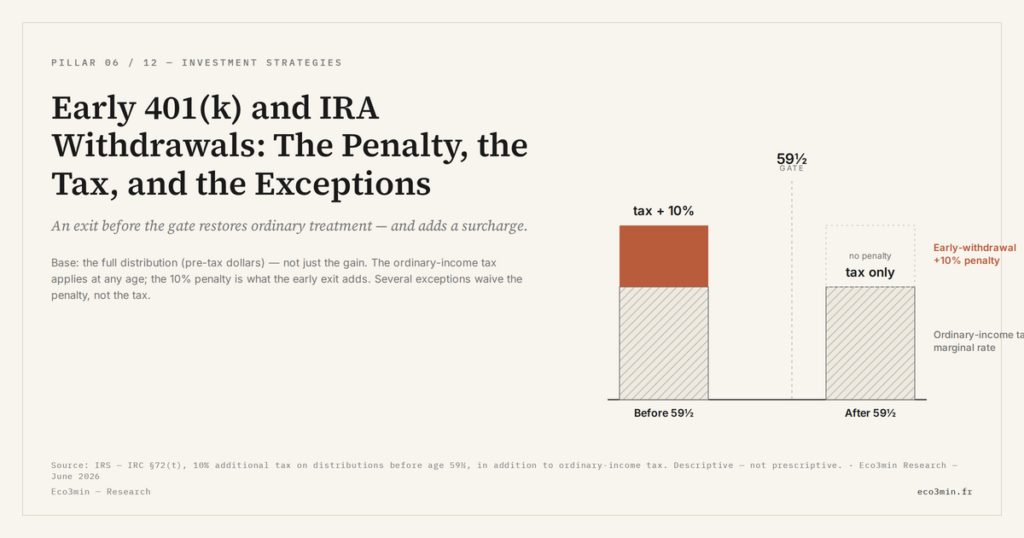
Before age 59½, a withdrawal from a traditional 401(k) or IRA is not a simple debit: it adds a 10% penalty on top of ordinary-income tax, and often state tax as well. The account’s advantage rewards leaving the funds until retirement age, and an early exit gives part of it back.
The penalty looks punitive, but it has a logic. Several exceptions waive it, and one wrapper escapes it entirely. This piece describes the mechanic step by step, with a descriptive aim: understand the cost of an early exit, not be deterred from it.
A withdrawal from a traditional 401(k) or IRA before age 59½ is taxed as ordinary income and carries an extra 10% penalty, with state tax often stacked on top.
- The full distribution is added to the year’s income, so a large withdrawal can also lift the marginal bracket that taxes it.
- A set of exceptions waives the 10% penalty, the Rule of 55, substantially equal periodic payments, disability, medical costs above 7.5% of income, among others, but ordinary-income tax still applies.
- Roth contributions can be withdrawn at any time without tax or penalty, the only wrapper that escapes the early-exit cost.
A traditional retirement account trades a tax advantage for an age commitment: contributions reduce income today, growth compounds untaxed, and the bill comes due at withdrawal. Once the saver reaches 59½, distributions are taxed as ordinary income but carry no penalty. Before that age, an extra layer applies. How that extra layer differs across account types is examined in early access under Roth and traditional plans. Understanding what happens before 59½ means looking at four things in order: what triggers the penalty, how the bill is computed, how a Roth differs, and where the exceptions sit. This is the concrete cost of the deferral whose floor is set in the ordinary-income floor on traditional withdrawals: here, the penalty that stacks on top of that floor when the exit comes early. Worth reading alongside: our reading of the retirement funding question.
1. What triggers the penalty
Amounts withdrawn from a traditional 401(k) or IRA before age 59½ are early distributions, and the IRS imposes a 10% additional tax on them unless an exception applies. This mechanism is set out further in our reading of hardship and 72(t) access. The penalty is calculated on the full amount withdrawn and is paid when the saver files for the year. It sits on top of the ordinary-income tax that any traditional distribution carries, regardless of age: the early withdrawal therefore combines two charges, the ordinary rate plus 10%, and in most states a third, state income tax.
One mechanical detail catches savers off guard. A 401(k) plan administrator is required to withhold 20% of the distribution for federal income tax automatically, but that withholding is not the same as the final bill. The 10% penalty is separate and is not withheld; it is settled at filing. A saver who withdraws expecting the 20% withholding to cover the cost can find an additional penalty, and possibly more income tax, owed in April. The 59½ threshold is a hard line: a distribution a month before it falls under the early-withdrawal regime, with the penalty, while the same distribution a month after does not. This is the liquidity constraint that distinguishes the wrapper, not a soft cost but a dated gate, and it complements the liquidity lever a wrapper imposes.
2. How the bill is computed
The taxable amount is the full distribution, not a gain above contributions. Because a traditional account was funded with pre-tax dollars, every dollar withdrawn is ordinary income: there is no separation between principal and growth, as there would be in a taxable brokerage. A $25,000 early withdrawal is added in full to the year’s income. For a single filer with a 22% marginal rate, that is roughly $5,500 in federal income tax, plus the $2,500 penalty (10% of $25,000), plus state tax where it applies. The combined hit can erase 30% to 45% of the withdrawal before it reaches the bank account.
The second effect is less visible. Because the full distribution lands in the year’s income, a large withdrawal can push the saver into a higher marginal bracket, taxing the top slice of the withdrawal, and any other income, at a higher rate. The cost of an early exit therefore grows with its size, not linearly but in steps, as the distribution climbs through the brackets. Unlike the French wrapper, where only the gain above contributions is taxed, the US traditional account taxes the whole sum, because none of it was taxed going in. Beyond the immediate bill, the withdrawn dollars also forfeit decades of tax-deferred compounding: a cost that never appears on the year’s return, but that compounds silently across a career and typically dwarfs the penalty itself. A related read: the criteria behind evaluating a broker.
3. Traditional versus Roth
The penalty bites pre-tax balances, which is why a Roth behaves differently. Roth contributions were made with after-tax dollars, and they can be withdrawn at any time, at any age, without tax or penalty, since the tax was already paid. Only the earnings inside a Roth are subject to the early-withdrawal rules, and a qualified Roth distribution, after the account has been held five years and the saver is 59½, is entirely tax-free. The Roth is the wrapper that escapes the early-exit cost on contributed principal.
That escape comes with a constraint already familiar from the wrapper’s other tier: a contribution cap, and after-tax funding, which means no deduction today. The trade is symmetrical to the traditional account’s. A traditional account defers tax to an uncertain future rate and penalizes early access to pre-tax dollars; a Roth pays tax today and leaves contributed principal reachable. Neither removes the question of which rate, today’s or tomorrow’s, the saver is betting against, a question that belongs to a separate analysis.
4. Where the exceptions sit
The tax code carves out situations where the 10% penalty does not apply, though ordinary-income tax still does on pre-tax distributions. The most practical is the Rule of 55: a saver who separates from an employer during or after the year they turn 55 can take penalty-free distributions from that employer’s 401(k), but not from IRAs or older plans; public-safety employees qualify at 50. Substantially equal periodic payments, under Section 72(t), waive the penalty at any age if the saver commits to a fixed schedule for the longer of five years or until 59½, a schedule that cannot be altered without retroactive recapture of the penalty plus interest. In depth: our framework for choosing 401(k) investments.
Other exceptions target specific events: total and permanent disability, death for beneficiaries, unreimbursed medical expenses above 7.5% of adjusted gross income, a first-time home purchase up to $10,000 and higher-education costs, both of which apply to IRAs but not 401(k)s, birth or adoption up to $5,000, and a SECURE 2.0 emergency distribution of up to $1,000 per year, repayable within three years. A hardship withdrawal is a separate mechanism, not an exception: it lets a plan release funds for an immediate and heavy need while the saver is still employed, but it does not automatically waive the 10% penalty. A 401(k) loan, where the plan allows it, avoids both tax and penalty if repaid on schedule, but an unpaid balance after leaving the job becomes a deemed distribution, taxable and penalized if the saver is under 59½.
- A traditional 401(k) or IRA withdrawal before 59½ is taxed as ordinary income and carries an additional 10% penalty, plus state tax where it applies.
- The full distribution is taxable, not just the gain, because the account was funded with pre-tax dollars; a large withdrawal can raise the marginal bracket.
- Roth contributions can be withdrawn at any time without tax or penalty; only earnings face the early-withdrawal rules.
- Exceptions, the Rule of 55, 72(t) payments, disability, medical and others, waive the penalty but not the ordinary-income tax on pre-tax distributions.
5. What the mechanic does not say
Describing the cost of an early exit does not say whether to avoid it. The combined penalty and tax on a pre-59½ withdrawal are real, but they always weigh against a concrete situation: an immediate liquidity need, a choice between holding a position and using it, or the value of the funds withdrawn. The mechanic lights up a cost; it does not rank the reasons to take it.
The 59½ rule illustrates the general principle of any tax-advantaged wrapper: the advantage is the price of a commitment, here an age rather than a holding period, and breaking it restores ordinary treatment with a surcharge. This sits within the wider question of investment choices across regimes, where the horizon to retirement shapes whether the wrapper’s deferral pays off at all, a comparison set out among the account types and their rules.
One question remains, made visible without being settled: for a given balance, at what point does the cost of an early withdrawal become acceptable against the need that drives it? The answer depends on the marginal bracket, the distance to 59½ and the nature of the need. It is because it depends on all three that an early withdrawal reads as a calculation of circumstance, not a uniform rule.
Last updated — 12 July 2026
Disclaimer – Financial Information: The analyses, commentary, and content published on eco3min.fr are provided for informational and educational purposes only. They do not constitute investment advice or a solicitation to buy or sell financial instruments. Past performance is not indicative of future results. All investment decisions involve risk and are the sole responsibility of the reader.
Read next
Full pillar →Beneficiary Designations, the Step-Up in Basis, and the 10-Year Rule: How US Accounts Transfer at Death
At death, most US financial accounts pass outside the will, straight to a named beneficiary, under tax rules…
The Fee Stack in Variable Annuities: M&E Charges, Riders, and Subaccount Costs
A variable annuity does not carry one fee, but a stack of them. Mortality and expense charges, subaccount…
The Conventional 401(k)-Match-First Funding Order: Where It Comes From, How It Works
The question of what order to fund accounts in usually draws a fixed list, presented as a rule…