The Real Tax Floor Behind ‘Tax-Advantaged’ Accounts

The phrase “tax-advantaged” names a benefit, not the absence of tax. Beneath the label a floor remains: ordinary-income rates on traditional withdrawals, or a federal surtax plus state tax on a taxable account. The label describes one tier, not the whole bill.
Brochures advertise “tax-free growth.” The floor was always there, and on taxable accounts a surtax whose thresholds never move keeps lowering the bar. This piece reads where each wrapper’s floor sits, with no recommendation.
A “tax-advantaged” account’s floor is not zero: traditional withdrawals are taxed as ordinary income, often above the long-term capital-gains rate a taxable account would face. The corresponding framing appears in the mechanics of tax-deferred saving.
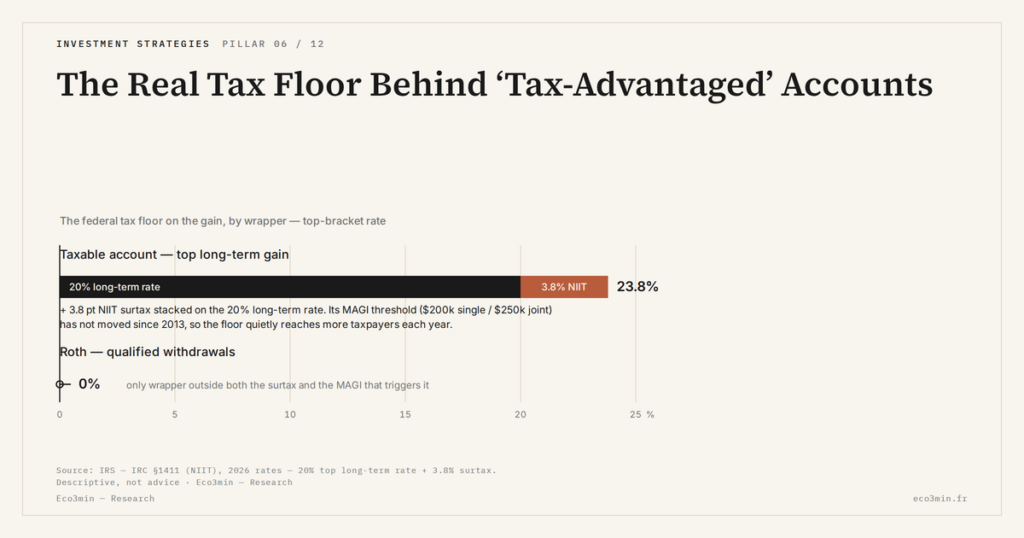
- On a taxable account, the 3.8% net investment income tax sits on top of capital-gains tax above a MAGI of $200,000 single or $250,000 joint, raising the top long-term rate to 23.8%.
- Those NIIT thresholds have not been indexed for inflation since 2013, so the surtax reaches more taxpayers each year regardless of real income.
- A Roth account is the only wrapper whose qualified withdrawals stay outside both the surtax and the MAGI that triggers it, but contributions are capped.
The phrase “tax-advantaged,” applied to a retirement or investment account, names something precise and limited: a deferral of tax, or an exemption confined to one tier. A traditional 401(k) or IRA defers income tax until withdrawal; a Roth exempts qualified withdrawals; a taxable brokerage offers neither but taxes long-term gains at preferential rates. None of these labels means “untaxed.” Beneath each sits a floor, the part of the bill the advantage does not remove, and on a taxable account that floor has been quietly rising as one of its components stays frozen in place. This piece describes that floor across wrappers, recommending none: it complements the reading of the wrapper sets the tax floor by examining its least visible layer.
1. The floor the “tax-advantaged” label hides
A traditional account’s advantage is deferral, not exemption. Contributions reduce taxable income today, growth compounds untaxed, and the bill arrives at withdrawal, when distributions are taxed as ordinary income. That last word is the floor. Ordinary-income rates run up to 37% at the top federal bracket, against a top long-term capital-gains rate of 20% in a taxable account. A retiree drawing on a traditional balance pays the ordinary rate on the full distribution, principal and growth alike, regardless of how long any underlying asset was held. The deferral is real; the eventual rate is the ordinary one, and it is frequently higher than the capital-gains rate the same dollars would have faced outside the wrapper. Steering the assets held inside such an account toward retirement, on autopilot or by hand, is compared in target-date funds against a self-directed allocation.
This is where the label misleads. “Tax-advantaged” reads as “tax-free,” when it means “tax-deferred at ordinary rates.” The advantage is the timing, the decades of untaxed compounding, not a lower rate at the end. Whether that trade favors the saver depends on the gap between today’s marginal rate and the rate at withdrawal, a comparison that belongs to a separate question. What matters here is that the floor exists and that it is set in ordinary-income terms, not capital-gains terms.
A Roth account is the exception that proves the rule. Qualified Roth withdrawals are tax-free, and they are excluded from modified adjusted gross income entirely, so they do not even count toward the thresholds that trigger other taxes. The Roth has no floor in the sense used here. But the trade-off is a contribution cap, $23,500 for a 401(k) in 2026 and far less for an IRA, with income limits on direct Roth IRA contributions. The only wrapper that removes the floor also limits how much can pass through it. For the broader comparison between sheltered and taxable accounts, see the choice between sheltered and taxable accounts.
2. The taxable-account floor: a surtax plus state tax
A taxable brokerage has no withdrawal penalty and no holding-period lock, but it carries its own floor, built from two pieces stacked on the capital-gains rate. The first is the net investment income tax, a 3.8% federal surtax on investment income, applied once modified adjusted gross income exceeds $200,000 for a single filer or $250,000 for a married couple filing jointly. The surtax is levied on the lesser of net investment income or the amount by which MAGI exceeds the threshold, and it sits on top of the regular capital-gains tax: it raises the top long-term rate from 20% to 23.8%, and the top ordinary rate on short-term gains from 37% to 40.8%. Inside an insurance wrapper a different stack applies, this one built from product charges, broken down in the layered costs of a variable annuity. For context: placing REITs inside tax-sheltered accounts.
The structural detail is that these thresholds have never been indexed for inflation. Set at $200,000 and $250,000 when the tax took effect in 2013, they remain unchanged, while ordinary-income brackets and the standard deduction rise with inflation each year. The consequence is mechanical: as nominal incomes climb, a growing share of taxpayers crosses a line that does not move. The surtax floor on a taxable account therefore reaches further every year, not because anyone’s real income rose, but because the threshold is frozen, the same mechanic by which thresholds frozen against inflation raise real tax burdens elsewhere in the code. A single large capital gain, by lifting MAGI for one year, can pull an otherwise unexposed investor over the line.
The second piece is state income tax. The surtax has no state-level equivalent in most states, but states tax investment income in their own right, layering a state rate on top of the federal capital-gains rate and the surtax. The combined floor on a high-income taxable account is therefore the long-term capital-gains rate, plus 3.8% above the MAGI threshold, plus the applicable state rate. The “preferential” capital-gains treatment is real, but it is a ceiling on one component, not the floor of the whole. Move that ceiling and the discounting moves with it, a chain followed in how tax changes feed through to asset valuations.
3. Where each wrapper’s floor sits
The three wrappers carry three different floors. A traditional 401(k) or IRA defers to the ordinary-income rate at withdrawal: its floor is whatever marginal bracket applies in the year distributions are taken. Reaching that balance before age 59½ adds the penalty for tapping a traditional account early on top of the floor. A taxable brokerage applies the long-term capital-gains rate, plus the 3.8% surtax above the threshold, plus state tax: its floor is the stacked total, lower than the ordinary rate for many investors but rising as the surtax threshold stays fixed. A Roth removes the floor on qualified withdrawals, at the cost of a contribution cap. That removal of the ordinary-income floor is the crux of Roth versus traditional tax treatment.
An order of magnitude fixes the idea. On $10,000 of long-term gains in a taxable account, a high earner above the surtax threshold pays the 20% capital-gains rate plus 3.8%, or $2,380 in federal tax, before any state tax. The same $10,000 withdrawn from a traditional account, taxed as ordinary income at a 32% bracket, costs $3,200 in federal tax. The same $10,000 of qualified Roth withdrawal costs nothing and does not raise MAGI. These figures name no account to favor: they show that the floor differs by wrapper, and that “tax-advantaged” can sit either above or below the taxable-account floor depending on the rates involved. How that floor changes once an account is inherited, under the schedule that now applies to beneficiaries, is examined in the step-up basis and the ten-year rule.
One subtlety connects the wrappers. Traditional distributions are themselves excluded from net investment income, so they do not pay the 3.8% surtax directly. But they increase MAGI, and a higher MAGI can push a saver’s other investment income, capital gains and dividends held in a taxable account, over the surtax threshold. A traditional withdrawal can therefore trigger surtax on income it does not itself bear, an interaction the labels never advertise.
Reading “tax-advantaged” as “tax-free” overlooks the floor each wrapper keeps. A traditional account defers to ordinary-income rates at withdrawal, often above the capital-gains rate; a taxable account stacks a 3.8% surtax and state tax on top of capital-gains tax above a frozen MAGI threshold. Only a Roth removes the floor on qualified withdrawals, and only within a contribution cap.
4. What the floor does not say
Knowing where a wrapper’s floor sits does not say which account to use. A Roth’s absence of floor is not, on its own, an argument: it is one parameter among the contribution cap, the gap between today’s marginal rate and the rate at withdrawal, the holding horizon and the need for liquidity. The floor lights up one tier of taxation; it does not rank the containers.
The frozen surtax threshold illustrates a more general mechanic: a wrapper’s tax parameters are not fixed by nature, and a detail that looks merely technical, a threshold that does not move, can reshape the comparison over time. What functioned as a high ceiling reached by few becomes, year by year, a floor met by more. This sits within the wider reading of investing across the rate cycle, where the tax environment shifts with legislation, like everything else.
One question remains, made visible without being settled: for a given account, at what rate does the floor stand once the advertised advantage has done its work? The answer, the ordinary rate for a traditional account, the stacked capital-gains total for a taxable one, zero for a qualified Roth, depends on the wrapper and on the year. It is because the answer depends on both that “tax-advantaged” deserves to be read for exactly what it says: the removal of one tier, not the disappearance of tax.
Last updated — 29 August 2026
Disclaimer – Financial Information: The analyses, commentary, and content published on eco3min.fr are provided for informational and educational purposes only. They do not constitute investment advice or a solicitation to buy or sell financial instruments. Past performance is not indicative of future results. All investment decisions involve risk and are the sole responsibility of the reader.
Read next
Full pillar →Beneficiary Designations, the Step-Up in Basis, and the 10-Year Rule: How US Accounts Transfer at Death
At death, most US financial accounts pass outside the will, straight to a named beneficiary, under tax rules…
The Fee Stack in Variable Annuities: M&E Charges, Riders, and Subaccount Costs
A variable annuity does not carry one fee, but a stack of them. Mortality and expense charges, subaccount…
The Conventional 401(k)-Match-First Funding Order: Where It Comes From, How It Works
The question of what order to fund accounts in usually draws a fixed list, presented as a rule…