Rule of 55, 72(t), and Hardship: The Narrow Doors Out of US Retirement Accounts

A 401(k) or IRA is not sealed until 59½: it has narrow exits, and each carries its own conditions. Some waive the 10% early-withdrawal penalty; a hardship withdrawal often does not.
The same phrase, early access, covers exits whose real cost ranges widely. Whether the penalty applies depends on which door is opened, not on the fact of withdrawing.
Before 59½, a 10% penalty is the default; the exceptions that waive it are narrow and each carries its own conditions.
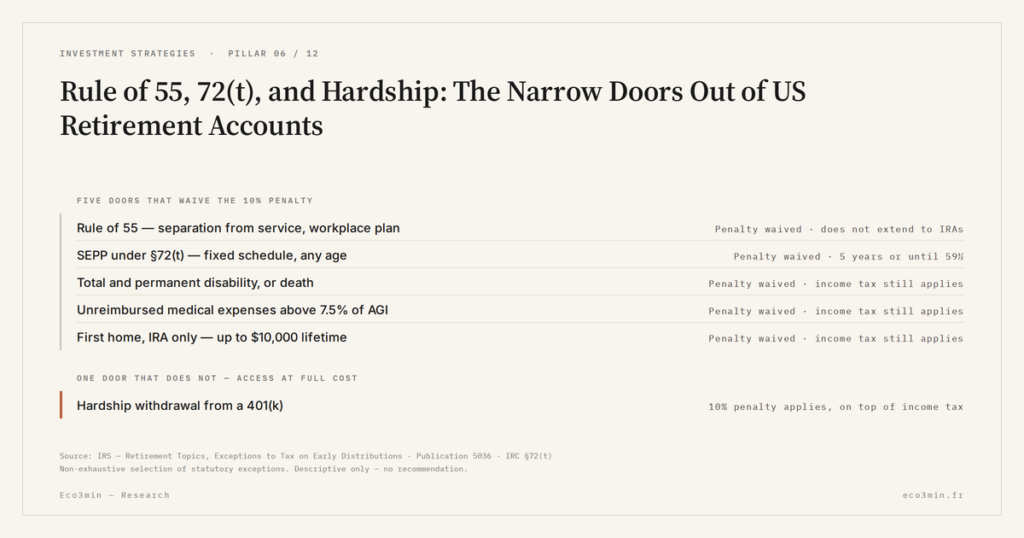
- The Rule of 55 lets separated employees tap a workplace 401(k) penalty-free from the year they turn 55; it does not apply to IRAs.
- SEPP under Section 72(t) waives the penalty at any age, but the schedule must hold for five years or until 59½, whichever is longer.
- Hardship withdrawals remain taxable and, unless a separate exception applies, still incur the 10% penalty; a first-home IRA withdrawal waives it on up to $10,000.
A pre-tax account is described as locked until 59½, a simple rule. It has exceptions, though, and it is in the detail of those exits that a deferred cost often goes unnoticed. Most people know a withdrawal before 59½ is penalized; fewer know that the exceptions which waive that penalty are narrow, conditional, and easy to confuse with one another. The underestimated risk lies exactly there: assuming an emergency, or a hardship, automatically means penalty-free access, when in most cases the 10% penalty still applies on top of ordinary income tax. This article maps each door and its conditions, not to encourage forcing a lock, but to make legible what the liquidity lock at the core of the account really covers.
Not sealed, but narrow: the 10% rule and its exceptions
The baseline is straightforward. A withdrawal from a traditional account before age 59½ is taxed as ordinary income and hit with an additional 10% early-withdrawal penalty. That penalty is the default, not the exception, and it stacks on top of the income tax the balance would owe anyway. The generic cost of crossing that line, income tax plus penalty, is priced separately in the generic cost of early withdrawal; the present article focuses on the specific exceptions that remove the penalty, and on the conditions each one attaches.
Those exceptions do not form a single homogeneous set. Some waive the penalty cleanly under defined conditions; others, like hardship, waive the immediate obstacle to access but leave the penalty in place. Sorting them matters, because the word “exception” hides a wide range of real costs. Knowing which door waives the penalty and which merely permits the withdrawal is the difference between recovering a net sum and recovering it minus a fifth, on top of the income tax. That distinction, invisible on the account statement, is where the real cost of early access is decided.
The penalty-free doors: Rule of 55 and SEPP 72(t)
Two exceptions waive the penalty without requiring an emergency. The Rule of 55 applies to a workplace 401(k): an employee who separates from service in or after the calendar year they turn 55 can take distributions from that plan free of the 10% penalty, though the withdrawals remain taxable as ordinary income. It does not extend to IRAs, and rolling a 401(k) into an IRA forfeits it. Substantially equal periodic payments under Section 72(t) offer a second route at any age: the account holder commits to a fixed schedule of withdrawals, computed by an approved method, and the penalty is waived as long as the schedule is respected.
The 72(t) door carries a strict condition that is easy to underestimate. The payment schedule must continue for at least five years or until age 59½, whichever is longer, and modifying or stopping it early triggers the penalty retroactively on all the payments already taken, plus interest. What looks like flexible early access is in fact a binding, multi-year commitment. The two doors therefore differ in spirit: the Rule of 55 is tied to a life event, separation from service, while 72(t) is a self-imposed schedule that trades flexibility for the waiver.
A further set of statutory exceptions waives the penalty for specific circumstances rather than for planned access. Total and permanent disability, death of the account owner, certain unreimbursed medical expenses above a threshold, and, for IRAs, qualified higher-education costs and health-insurance premiums while unemployed, each remove the penalty under defined conditions. More recent additions allow limited penalty-free withdrawals for a birth or adoption, capped per event, and for certain emergency personal expenses. These are protective doors, tied to hardship or life events the saver did not choose, closer in spirit to the accident-of-life exemptions than to a voluntary early withdrawal. In every case the income tax still applies; only the penalty is waived.
Believing a hardship withdrawal is penalty-free. A hardship withdrawal permits access under defined emergencies, but it remains taxable and, unless a separate exception applies, still incurs the 10% penalty. It removes the obstacle to withdrawing, not the tax cost of doing so.
Hardship and the first-home exception
Hardship withdrawals sit apart. A 401(k) may permit them for defined immediate and heavy financial needs, but they are not a penalty exception in themselves: the distribution is taxed as ordinary income and, in most cases, still bears the 10% penalty unless it independently qualifies under another rule. Hardship access solves a liquidity problem at a real tax cost, which is why it is the door most often misread as “free” when it is among the more expensive. The specific list of qualifying needs and the documentation required are set by the plan within the statutory framework.
The conditional nature of every door is worth stressing, because it undercuts the idea of a valve always within reach. Each exception requires a specific, documented trigger, a separation from service for the Rule of 55, a fixed schedule for 72(t), a qualifying emergency for hardship, and access is neither automatic nor instant. The withdrawal draws on the balance actually accumulated, not on a guaranteed amount, and the plan administrator applies the plan’s own rules on top of the statutory ones. These doors therefore do not turn a retirement account into a precautionary reserve; they cushion specific shocks under specific conditions, without offering the continuous availability of a liquid vehicle. Mistaking a conditional safety valve for freely mobilizable savings is the error the whole map is meant to prevent. For context: how much a retirement target implies.
The first-home exception is narrower and cleaner, but limited. An IRA, not a 401(k), allows a penalty-free withdrawal of up to $10,000 over a lifetime toward a first home, though the amount remains subject to ordinary income tax for a traditional IRA. The cap makes it a marginal help against the price of a home rather than a funding source, and its lifetime nature means it cannot be reused. Like the other doors, it waives the penalty under a precise condition and leaves the income tax untouched, so the sum recovered is still net of tax. A Roth IRA behaves differently on this point, since contributions can generally be withdrawn at any time without tax or penalty, though the earnings remain subject to the same rules, one more reason the pre-tax-versus-Roth choice reaches into the question of access. Worth reading alongside: how costs and index shape a 401(k) choice.
What the lock is really worth
Reading these doors together clarifies the nature of the lock. The 10% penalty is not an arbitrary obstacle: it is the counterpart of the deferral, the tax advantage being granted only because the balance is committed over a long horizon. The exceptions do not remove that logic; they qualify it. Some waive the penalty for life events or self-imposed schedules, one merely permits access at full cost, one helps marginally with a first home. The real cost of the lock therefore depends on the probability and nature of a saver’s liquidity needs, a variable specific to each situation.
The narrowness of these doors is itself information. A vehicle whose only penalty-free exits are life events, a rigid multi-year schedule, or a capped first-home draw is not designed to serve ordinary liquidity needs. That is a description of the account’s structure, not a prescription: it simply means the lock and the deferral are two sides of the same instrument, and that the account behaves as long-term capital rather than as an accessible reserve. Reading it as a rainy-day fund is the structural counterpart of reading the deduction as a permanent saving, the same misunderstanding seen from the exit rather than the entrance.
This reading connects to the comparison with liquid vehicles. What the lock is worth is measured how the lock weighs against a liquid alternative, whose permanent availability has value of its own. It also echoes the holding-period logic of other long-horizon vehicles, such as the holding-period clock and sequencing risk, where the time held conditions both access and tax. The lock is neither a trap nor a guarantee: it is a parameter whose cost reads against real needs, placed back in the cycle, as the frame on long-horizon vehicles and the macro cycle invites.
The lock on a pre-tax account therefore spans very unequal situations. Forcing a door at full cost, income tax plus a penalty that the exceptions do not always remove, is expensive; the doors tied to genuine exceptions cost less or nothing beyond the income tax. This article does not say whether to withdraw, a decision that depends on each situation, but makes visible what each door costs, so the choice is made in full knowledge rather than on the assumption that the balance is uniformly recoverable. The useful question is not whether access is possible, but at what tax cost, and the answer depends on the door and the timing. Knowing the map in advance is what separates a planned exit from a costly surprise. A related read: fees, execution and protection compared.
Last updated — 26 July 2026
Disclaimer – Financial Information: The analyses, commentary, and content published on eco3min.fr are provided for informational and educational purposes only. They do not constitute investment advice or a solicitation to buy or sell financial instruments. Past performance is not indicative of future results. All investment decisions involve risk and are the sole responsibility of the reader.
Read next
Full pillar →Beneficiary Designations, the Step-Up in Basis, and the 10-Year Rule: How US Accounts Transfer at Death
At death, most US financial accounts pass outside the will, straight to a named beneficiary, under tax rules…
The Fee Stack in Variable Annuities: M&E Charges, Riders, and Subaccount Costs
A variable annuity does not carry one fee, but a stack of them. Mortality and expense charges, subaccount…
The Conventional 401(k)-Match-First Funding Order: Where It Comes From, How It Works
The question of what order to fund accounts in usually draws a fixed list, presented as a rule…