End of Fixed-Rate Bank Loans: A New Risk for Real Estate
The end of fixed-rate bank loans is reshaping real estate cycles: how this structural shift modifies risk, prices and financing.

The end of fixed-rate bank loans is reshaping real estate cycles: how this structural shift modifies risk, prices and financing.
TL;DR
As banks shorten fixed-rate periods and add resets, rate risk shifts from lender to borrower, making residential real estate move more closely in step with monetary cycles.
- The 2022–2024 policy-rate rise of roughly 4–5 points lifted bank refinancing costs and capital charges, prompting shorter fixed periods and hybrid 5–10-year resets.
- On €250,000 over 20 years, a 2-point rate gap can swing the monthly payment by about €260–280, a variability that previously sat with the lender.
- Western European housing, long seen as less procyclical than variable-rate Anglo-Saxon markets, edges toward that more volatile, rate-synchronised model.
- Cumulative 2021–2025 inflation has already cut purchasing power by more than 15% in several European countries, raising the macro weight of newly variable mortgage charges.
End of fixed-rate bank loans: what is silently changing for real estate
What prices are still digesting imperfectly today is that a gradual shift towards more variable loans is turning real estate into a far more sensitive asset to rate shocks. In several European countries, including France, banks are shortening fixed-rate periods or transferring part of the rate risk back to the borrower. The shift looks technical, but it deeply reprograms how the residential market operates — and it helps to better understand the mechanisms by which real estate prices form.
Dominant search intent: understanding the precise economic mechanism of the end (or reduction) of fixed-rate bank loans and its structural effects on the real estate market, without entering into individual recommendations.
Starting point: why this topic is becoming central now
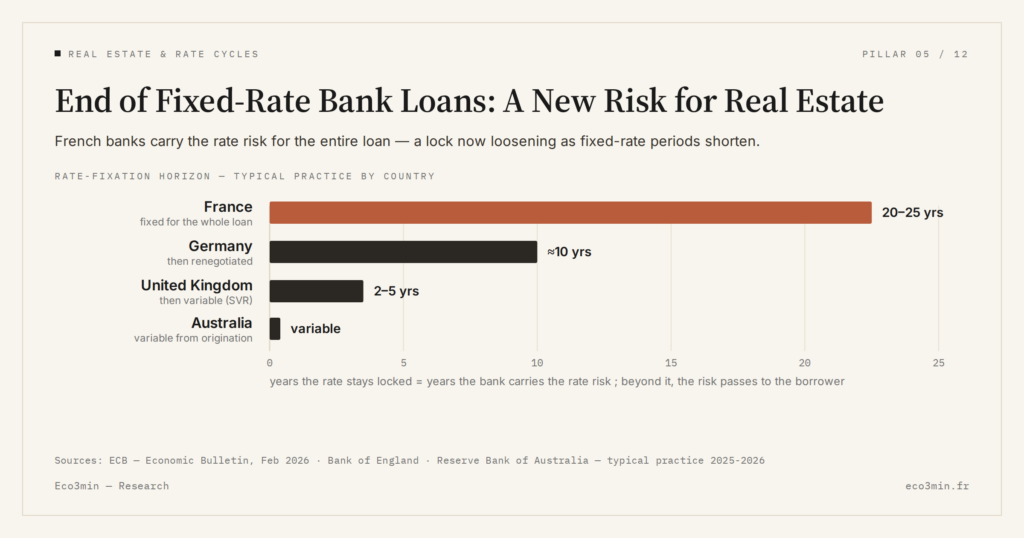
Since the abrupt rise in policy rates from 2022 to 2024 (cumulative increase of around 4 to 5 percentage points across the major advanced economies according to central banks), the classic long-term fixed-rate mortgage model has come under pressure. Banks, caught between higher refinancing costs, stricter prudential regulation and compressed margins, are reducing their exposure to rate risk over 20 to 25 years. Borrowers work the same rate risk from the other side, and French mortgage renegotiations measured against new lending follow the low points of the rate cycle.
In the credit production data published over 2024–2025, three recurring trends are already visible: shortening durations, higher rate premia for long fixed loans, and the rise of hybrid formulas (fixed for 5–10 years then reset). It is this regime shift that is now interesting real estate markets.
Mechanism: how the end of fixed-rate bank loans reprograms risk
Historically, in countries such as France, rate risk was largely borne by banks: they lent at fixed rates, sometimes over 20 to 25 years, while refinancing themselves on shorter maturities in the markets. Their business consisted of managing this maturity mismatch through the yield curve, derivatives and regulation.
When market rates surged after 2022, this model showed its limits:
- banks’ refinancing costs rose rapidly, while existing loans remained locked at low rates;
- regulatory capital requirements tightened for long fixed-rate exposures;
- unit margins on new loans narrowed as competition for real estate financing remained intense.
The logical response from the banking sector is to let more of the rate float so that the loan’s compensation tracks the cost of money. In practice, this goes through:
- greater indexation to market references (Euribor, swap indices);
- shorter fixed periods (5–10 years) followed by a reset;
- partial cap mechanisms (rate tunnels, caps) rather than a full 20-year lock.
The economic outcome of this shift is simple: rate risk moves from the bank to the borrower. It is this risk transfer that turns the end of fixed-rate bank loans into a structural shock for real estate.
In a regime dominated by long fixed rates, a policy rate hike mainly impacts:
- new buyers (higher cost of credit, reduced borrowing capacity);
- new credit production;
- and, more slowly, transaction prices via the contraction of marginal demand.
Households already financed at fixed rates remain largely protected as long as they do not refinance. Real estate then behaves as an asset with relatively stable nominal cash flows, which gives it some apparent resilience to monetary shocks.
In a regime where fixed-rate bank loans recede in favour of more variable formulas, the dynamic changes:
- a rise or fall in policy rates passes through much more rapidly to the monthly payments on part of the loan stock;
- macro sensitivity of household consumption to the cost of mortgage debt rises;
- real estate price cycles become more synchronised with rate cycles and inflation expectations.
Mainstream analyses up to now have considered Western European residential real estate as less procyclical than in countries with high prevalence of variable rates (such as some Anglo-Saxon economies). The current shift towards fewer fixed-rate bank loans gradually brings this regime closer to the more flexible — and thus more volatile — model.
This shift takes its full meaning when placed in the broader functioning of the real estate market, where prices do not react directly to rates, but to the dynamics of financing. The deep-dive analysis on the mortgage credit cycle as the real driver of prices shows why rate shocks transmit first through credit supply, before showing up — often with a lag — in valuations. Related discussion: the leverage mechanics behind REITs.
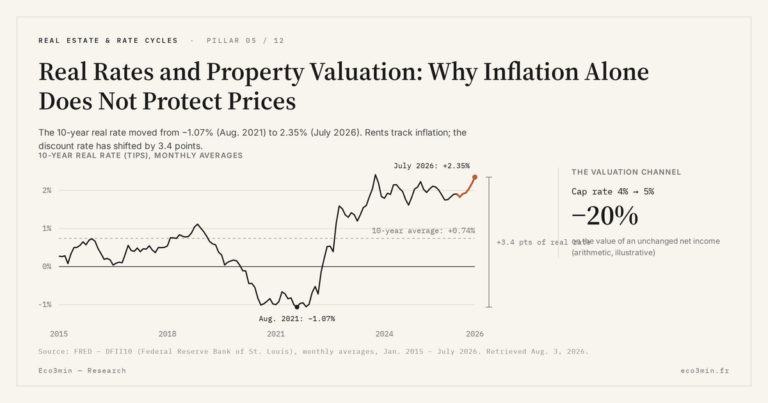
To place this move within a broader framework of monetary policy and cycle, the general framework on real policy rates helps understand how the real cost of money drives long-term assets such as housing.
Micro impact: monthly payments, prices and market structure
1. Higher volatility of housing costs
When rates are largely fixed, housing expenditure for owner-occupier households remains relatively predictable: most of the monthly payment (excluding service charges and tax) is insensitive to market fluctuations. With the gradual end of fixed-rate bank loans, a growing share of homeowners sees their charge potentially vary over the loan horizon.
Simplified illustration: for €250,000 of remaining principal over 20 years, a 2 percentage point rate gap can represent a ≈€260–280 swing in the monthly payment, depending on the schedule. In a context where cumulative inflation 2021–2025 has already eroded household purchasing power (more than 15% in several European countries according to consumer price statistics), this new elasticity of the credit charge becomes macroeconomically relevant.
2. A revision of the “floor value” of properties
Real estate market consensus often rests on the idea of a “long-term value” anchored in land scarcity, demographics and construction costs. But this reasoning implicitly assumes relatively stable financing. When rates are no longer locked over 20 years but become partly variable, a property’s floor value is no longer determined solely by its physical fundamentals, but also by the average household’s capacity to absorb rate moves over time. On this point: our breakdown of the real estate credit cycle and its price dynamics.
This suggests that equilibrium prices may become more sensitive to future rate scenarios than they were in a world dominated by fixed rates. Some current estimates still favour the opposite assumption (that real estate would remain weakly correlated with future rate moves), but this reasoning often relies on a financing regime that is precisely now changing.
3. Borrower selection and market segmentation
Faced with more variable loans, banks refine their dossier selection: income stability, residual living expenses, debt-to-income ratios become even more central. Buyers most sensitive to monthly payment variations (unstable income, low savings) see their access to credit become more complex.
Conversely, certain profiles may accept more variable formulas in exchange for a lower initial cost. The market is thus moving towards a more segmented structure where the type of rate (residual fixed, mixed, capped variable…) becomes a differentiator between buyer categories, and potentially between property types (tight urban vs periphery, new vs existing).
What many readers are really trying to understand behind this shift
The implicit question is not only whether the end of fixed-rate bank loans will push real estate prices up or down. What many really want to clarify is whether this new regime makes real estate riskier to hold over long periods and whether cycles will become more violent or more frequent.
Behind this question sits a simple concern: housing costs becoming less predictable, just as inflation, local taxes and energy costs have already risen over 2021–2025. Understanding how rates transmit to prices and to monthly payments thus becomes a risk-management issue rather than a “perfect timing” issue.
Weak signals to monitor in this new regime
A key indicator is the share of new loans granted at fully fixed rates over more than 15 or 20 years, relative to hybrid or variable formulas. If this share declines steadily across several quarters, it confirms the structural regime shift.
Tracking this indicator allows assessment of how quickly the entire mortgage stock’s sensitivity to monetary policy decisions will rise in the coming years.
2. Debt-service to disposable income ratio
Another KPI to monitor is the average ratio of mortgage debt service to household disposable income (often calculated in housing credit statistics). If variable or hybrid rates become widespread, this ratio mechanically becomes more volatile over time.
A rapid rise in this ratio in case of a rate increase would be an early warning signal for overall economic activity, as non-housing consumption could be compressed more sharply. Macro bulletins, such as the regular monitoring of the macroeconomic climate, help to articulate this signal with the broader cycle.
3. Valuation gaps between “cash” segments and highly financed segments
Finally, a finer signal is to observe the price dynamic gap between segments highly dependent on credit (peri-urban areas, young heavily indebted households) and segments where transactions occur with more equity or own liquidity (highly sought-after city centres, high-end segments). If the end of fixed-rate bank loans strengthens market sensitivity to the cost of money, these gaps could widen.
Counter-reading: what could limit the magnitude of the shock
Part of the consensus expects this change to remain manageable. The argument rests on several assumptions:
- banks would retain a long fixed-rate offer for the strongest profiles, maintaining a “hard core” of loans relatively insensitive to rates;
- regulators would impose strict safeguards on variable loans (variation caps, stress tests);
- central banks, facing more sensitive markets, would remain cautious in managing policy rates.
This scenario assumes the transition stays gradual, prudential discipline is sufficient and future rate shocks are more moderate than those of 2022–2024. If this combination holds, the structural shock would be cushioned and real estate would retain part of its apparent stability.
Conversely, a new phase of rising real rates, or sustained high nominal rates while inflation falls back towards 2%, would increase pressure on variable and hybrid loans.
Frequent misreadings around the end of fixed rates
- Confusing the disappearance of fixed rates with the end of mortgage credit. The retreat of fixed-rate bank loans does not mean the disappearance of financing, but a reallocation of rate risk. The central question becomes the distribution of this risk between banks, households and possibly insurers, not access to credit itself.
- Extrapolating past price dynamics without integrating the new rate regime. Mechanically using 2000–2020 price increases to project the future ignores that those years were marked by a long decline in nominal rates. In a world of more volatile and less fixed rates, cycles can change in amplitude and frequency.
- Reading the apparent cost of credit in isolation without looking at reset risk. Focusing only on the initial rate level masks the potential for future variation. The real economic parameter becomes the combination of the starting rate, a plausible reset scenario and the budget’s capacity to absorb that variability.
Macro reference points and broader reading frame
To understand this shift, it is useful to link it to the broader forces at work:
- Higher cost of capital: real policy rates having returned to positive territory over 2023–2025 in most advanced economies structurally raise long-term financing costs.
- More uncertain inflation: after a peak around 7–10% in several zones in 2022, the return towards the 2% target remains partial and uncertain, making 20-year rate fixing riskier for banks.
- Prudential regulation: capital requirements for long exposures push banks to shorten the duration of their rate risk.
In this context, real estate is no longer just a story of square metres, but of financial cycle. For a broader view of the interactions between real estate, credit and the business cycle, the category page on real estate, cycles and interest rates offers a systemic frame to place this signal within the wider market.
Outlook: what kind of real estate market this regime can lead to
Scenario 1: managed transition, contained volatility
In a first scenario, the share of fixed-rate bank loans declines but remains significant. Banks continue to offer long fixed rates for certain profiles, variable rates remain framed and central banks gradually stabilise policy rates. Real estate becomes more sensitive to monetary policy but without abrupt regime change: price cycles synchronise more with rates, without major excess.
Scenario 2: rate shock and accelerated price adjustment
In a second scenario, a new inflationary episode or a public debt shock forces an additional rise in real rates. Hybrid and variable loans see their monthly payments rise faster than expected. The most constrained households must arbitrate: lower consumption, difficult renegotiations, even forced sales. Real estate then behaves more like a leveraged financial asset, where prices react sharply to rate moves.
Scenario 3: partial reintermediation of risk via insurers and hybrid products
A third scenario envisages the rise of products where rate risk is shared between banks, insurers and borrowers via caps, tunnels, payment insurance or savings-linked products. The overall financing cost may remain higher than in the pre-2022 long fixed-rate world, but volatility experienced by households is smoothed. The risk is then more diffuse, harder to read, but potentially less concentrated.
What this implies for various actors
For institutional investors, the end of fixed-rate bank loans strengthens the link between real estate and monetary policy. Residential real estate becomes an asset whose risk profile depends more on the structure of underlying loans than on demographic dynamics alone.
For sector firms (developers, builders, intermediaries), heightened household sensitivity to monthly payment variations can make demand more cyclical and harder to anticipate. Project pipeline and inventory management become more strategic.
For individuals, the main issue is not “predicting” prices, but understanding that the past stability of credit charges is no longer guaranteed in the same way. Real estate financing turns into an engagement more conditional on the macro context, central bank decisions and the inflation trajectory — all dimensions tracked in benchmark macro and financial market analyses.
This is not necessarily today’s central scenario of extreme crisis, but the gradual end of fixed-rate bank loans adds a layer of risk less visible than others — and therefore easier to underestimate. Real estate cycles in the next decade could be less slow, more correlated with rates, and more demanding in terms of financing risk management.
Frequently asked questions about the end of fixed-rate bank loans
Does the reduction of fixed-rate bank loans imply a systematic fall in real estate prices?
Not necessarily. Prices also depend on demographics, housing supply, incomes and taxation. Reduced availability of fixed rates above all strengthens price sensitivity to future rate scenarios, which can amplify moves both up and down.
Does a market dominated by variable rates lead to more credit defaults?
Historically, periods of rapid rate rises have increased pressure on variable-rate borrowers. But the actual default level also depends on safety nets (insurance, renegotiations, public policies) and on labour market strength. The risk is therefore conditional, not mechanical.
Could banks return massively to long fixed rates if rates fall again?
They could do so if the yield curve becomes favourable again and visibility on inflation improves. But regulatory constraints and the lessons of the recent cycle make a full return to the pre-2022 model unlikely. The coming regime could remain more hybrid.
Does this regime change concern mainly homeownership or also rental investment?
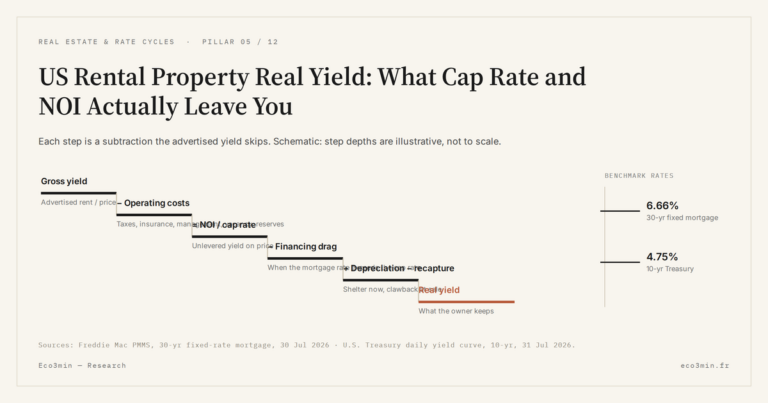
Both are concerned, since the mechanism applies to financing structure. For rental investment, the potential variability of monthly payments alters the relationship between expected rents, charges and rate risk over time.
How can this phenomenon be tracked concretely?
Series on the share of fixed vs variable loans, statistics on average loan duration and debt-service to income ratios are key benchmarks. Their evolution over several quarters allows verification of whether the transition is gradual or faster. For more detail: The case for duration or convexity.
- 3 takeaways
- The end of fixed-rate bank loans shifts rate risk from banks to households, making real estate more sensitive to monetary policy decisions.
- In this new regime, real estate price cycles could become more synchronised with the evolution of real rates and inflation.
- The market is still imperfectly digesting the fact that the past stability of monthly payments is no longer guaranteed in the same way, which changes the nature of real estate risk.
Last updated — 10 September 2026
Disclaimer – Financial Information: The analyses, commentary, and content published on eco3min.fr are provided for informational and educational purposes only. They do not constitute investment advice or a solicitation to buy or sell financial instruments. Past performance is not indicative of future results. All investment decisions involve risk and are the sole responsibility of the reader.
Read next
Full pillar →US Rental Property Real Yield: What Cap Rate and NOI Actually Leave You
A rental listing leads with a yield. Divide the annual rent by the price and the number looks…
Cap Rate Spread: What Rental Yield Pays Over the 10-Year Treasury
A 5% cap rate sounds attractive. But 5% against what? A risk-free 10-year Treasury yields near 4.5% in…
Vacancy and Turnover: The Cost That Erodes a Landlord’s Real Return
A listing shows full rent, twelve months a year. The owner knows the gaps between tenants, the make-ready…