Financial AI: The New Regime the Market Underestimates
Financial AI: a new regime that the market has yet to fully integrate into margins, model risk and 3–12 month allocations.

Financial AI: a new regime that the market has yet to fully integrate into margins, model risk and allocations.
Most investors view AI through the prism of big tech. The real shift, however, is happening in finance: automated credit scoring, augmented portfolio management, real-time compliance. Financial AI is no longer a concept — it is a line of costs, risks and revenues, with effects already visible on valuations. To structure investment choices, it pays to look beyond the marketing narrative and cross-reference productivity, operational risk and the regulatory framework. Tools designed for financial decision-support are a logical extension of this lens.
This transformation is part of a broader reshaping of financial infrastructure, instruments and business models. Financial AI is one of its most visible vectors, within a wider set analysed in our pillar page on financial innovation, which places these technological shifts within a long-term economic and structural reading.
TL;DR
The real AI shift is happening inside finance — automated scoring, augmented portfolio management, real-time compliance — already visible in margins and valuations. The empirical extension sits in the Eco3min framework on artificial intelligence and systemic financial risk.
- Financial AI is no longer a concept but a line of costs, risks and revenues, weighing on banks' cost structure and margins.
- The model risk tied to its diffusion remains widely under-priced by the market.
- As a theme it behaves differently from a generic 'tech' exposure, with its own productivity, operational-risk and regulatory drivers.
What the market is actually watching: since the summer of 2025, part of the flow has concentrated on a few large AI names, leaving aside financial actors deploying AI in credit, payments and compliance. This gap creates atypical valuation spreads between ‘shovel sellers’ (AI infrastructure) and ‘end users’ (banks, fintechs, insurers). Read alongside: When Market Speed Becomes a Source of Fragility.
This article addresses artificial intelligence applied to traditional finance (banks, fintechs, regulated markets). It does not cover crypto-assets, digital tokens or mechanisms specific to blockchain ecosystems, which are analysed separately on Eco3min.
Key trends to watch
- Cost compression: some major banks report ≈5–8% reductions in operating costs over 2024–2025 from AI, mostly in back-office → mechanical support to margins if rates remain elevated.
- Data growth: data volumes processed for fraud detection have multiplied by ≈3 since 2022 across several major payment networks → improved risk control but heightened regulatory complexity.
- Tokenisation & AI: combining AI with asset tokenisation is starting to alter the micro-structure of private markets, with platforms offering near-continuous pricing → more liquidity, but also more pro-cyclicality.
- Model risk: incidents of ‘algorithmic mispricing’ reported to supervisors have reportedly more than doubled between 2023 and 2025 → potential cost in fines and reputation.
- Regulatory pressure: several sectoral AI frameworks anticipate, for 2026, regular audit requirements for critical models → higher fixed costs for smaller fintechs.
What this signals at depth
Part of the consensus views financial AI as a linear productivity lever, gradually translating into a few additional points of margin on bank balance sheets and listed fintechs. This scenario assumes cost gains exceed operational risks, with regulation remaining ‘reasonable’.
The observed dynamic is more uneven. At the macro level, in an environment of soft growth (eurozone real GDP around 1–1.5% in 2025) and rates still above 3% in major economies, AI allows the most advanced players to maintain ROE without credit-volume growth. Concretely: KYC automation, real-time scoring, prioritisation of high-margin files. Laggards face the same capital-cost pressure but without these efficiency gains. A companion piece: Our read of currency markets and the monetary cycle.
At the micro level, instant-payment fintechs and online brokers that have heavily integrated AI in order processing, fraud detection and customer service are already showing effects on the cost-to-income ratio, sometimes improved by 3 to 5 points between 2022 and 2025. Notably: these gains are not always reflected in valuation multiples, compressed by the perception of ‘old fintech, no hype’. Conversely, some asset-tokenisation players trading at twice the revenue multiple have yet to demonstrate their ability to monetise AI beyond the narrative.
Finally, financial AI is changing the way risks propagate. When allocation and risk-management models converge (same datasets, same APIs, same AI scoring services), portfolios become more correlated, particularly across thematic ETFs. The recent surge in flows into equity ETFs makes this model homogeneity more sensitive during stress phases.
Concrete impacts: what changes now
For investors, treating financial AI as a mere ‘tech sub-theme’ underestimates a concentration risk and a potential margin differential between winners and laggards. The same ground is walked from another angle in the article on Why AI Drives Concentration Among Financial Players.
- Allocation framework: a measured approach observed in some institutional portfolios involves sizing broad AI exposure within an equity sleeve, with roughly half on large tech names and half on AI users (advanced banks, payment fintechs, market infrastructure). The 60/30/10 logic described for a robust asset allocation remains valid, but the equity block warrants this dedicated brick.
- Risk management: limiting position size on unprofitable AI pure-plays — historically observed at 1–2% of portfolios — has been associated with better resilience, particularly when market volatility returns abruptly.
- Non-financial corporates: for SMEs and mid-cap companies, integrating financial AI through treasury management, cash-flow forecasting and rate-risk management has historically delivered more measurable returns in the short term than launching broad ‘transversal AI’ projects. The return on investment shows up directly in debt cost and working-capital control.
- Individuals: using AI tools for allocation or simulation (calculation of compound interest, savings projections, scenario probabilities) helps structure more rational decisions, provided the parameters remain user-controlled.
Micro-trends that matter
- ‘False alert’ rate in compliance: several institutions report that in 2025, fewer than 10% of AI-generated AML alerts are actually relevant, versus ≈3–5% in 2022. The KPI to track: the ratio of useful alerts to total alerts, which drives the human cost of control.
- Weight of AI cloud spend: for some neobanks, costs related to AI APIs and cloud already exceed 12–15% of 2025 operating expenses. Beyond 20%, the model becomes fragile if growth slows.
- Algorithmic incident curve: the number of incidents reported to regulators (pricing errors, order-routing errors, credit bias) has been trending higher since 2023. If this curve accelerates further in 2026, regulation could tighten abruptly. This kind of inflection is never immediate, as detailed in our analysis of the inverted yield curve and its lagged effects on credit.
- Funding spreads, fintechs vs banks: the 3-year funding-cost gap between major banks and unprofitable fintechs has widened by ≈150–200 basis points since 2022. This spread acts as an indirect barometer of confidence in their AI usage.
Probable medium-term scenarios
Mainstream projections rest on a soft scenario: generalisation of financial AI, a few regulatory adjustments, productivity gains absorbed into valuations. Three trajectories deserve to be distinguished.
- Scenario 1 — Controlled diffusion (high probability): large players structure their models, regularly audit their algorithms, and fines remain occasional. Bank margins stabilise despite mildly lower rates by 2026. For investors, this scenario points toward staying exposed but diversified.
- Scenario 2 — Regulatory shock (intermediate probability): a series of visible incidents (biased credit scandal, large market error) triggers rapid regulatory tightening, with mandatory external validation of critical models. This weighs on smaller fintechs and reinforces already well-capitalised players.
- Scenario 3 — Technological saturation (lower probability): marginal AI productivity gains diminish from 2027, while maintenance and security costs rise sharply. Valuation multiples contract abruptly on names most exposed to the ‘AI promise’.
What could invalidate these trajectories: a much more restrictive monetary policy than expected, forcing banks to scale back technology investment, or conversely a very-low-rate cycle compressing margins and pushing for even more aggressive AI-driven productivity gains.
Conclusion
Financial AI cannot be reduced to a few star names, nor to a back-office gadget. It is reshaping how risk is measured, how flows move, and who actually captures margin in the financial chain. It may not be the central scenario in today’s market models, but the theme deserves to be isolated in allocations and tracked through a few simple KPIs: cloud costs, model incidents, useful-alert ratio. The market is not yet fully pricing this granularity. We will revisit shortly with a possibly different market backdrop.
Three takeaways
- Financial AI creates a durable productivity gap between advanced and laggard institutions, in a still-elevated rate context.
- AI model risk is rising, but remains poorly integrated in valuations, especially on the fintech side.
- Treating financial AI as a dedicated allocation block (5–10% of equities has been documented in some institutional setups) is becoming a pragmatic approach for diversified portfolios.
Last updated — 4 August 2026
Disclaimer – Financial Information: The analyses, commentary, and content published on eco3min.fr are provided for informational and educational purposes only. They do not constitute investment advice or a solicitation to buy or sell financial instruments. Past performance is not indicative of future results. All investment decisions involve risk and are the sole responsibility of the reader.
Read next
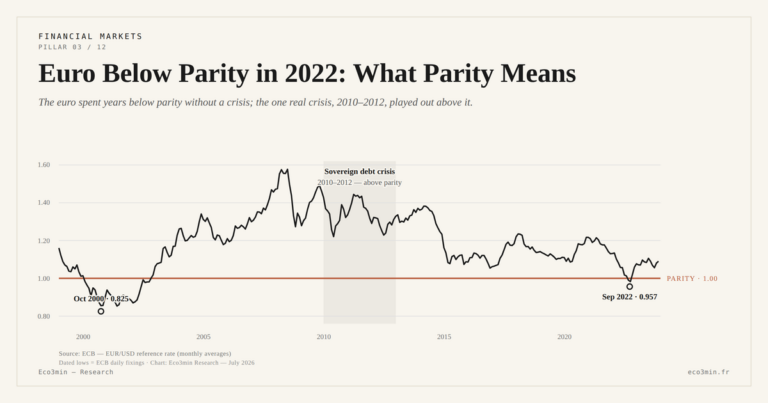
Full pillar →Euro Below Parity in 2022: What Parity Means
In September 2022, the euro fell below parity with the dollar, to around 0.95, a low not seen…
Eurozone Fragmentation: Sovereign Spreads and the Euro
The euro is issued by a monetary union without a complete fiscal union: nineteen sovereign debts coexist under…
The Euro’s Energy Import Bill: the Gas Shock and the Currency
In 2022, the surge in gas prices turned the euro area's historic current-account surplus into a deficit and…