
Inverted Yield Curve: Why a Slow Signal Still Works
The inverted yield curve does not promise a dated event. It describes a regime imbalance whose slowness is integral to its meaning, not evidence that it has failed.

The inverted yield curve belongs to that family of indicators whose reputation often exceeds genuine understanding. It is frequently invoked as an “imminent” recession signal, then dismissed when, for months or even quarters, nothing visible happens. This apparent contradiction feeds a simple but misleading idea: if the signal does not materialize quickly, it must no longer work. This reading rests on a fundamental confusion between regime indicator and cyclical trigger.
TL;DR
Slowness is the inverted curve's whole point: it registers a deteriorating intertemporal equilibrium, and the long quiet interval before visible effects is itself the message it carries.
- Inversion causes nothing by itself; it reveals an existing tension between financing, investment and future growth that spreads slowly through credit conditions and precautionary behaviour.
- The long intermediate phases, where activity stays stable while fragilities accumulate, are the signal at work; reading the lag as failure confuses a regime indicator with a cyclical trigger.
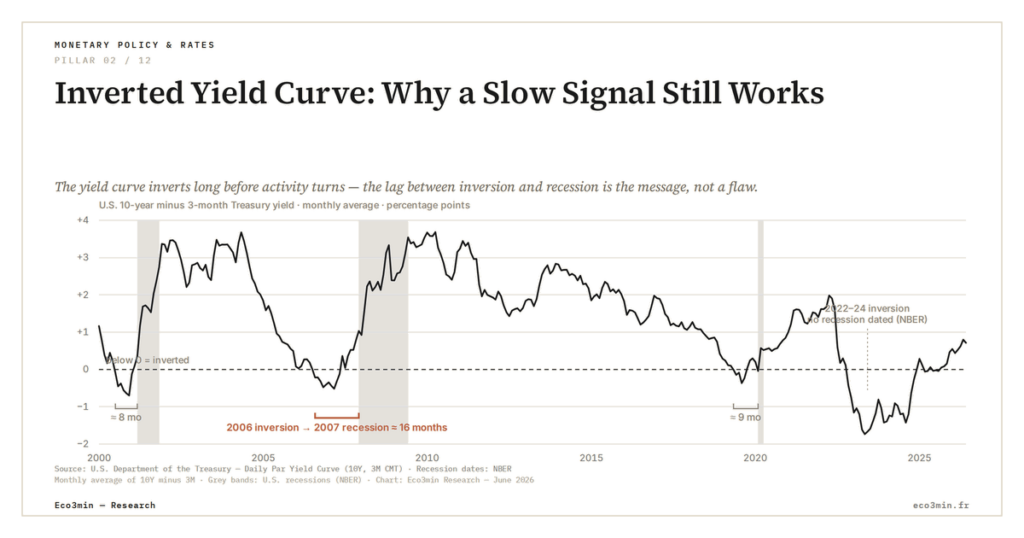
The problem lies less in the validity of the signal than in the horizon over which it is interpreted. The yield curve was never designed to announce a precise shock at a known date. It informs on a progressive imbalance between economic, financial, and monetary timelines. It is precisely this lag, often perceived as an “absence of effect”, that constitutes the core of the message conveyed by inversion.
The Yield Curve as a Regime Indicator, Not an Immediate Alarm
In its simplest form, the yield curve compares short-term compensation to long-term compensation. A so-called normal curve reflects a preference for immediate liquidity and growing uncertainty as the horizon extends. Conversely, an inverted curve signals that the market demands more yield in the short term than in the long term, which constitutes an anomaly from an economic standpoint. our reading of bond maturity segments traces this mechanism across cycles.
This anomaly is not a discrete event. It reflects a regime configuration in which long-term expectations become more pessimistic than short-term constraints. This expectation dynamic is analyzed from the market side in the sub-pillar on market expectation cycles. In other words, the system accepts immediate tension, often through more restrictive financial conditions, because it incorporates a future normalization or slowdown. This reading is structural: it belongs to long cycles, rarely synchronized with media calendars.
The yield curve’s strength lies precisely in its slowness. It does not capture the exact moment when an economy tips over, but the moment when its intertemporal equilibrium deteriorates. Between these two instants, a temporal window opens, sometimes a long one, during which activity indicators can remain stable, even reassuring, without invalidating the underlying signal.
Why the Time Lag Is Constitutive of the Signal
Curve inversion causes nothing by itself. It reveals a tension already present between financing, investment (a signal-formation mechanism whose construction belongs to our sub-pillar on market expectation dynamics) and future growth. This tension takes time to spread to the real economy because it transits through intermediate channels: credit conditions, investment arbitrages, and precautionary behavior by economic agents.
These mechanisms are inertial. Firms do not instantly adjust their projects, households do not abruptly modify their behavior, and financial balance sheets often absorb the first shocks. The economy can therefore continue to operate within an apparently stable regime, while accumulating fragilities that remain invisible in the short term.
Interpreting this lag as an invalidation of the signal amounts to confusing speed of appearance with analytical relevance. A slow indicator is not a weak indicator. It is simply ill-suited to event-driven reading. The yield curve belongs to the family of signals that inform on the direction of the regime, not on the precise moment of its transition. Dating bank failures runs into exactly that gap between direction and moment, which is what the annual count of US bank failures since 1934 has to reckon with.
This lag between macro-financial signal and price dynamics can only be understood by placing the yield curve within a broader reading of the arbitrage, liquidity, and transmission mechanisms that structure how financial markets operate, beyond indicators taken in isolation.
- The inverted yield curve is a regime indicator, not a timing signal.
- The lag between inversion and visible effects is integral to the message.
- The intermediate phases, often long, are when imbalances accumulate.
The Most Frequent Reading Errors
The first error consists in expecting a dated prediction from the yield curve. This expectation mechanically leads to disappointment, then to questioning the tool itself. Yet no macro-financial regime indicator functions as a countdown. Economic temporality is non-linear, punctuated by phases of latency and acceleration.
The second error is to reason in terms of direct causality. Inversion does not “cause” a slowdown: it signals that the conditions necessary for sustainable growth are deteriorating. For the full framing, see how the copper-gold ratio behaves across rate cycles. This distinction is essential, because it explains why the economy can continue to grow for a time despite an already deteriorated signal.
Finally, a frequent simplification consists in starkly opposing periods “with effect” and periods “without effect.” In reality, the effect is often diffuse, progressive, and unevenly distributed. Some segments of the economy can adjust earlier than others, without this appearing immediately in aggregate measures.
Interpreting the absence of immediate slowdown as an invalidation of the yield curve amounts to confusing regime indicator with cyclical trigger.
Why the Simplified Reading Becomes Insufficient
Reducing the yield curve to a binary signal (valid or invalid) prevents understanding of what it really says about the structure of the cycle. This type of reading is inherited from an approach too focused on visible turning points, at the expense of the intermediate phases where imbalances build.
A more structural analysis consists in integrating the yield curve into a set of regime indicators whose role is not to predict an isolated event but to qualify an environment. This point ties back to our sub-pillar on central banks and rate-cycle transmission. From this perspective, the absence of immediate materialization is not an anomaly but information in itself: it indicates that the system still operates under constraint, without having absorbed the tensions revealed.
This logic connects with a broader idea developed in the analysis of market phases without an obviously exploitable signal: some periods are characterized not by sharp breaks but by a silent accumulation of imbalances, difficult to read through isolated indicators.
In economies marked by strong financial inertia, regime signals appear well before visible ruptures. Understanding this temporality helps avoid premature readings and hasty conclusions about the state of the cycle.
Going Further into the Recession Signal Analysis
Understanding the yield curve as a slow regime indicator naturally leads to a deeper exploration of its articulation with business cycles. This articulation is treated in our framework on macro-monetary cycles. A detailed analysis of this relationship, its mechanisms, and its limits allows the sterile opposition between “reliable signal” and “outdated signal” to be moved past.
This approach is developed in greater depth in an analysis dedicated to the relationship between yield curve and recession, which examines why the signal retains its relevance precisely when it appears to trigger nothing in the short term.
Conclusion
The inverted yield curve does not promise an event; it describes an imbalance. Its message is measured not by the speed of its realization, but by the coherence of what it reveals about the cycle’s trajectory. What is often interpreted as a weakness (the absence of immediate effect) actually holds the key to its correct reading.
During phases when “nothing happens,” inversion nevertheless continues to work beneath the surface, signaling a constrained regime, still functional but increasingly fragile. Understanding this lag means accepting that the most useful signals are sometimes those that speak the most slowly.
Last updated — 3 September 2026
Disclaimer – Financial and Legal Information: The analyses, commentary, and content published on eco3min.fr are provided for informational and educational purposes only. They do not constitute investment advice or a solicitation to buy or sell financial instruments. Past performance is not indicative of future results. All investment decisions involve risk and are the sole responsibility of the reader. Data, charts and calculated series are provided as is and may contain errors or lag behind their source: check any figure against the primary source cited before relying on it. Content describing laws, regulations or contracts reflects the law as of its publication date and does not constitute legal or tax advice; applying it to a specific situation requires a qualified legal or tax professional.
Read next
Full pillar →The Yield Curve: What the Level Says That the Slope Doesn’t
A flat curve can sit at 1.5% or at 4.2%: the slope is the same, but the cost…
Real Interest Rates: The Quiet Signal Reshaping Markets
Real interest rates: why their persistence in positive territory in 2026 is reshaping the rules for bonds, equities,…
OAT-Bund Spread: A Quiet Gauge of French Sovereign Risk
OAT-Bund spread: how this yield gap has become a key signal on French sovereign risk, fiscal policy and…