Gold Pays No Coupon: Why the Real Rate Is Its Cost to Hold

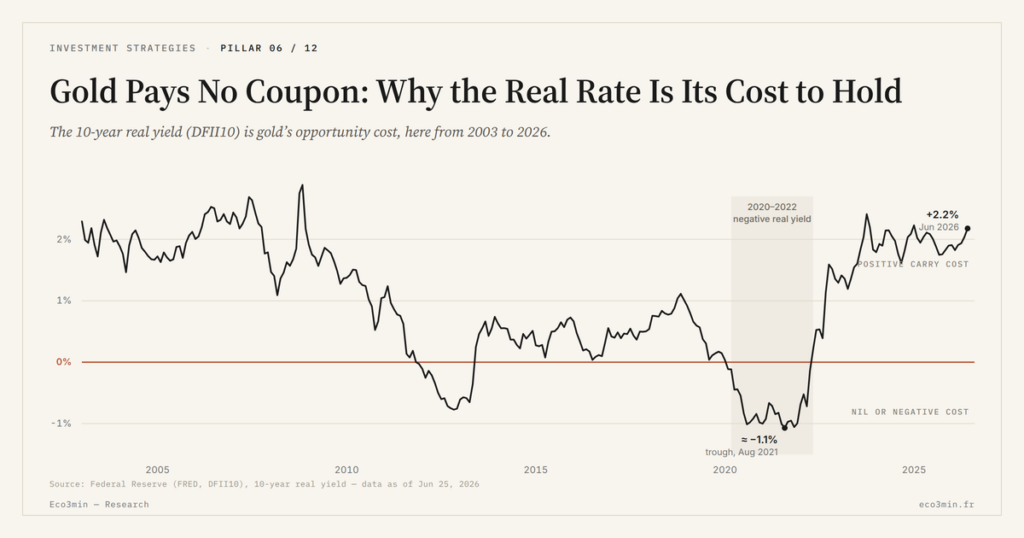
An asset that pays no income is not free to own. Holding gold means forgoing the real return an inflation-linked bond would pay: that shortfall, the real rate, is its true cost to hold.
TL;DR
Holding gold means giving up the real return an inflation-linked bond pays, a cost invisible on any statement yet measured precisely by the ten-year real yield.
- Gold's opportunity cost is the real return forgone versus an inflation-linked bond, gauged by the Federal Reserve's ten-year real yield series (DFII10).
- When real yields turned negative in 2020-2022 the safe benchmark itself lost purchasing power, holding gold cost nothing to carry and investment demand surged; the 2022 tightening reversed it.
- It is the real return, not the nominal rate or inflation alone, that sets this cost, and conflating them drives the most common misreadings of the metal.
This piece isolates the cluster’s foundation: not how the gold price forms, but what it costs to keep gold, and why that cost shifts with the regime.
An asset that pays nothing is not free to own. Holding gold ties up capital that could have earned a real return elsewhere — on an inflation-linked bond, for instance. That forgone real return is gold’s opportunity cost, and it has a name in the data: the ten-year real yield, tracked by the Federal Reserve under the series DFII10. When that yield rises, holding gold gets expensive; every year parked outside a paying asset widens the shortfall. When it turns negative — as it did from 2020 to 2022 — gold costs nothing to carry, and investment demand surges. This satellite sets the foundation for gold’s role by regime: not price formation, but the cost of holding. The rest of the cluster follows from there.
A cost that shows up on no statement
Gold’s cost is invisible on an account statement. No line debits it, no charge materialises it beyond custody fees. It is no less real for that: it is an opportunity cost, the return forgone by tying up capital in an asset that produces nothing. The notion is familiar in economics, yet it is often overlooked precisely where it matters most — for an asset whose defining feature is the absence of yield.
The right benchmark still has to be chosen. Gold’s opportunity cost is measured not against any asset, but against the one closest to it in function: a safe, inflation-protected store of value. That is the sovereign real-yield bond, archetypically the US Treasury Inflation-Protected Security. The real return it offers is exactly what the gold holder gives up: a return already net of inflation, contractual, free of credit risk for the benchmark sovereign issuer. The Federal Reserve series that tracks it, the ten-year real yield, therefore provides the best available gauge of gold’s cost, and one can follow US real rates since 1953 over the long run.
The distinction from the nominal rate is decisive here. A high nominal return does not necessarily mean a high opportunity cost for gold: if inflation is just as high, the real return — and so the shortfall — can stay low. Conversely, a modest nominal return can hide a large real cost when inflation is low. It is the real return, and it alone, that measures what holding gold truly costs. Conflating the two leads to the most common misreadings of the metal.
An order of magnitude fixes ideas. If the ten-year real yield sits around 2%, holding gold means forgoing roughly 2% of purchasing power a year versus an inflation-linked bond — a cost that compounds year after year. If that real yield falls to -1%, the comparison flips: the competing safe asset loses purchasing power, and gold, by paying nothing, stops being penalised and may even come out ahead in real terms. The holding cost then becomes a relative advantage. It is this switch, not a story of scarcity or fear, that most simply explains the metal’s major phases.
Why that cost shifts with the regime
Gold’s holding cost is not a constant: it rises and falls with the real rate, and that movement explains why gold looks alternately attractive and unloved. When the central bank raises rates faster than inflation, real returns climb and the shortfall grows heavier: carrying gold becomes costly. When real rates fall, and all the more when they turn negative, the sacrifice fades and gold stops weighing on the holder.
The 2020-2022 episode is the clearest illustration. Facing the pandemic shock, the Federal Reserve cut policy rates while inflation accelerated, pushing ten-year real yields well into negative territory. Gold’s opportunity cost was no longer merely low: it was negative, in the sense that competing safe assets were losing purchasing power. Holding gold cost nothing, and investment demand rose sharply. Conversely, the 2022 tightening, which took real yields back into positive territory, made holding gold dearer and weighed on the metal. For context: how gold behaves regime by regime.
This asymmetry is worth stressing: gold’s holding cost can turn negative, which is unusual for an asset. A negative real rate means the safe benchmark — the inflation-linked bond — is itself losing purchasing power. In that case, paying nothing stops being a handicap: gold preserves a purchasing power the paying asset no longer secures. Carry cost becomes a relative carry benefit. It is precisely in these windows that investment demand for the metal has historically been strongest, with no need to invoke any other driver. Worth reading alongside: how the macro regime reshapes investment choices.
This satellite stays on the logic of carry cost: it does not set out to measure the statistical correlation between gold and real rates by sub-period, nor to quantify the coefficients. That empirical demonstration, built on the measured gold–real-yield link since TIPS launched, is the subject of a separate analysis. Likewise, the formation of the gold price in markets belongs to another frame. Here the point is conceptual: to understand why a yieldless asset has a cost, and why that cost moves with the real-rate regime — not inflation alone, since inflation alone falls short of accounting for the metal’s behaviour.
What carry cost changes for a holding
For an investor, this frame shifts the question. Gold is neither “expensive” nor “cheap” in the absolute: it is so relative to the real return it makes one forgo. Holding it is a constant arbitrage against an inflation-linked bond — not a moral or emotional choice, but an implicit cost comparison that reconfigures with every move in the real rate. This reading ties gold to the sub-pillar’s overarching logic, where the relevant holding depends on the regime: it is the heart of investments and the macro cycle.
The chosen vehicle further changes the equation. A physically backed vehicle adds custody fees to the opportunity cost already imposed by the real rate: total carry cost rises. A gold miner, by contrast, shifts the calculation entirely — it introduces operational leverage, an extraction-cost structure and an equity beta the metal lacks, so that miners change the calculus of cost and risk. The holding cost remains the foundation, but its concrete translation depends on the instrument chosen.
A practical consequence follows: from a cost standpoint, gold and the inflation-linked bond are two sides of the same decision. To hold one is implicitly to forgo the other. This explains why the two, contrary to the intuition that pits them against each other, can move together in phases where the real rate shifts markedly: a single factor governs both. For a holding, carry cost is therefore not an accounting detail but the variable that ties gold to the rest of the safe-asset universe and makes it a standing arbitrage rather than a static position.
Three markers on the cost of gold
Three observations stand out, without extrapolation. First, the absence of yield is not the absence of cost: the cost exists, it simply does not show on a statement. Second, that cost has a measure — the real rate — and a direction: it rises when real returns rise, it fades when they turn negative. Third, it moves with the regime rather than with headline inflation, which is enough to explain why gold draws interest in some phases and disappoints in others. With this foundation set, the cluster’s other facets — protection by regime, currency, vehicles — arrange themselves around it.
Frequently asked questions
Why does gold pay no yield?
Gold is an inert material: it generates no interest, dividend or rent, because it represents no claim and no share in a business. Holding it creates no flow; it merely preserves value. That structural absence of yield is what makes the real rate — the return forgone elsewhere — its cost to hold.
Is the real rate gold’s only cost?
The real rate measures the opportunity cost, the main and invisible component. Explicit costs are added depending on the vehicle: custody fees for physical gold, management fees for a listed vehicle. These visible costs stack on top of the opportunity cost without replacing it.
Does a negative real rate make gold “free” to hold?
In opportunity-cost terms, yes, or better: if the real return on safe assets is negative, paying nothing stops being a penalty, since the benchmark itself loses purchasing power. Explicit custody fees remain, however, and a negative real rate is a cyclical state, not a lasting given.
- Gold’s holding cost is an opportunity cost: the real return forgone, measured by the ten-year real yield (Fed series DFII10).
- That cost shifts with the real-rate regime — high when real returns rise, nil or negative when they fall below zero, as in 2020-2022.
- It is the real return, not the nominal rate or inflation alone, that measures this cost; conflating them is the source of common misreadings of gold.
- The chosen vehicle (physical, miners) adds to or distorts this carry cost, without changing its foundation.
Last updated — 12 July 2026
Disclaimer – Financial Information: The analyses, commentary, and content published on eco3min.fr are provided for informational and educational purposes only. They do not constitute investment advice or a solicitation to buy or sell financial instruments. Past performance is not indicative of future results. All investment decisions involve risk and are the sole responsibility of the reader.
Read next
Full pillar →Beneficiary Designations, the Step-Up in Basis, and the 10-Year Rule: How US Accounts Transfer at Death
At death, most US financial accounts pass outside the will, straight to a named beneficiary, under tax rules…
The Fee Stack in Variable Annuities: M&E Charges, Riders, and Subaccount Costs
A variable annuity does not carry one fee, but a stack of them. Mortality and expense charges, subaccount…
The Conventional 401(k)-Match-First Funding Order: Where It Comes From, How It Works
The question of what order to fund accounts in usually draws a fixed list, presented as a rule…