Physical Gold ETFs vs Gold Miners: Two Exposures, Two Regime Behaviours

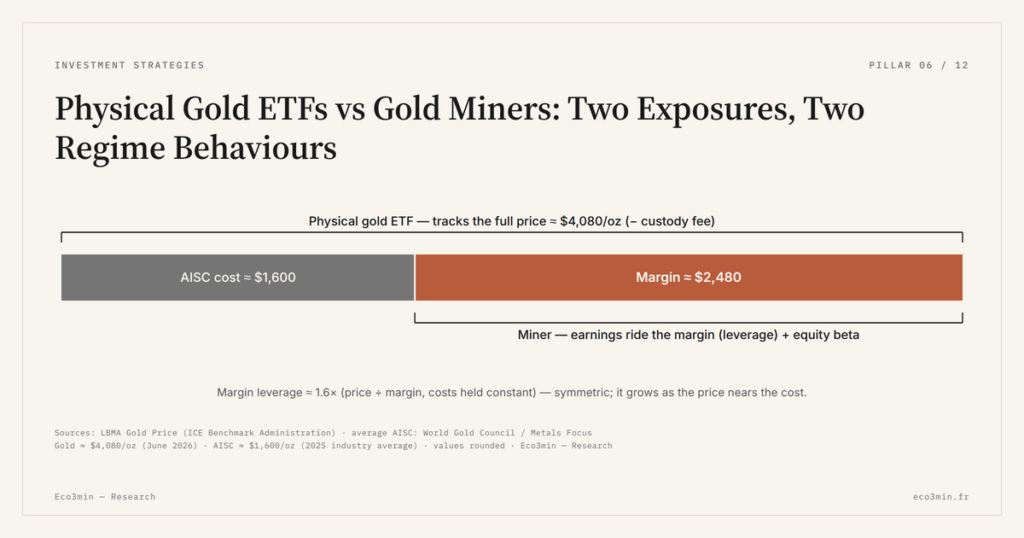
Owning “gold” covers two distinct exposures: a physically backed vehicle replicates the spot price, while a gold miner is a company, with operational leverage and an equity beta the metal does not have.
TL;DR
Holding gold through a physical ETF or through miners gives the same exposure two defensive profiles: the bullion keeps its cushion in downturns, the miners' equity beta erodes it.
- A physical vehicle holding allocated bullion follows the spot price less a custody fee and carries no corporate risk; some structures replicate the price synthetically, adding a counterparty risk that allocated metal does not, so "backed by gold" is not always "holding gold".
- A miner's profit turns on the margin between the gold price and its all-in cost of production: a moderate rise in gold can lift earnings far more, but higher energy, wages or inputs compress that margin even when gold is flat.
- The gap shows at regime turns: in the March 2020 forced selling gold dipped briefly while miners fell further before both rebounded, and over long stretches miners have often trailed the metal as cost inflation and dilution eroded the theoretical leverage.
This piece separates two ways to give a portfolio gold exposure — the replicated metal and the miners — and describes how their behaviour diverges by regime, without crowning a “better” vehicle.
Owning “gold” covers two very different exposures. A physically backed gold ETF replicates the metal: its value follows the spot price, less custody fees. A gold miner is a company — with extraction costs, debt, a management team and a share price tied to the equity market. The consequence is leverage: when gold rises above the cost of production, a miner’s earnings can jump far more. But that leverage cuts both ways, and miners carry an equity beta the metal does not. This piece describes the two profiles without crowning one “better” — relevance depends on the regime and the objective. For the broader picture: Our analysis of which bond ETF for the rate regime.
The replicated metal: a mirror of the price
A physically backed vehicle pursues a simple aim: to reproduce the metal’s price. It holds allocated bullion, and its value follows the ounce, less an annual fee covering custody. Tracking error is small, and its behaviour follows the one set out by the regime frame: it rises when the real rate falls, it struggles when it climbs. It is, at the vehicle level, the most direct translation of two ways to hold gold, the one of which carries no corporate risk.
That purity has a flip side: the absence of any current yield. The replicated metal pays no dividend and no interest, and its custody fee adds to the opportunity cost already imposed by the real rate. In exchange, it introduces none of the uncertainties specific to a company — no debt, no management decisions, no geological or jurisdictional risk. For an investor seeking exposure to the metal and nothing else, it is the vehicle that comes closest.
Not all “physical” vehicles are alike, however. The most rigorous hold allocated bullion, identified and segregated, whose net asset value directly reflects the quantity of metal. Other structures, by contrast, do not hold the metal outright and rely on a counterparty or a synthetic mechanism: they replicate the price but add a counterparty risk that allocated bullion does not carry. The distinction is invisible on a performance chart in calm periods; it surfaces under stress on the issuer. “Backed by gold” does not always mean “holding gold.”
For most investors, the practical appeal of the replicated metal is access: it turns a physical commodity, awkward to buy, store and insure, into a listed line as easy to hold as a share. That convenience is part of what the custody fee pays for. It does not change the exposure — still the metal, still the regime frame — but it lowers the friction of holding it, which matters as much for a small position as for a large one.
The miner: a company against a backdrop of gold
A gold mining company is anything but a simple proxy for the metal. Its revenue depends on the gold price, but its profit depends on the margin between that price and its all-in cost of production — the “all-in” cost per ounce mined. From that gap comes operational leverage: if the cost of production sits well below the price, a moderate rise in gold can lift earnings by a far larger proportion. Conversely, when the price moves toward the cost of production, the margin compresses sharply, and earnings can collapse even though the metal has barely fallen. Companion analysis: the mechanics of holding gold.
A miner’s margin does not depend on the price alone: it also depends on its costs, which are not fixed. A rise in energy prices, wages or inputs lifts the all-in cost of production and compresses the margin, even if gold is flat. This cost-inflation phenomenon has, in some periods, erased part of the theoretical leverage: miners were producing more expensively just as gold was rising. Unlike gold, however, a miner can pay a dividend — some even tie that payout to the metal’s price — offering a current yield the bullion, by nature, does not provide.
On top of that leverage sit the attributes of an equity: a beta to the stock market, debt, capital-allocation choices, operational, geological and jurisdictional risks. Historically, that leverage has not always translated into outperformance: over long stretches, miners have often done worse than the metal itself, with cost inflation, dilution and unfortunate investment decisions eroding the theoretical edge. The formation of the underlying metal’s price belongs to another frame — how the metal’s price forms — whose the gold price history can be followed over the long run.
“The miners” are not a homogeneous block either. A large established producer, a project developer with no production yet, and a royalty company that finances mines in exchange for a share of future output present very different risk profiles. Leverage, equity beta and cost exposure vary widely across them. This internal diversity, which there is no need to detail here, is a reminder that speaking of “the miners” in the singular hides a spectrum of behaviours.
Two behaviours by regime
The distinction comes into its own at regime turns. In a stress phase where the real rate falls, gold rises but equities fall: the replicated metal advances, while miners, dragged by their equity beta, can stagnate or decline despite the metal’s rise. The forced selling of March 2020 is the extreme illustration — gold dipped briefly, but miners more so, before both rebounded. Conversely, in a risk-on recovery where the metal appreciates without market stress, the miners’ leverage can carry them well past the metal. Related coverage: the real-rate reading of gold.
This contrast has a consequence for portfolio diversification. The replicated metal, with no equity beta, keeps its cushioning potential in market downturns; miners, by contrast, see their equity component erode that property precisely when it would be most useful. The same bet on gold can therefore diversify or not depending on the chosen vehicle — the vehicle does not merely scale the exposure, it changes its defensive nature.
Neither profile is superior in the absolute: they serve different objectives and behave differently by configuration. The replicated metal offers a clean exposure to the real-rate regime; miners add a leverage and an equity risk that can cut both ways. Choosing between them therefore follows the same reasoning as the rest of the sub-pillar, where choosing the vehicle for the cycle takes precedence over any fixed hierarchy. And gold does not exhaust the question: the same frame extends beyond gold: silver and platinum, whose profiles differ further still.
What the vehicle shifts in the position
Three observations, without extrapolation or ranking. First, the replicated physical metal tracks the price closely and carries no corporate risk; it translates the regime frame almost without distortion. Second, the miner adds operational leverage — the margin over the cost of production — and an equity beta, which amplify moves both ways and pull it away from the metal. Third, the behavioural gap shows up above all at regime turns, where physical and miners can diverge sharply, as in March 2020.
Treating a gold miner as “gold with leverage” forgets that it is an equity. That reading ignores the equity beta, the debt and the extraction costs, which can sink a miner when the market falls, even if the metal holds. The leverage on the production margin is real, but it comes with a corporate risk absent from the physical metal.
Frequently asked questions
Does a gold miner behave like gold?
Not exactly. Its share price depends on the gold price, but also on its production costs, its debt and the equity market. It can amplify the metal’s gains through the margin leverage, but also fall when equities drop, even if gold holds. It is an equity exposed to gold, not the metal itself.
Why do miners sometimes rise more than gold?
Because of operational leverage. A miner’s earnings depend on the margin between the gold price and its cost of production; when gold rises above that cost, the margin — and so earnings — can grow by a far larger proportion than the metal. That leverage, however, also works on the way down.
Does a physical gold ETF track the gold price exactly?
Very closely, save for an annual custody fee. It holds allocated metal and its value follows the ounce, less that fee. Tracking error is small, and it carries no corporate risk, unlike a miner.
Do all gold miners behave the same way?
No. A large producer, a developer with no production, and a royalty company have distinct risk profiles, with widely varying levels of leverage, equity beta and cost exposure. Speaking of “the miners” as a single block hides this diversity.
Can a gold miner pay an income, unlike gold?
Yes. Unlike the metal, which produces no flow, a mining company can pay a dividend, and some tie it to the gold price. That current income remains subject to corporate risk, however, and can be cut or suspended depending on results.
Last updated — 12 July 2026
Disclaimer – Financial Information: The analyses, commentary, and content published on eco3min.fr are provided for informational and educational purposes only. They do not constitute investment advice or a solicitation to buy or sell financial instruments. Past performance is not indicative of future results. All investment decisions involve risk and are the sole responsibility of the reader.
Read next
Full pillar →Beneficiary Designations, the Step-Up in Basis, and the 10-Year Rule: How US Accounts Transfer at Death
At death, most US financial accounts pass outside the will, straight to a named beneficiary, under tax rules…
The Fee Stack in Variable Annuities: M&E Charges, Riders, and Subaccount Costs
A variable annuity does not carry one fee, but a stack of them. Mortality and expense charges, subaccount…
The Conventional 401(k)-Match-First Funding Order: Where It Comes From, How It Works
The question of what order to fund accounts in usually draws a fixed list, presented as a rule…