How an Administered Savings Rate Is Set: The Inflation-Plus-Money-Market Formula

France’s Livret A rate follows a published formula: a half-yearly average of inflation excluding tobacco and a money-market rate, the €STR, rounded, with a floor. But that formula is only a proposal, and the government has departed from it repeatedly since 2008.
Decomposing the formula term by term, then cataloguing each override, reveals a recurring gap between the rate the calculation produces and the rate actually paid.
The Livret A formula averages inflation excluding tobacco and the €STR, rounds to the nearest tenth and applies a 0.5% floor, but the government keeps the power to depart from it, and it has done so repeatedly since 2008.
- Since 2021 the theoretical rate equals the average of inflation excluding tobacco (INSEE) and the €STR over six months, rounded to the nearest tenth, with a legal floor of 0.5%.
- The formula has been overhauled several times: a 2008–2016 version built on EONIA with quarter-point rounding, then the current version in force since February 2020.
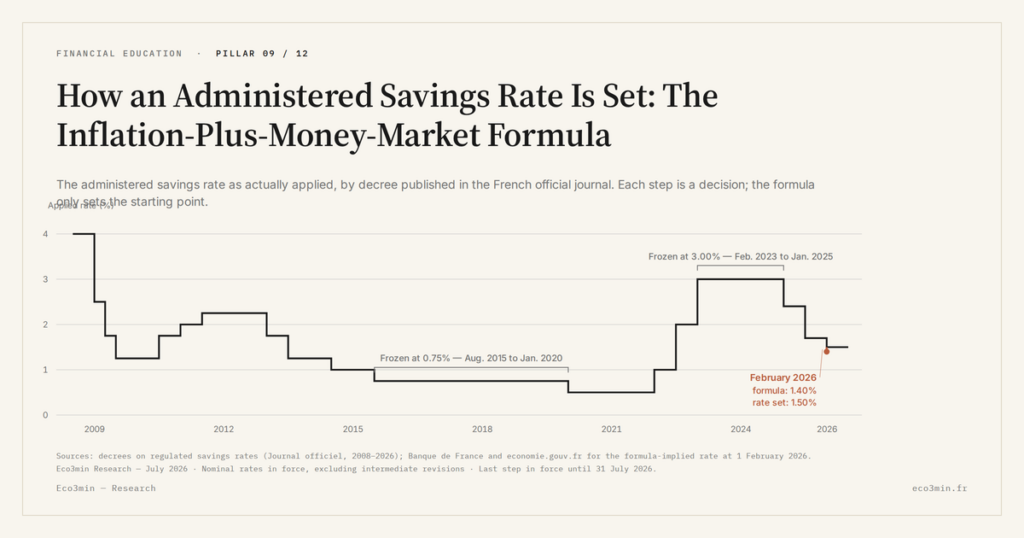
- The government has departed in both directions: a 0.75% freeze from 2015 to 2020 above the formula, a 3% freeze from 2023 to 2025 to smooth the inflation shock, and a lift from 1.4% to 1.5% in February 2026.
- The gap between the formula rate and the applied rate measures a political wedge that consumer explainers never surface.
Most savers never realise that the Livret A rate follows a published formula. Since its last reform, the rate is computed twice a year as a half-yearly average of consumer-price inflation excluding tobacco, measured by INSEE, and a money-market rate, the €STR published by the European Central Bank, with a rounding rule. The Banque de France proposes; the minister sets. But the formula is only a starting point: since 2008 the government has repeatedly overridden it, through freezes, floors and favourable rounding, whenever the rate produced by the calculation became inconvenient, upward or downward. This article decomposes the formula term by term, then catalogues the government overrides, and sets the implicit formula rate against the rate actually applied. This mechanical reading extends, and makes precise, the policy arbitration behind the rate set out at cluster level.
The formula, term by term
In its version in force, codified by the ministerial order of 27 January 2021, the Livret A rate rests on the half-sum of two components computed over the latest six months available. The first is inflation excluding tobacco, year on year, as published by INSEE: it captures the price erosion the household faces. The second is the €STR, the euro area’s overnight interbank rate published by the European Central Bank, which replaced the former EONIA benchmark: it captures the cost at which a bank could place the same liquidity without credit risk. The average of these two components is then rounded to the nearest tenth of a point, and a legal floor of 0.5% prohibits any revision below that threshold, whatever the calculation yields.
Concretely, the mechanism reads as follows for the February 2026 revision. Over the reference half-year, average inflation excluding tobacco came in low, around 0.8% year on year according to the final December 2025 data, while the €STR stabilised around 1.93% from late 2025. The half-sum of these two terms leads to a theoretical rate close to 1.4% after rounding. That is exactly the figure strict application of the formula would have produced, and it is the starting point on which the Banque de France based its recommendation to the minister. Half of that figure is nothing other than France’s year-over-year inflation rate since 1991, averaged over six months.
Two features of this formula weigh on the result. The first is the calendar: the revision is semi-annual and based on past averages, so that the rate applicable on 1 February and 1 August reflects the inflation of the preceding six months, not inflation in the moment. In a period of rapid turning points, that lag creates a mechanical delay. The second is the inclusion of a money-market term: by tying the rate to the €STR, the regulator makes it sensitive to European Central Bank policy, so that a cut in policy rates drags the return down independently of inflation. The decline observed in 2025 and into early 2026 thus owes as much to the recession in short rates as to the recession in prices. More context: widespread misconceptions about money and markets.
A formula that has changed a great deal
The current formula is not a constant: it is the outcome of several overhauls. Between February 2008 and November 2016, the rate took the higher figure, rounded to the quarter-point, between inflation plus a quarter-point and the average of EONIA and inflation. That method, more generous in principle since it took the maximum of two terms, accompanied the rise of the rate to 4% in August 2008, at the height of pre-crisis inflation. In November 2016 a new formula was published, but it was never applied: the rate stayed frozen.
The decisive overhaul was announced in late 2017 and confirmed in April 2018 by the finance minister, for entry into force on 1 February 2020. It replaced EONIA, due to disappear, with the €STR, fixed the half-sum of inflation and that money-market rate, lowered the rounding to the tenth of a point and introduced the 0.5% floor, alongside a smoothing rule capping the change between two successive revisions at half a point. The order of 27 January 2021 consolidated the whole, and EONIA was definitively abandoned in January 2022. This history of reforms illuminates why the formula, far from being a stable technical datum, belongs to how a savings vehicle is built and evolves with public choices.
The catalogue of overrides since 2008
The recent history of the Livret A is dotted with decisions where the public authorities deliberately departed from the calculation. The clearest case is the 0.75% freeze between August 2015 and February 2020. In June 2015, with negative money-market rates and inflation excluding tobacco of 0.3%, applying the formula would have led to a rate of 0.5%. The government, judging that level too low, retained 0.75%, then froze that rate for close to five years, officially while preparing the overhaul of the formula. Over that whole period the applied rate stayed above what the mechanism would have given: the override then worked in the saver’s favour. Freezes of that kind leave a flat line in the data: the rate on newly opened PEL plans, monthly since 2012 sat at 1.01% for 65 consecutive months.
The direction reversed in the following episode. After the rate rose to 3% in February 2023, the government held that level until 31 January 2025. That freeze first muted the 2023 inflation shock, by preventing the rate from fully tracking the surge in prices, which would have added to the cost of financing social housing; then, as inflation receded in 2024, holding at 3% ended up working the other way, keeping a rate above what the receding formula would have commanded. The 3% freeze thus smoothed the path in both directions before ending when the gap became untenable, with the cut to 2.4% in February 2025 and then 1.7% in August 2025. The latest revision, on 1 February 2026, finally lifts the rate from 1.4% to 1.5% to better protect purchasing power. What this succession of rates ultimately produced in purchasing-power terms is the subject of a separate analysis, which reconstructs what the formula produced since 1960.
An asymmetry emerges from this catalogue. In disinflation, when the formula would push the rate very low, the government tends to hold it above the calculation, out of concern for savers’ psychology and so as not to drain the product of its appeal. In an inflation shock, when the formula would push the rate sharply higher, it tends instead to smooth the increase to protect housing finance and banks. How that same administered rate reads once placed in successive macroeconomic configurations is examined separately, in the analysis of how it reads across macro regimes.
The political wedge: formula versus application
From this comparison emerges a quantity that consumer communications never surface: the gap between the rate the formula would have produced and the rate actually applied. One can call it the political wedge. When the government lifts the rate from 1.4% to 1.5%, the wedge is positive. When it freezes a rate the formula would push higher, it is negative. Reconstructing that wedge over time means recomputing, revision after revision, the implicit formula rate from the inflation and €STR data, then subtracting it from the official rate. The exercise turns a string of announced figures into a reading of public intent.
That wedge is not a footnote. It signals, at each revision, which side the decision-maker tilted the trade-off between the saver and public financing. But it does not tell the whole story of the outcome borne: a rate generous relative to the formula can still fall below inflation, and a rate held down can still stay above it. What determines purchasing power is not the gap to the formula but the gap to inflation. The wedge reveals intent, the real return reveals effect. A reader can put a number on that real return directly, subtracting the inflation rate from the nominal rate over any chosen period or doing it with a dedicated tool: compute it with our calculator.
Believing that the formula decides the rate is inaccurate. The formula produces a proposal that the Banque de France submits to the minister, but it is the public decision that sets the rate paid. Since 2008 that decision has departed from the calculation on many occasions, in both directions, which makes the Livret A rate an arbitrated parameter, not an automatic result.
The Livret A formula thus offers an appearance of objective mechanics that masks a more political reality. It provides an anchor, a reference proposed by the Banque de France, but the final decision belongs to the minister, who has regularly amended it according to circumstances. Reading the Livret A rate therefore means holding both faces of the instrument together: the calculation that gives its base, and the arbitration that sets its level. The next revision, expected on 1 August 2026 on the first half-year’s data, will again set the formula’s result against the government’s decision, and the gap between the two will say, as at every deadline, which side the trade-off tilted toward.
Last updated — 10 September 2026
Disclaimer – Financial Information: The analyses, commentary, and content published on eco3min.fr are provided for informational and educational purposes only. They do not constitute investment advice or a solicitation to buy or sell financial instruments. Past performance is not indicative of future results. All investment decisions involve risk and are the sole responsibility of the reader.
Read next
Full pillar →Series I and EE Savings Bonds: Locked Formulas in a Moving Rate World
US savings bonds lock a rate formula at the moment you buy them, for the life of the…
Where the Livret A’s Money Goes: The Caisse des Dépôts Circuit and Social-Housing Finance
The savings held on Livret A accounts do not sit idle. A regulation-set share is centralised at the…
France’s LEP vs the Livret A: A Means-Tested Higher Rate, Explained
France’s Livret d’épargne populaire is often described as "the Livret A, only better". The description misleads: the LEP…