Regulated Cash Across Macro Regimes: When Administered Savings Hold, and When They Erode

“Does cash protect against inflation?” The question expects a yes or a no. The series since 1960 answers differently: the real return depends on the macro regime. The same instrument protects in one configuration and erodes in another.
“Does cash protect against inflation?” The honest answer is neither yes nor no: it depends on the macro regime. This article maps the real return on administered cash onto Eco3min’s macro-regime grid, using France’s Livret A as the worked example. The deepest repression case appears when inflation runs high while administered rates are held low by policy: the real return turns sharply negative and savings melt in purchasing-power terms. The favourable case appears in disinflation, when the nominal rate was set high and inflation recedes: the real return swings positive. Between them lie intermediate configurations. The proprietary artefact: the real return classified by regime from the 1960–2026 series, turning a binary question into a conditional read. No allocation guidance: a framework for seeing in which regime “safe” cash keeps its promise, and in which it breaks it.
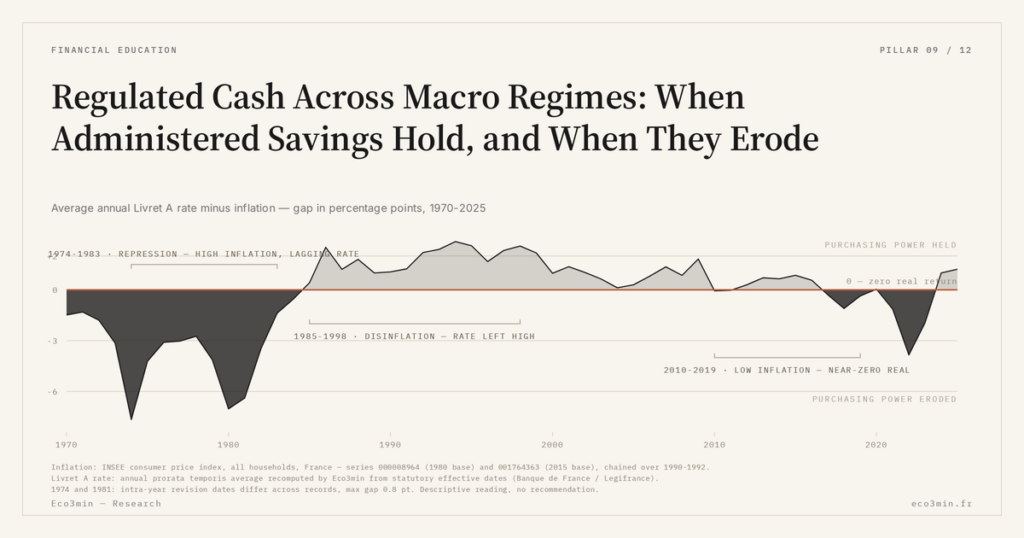
In short. The real return on administered cash is not a fixed property of the instrument: it depends on the macro regime. In an inflationary regime, when inflation accelerates faster than the administered rate follows, the real return turns sharply negative (the 1974–1983 case, then 2021–2023). In a disinflationary regime, when inflation recedes while the rate was left set high, the real return swings positive (the 1985–1998 case). In stable low inflation, the real return hovers around zero (the 2010s). The same account, depending on the regime, protects or erodes purchasing power.
A badly framed question
Asking whether the Livret A “protects against inflation” assumes a stable answer, valid at all times. The historical series shows that no such answer exists. Across sixty-six years, the same instrument has at times preserved purchasing power and at times let it melt by several points a year. What changes from one period to the next is not the product, whose rules have stayed stable, but the macro regime in which it sits. Reframing the question means asking instead: in which regime is the real return on regulated cash positive, and in which does it turn negative? A broader view: France’s Livret A ceiling and its mechanical effects.
This reframing follows from the policy nature of the rate. Because the Livret A rate is set by public decision and does not adjust instantly, its gap to inflation depends on where in the cycle one stands. Reading a vehicle by regime is precisely the practice of conditioning its expected real return on the macro context, rather than ascribing to it an intrinsic quality.
The reading grid: inflation regime and the rate’s response
The real return on the Livret A sorts along two crossed dimensions. The first is the inflation regime: inflation accelerating, inflation receding, or inflation low and stable. The second is the stance of the administered rate relative to that inflation: lagging, set high, or aligned. It is the interaction of the two that determines the sign of the real return. Because the administered rate always adjusts with a delay, that delay works against the saver when inflation rises, and in the saver’s favour when it falls.
This delay is not accidental: it is written into the formula. The Livret A rate is anchored to inflation over the last six known months, and is revised only twice a year. By construction, it therefore reflects inflation that has already passed. As long as inflation follows a steady slope, the gap stays contained; but the moment its pace changes abruptly, up or down, the administered rate takes several quarters to catch up. The sign of the real return is decided precisely in these break phases, where the inertia of the formula offsets the rate paid from the inflation actually borne. Related framing: How an Administered Savings Rate Is Set: The Inflation-Plus-Money-Market Formula.
| Regime | Inflation | Administered rate | Real return | Episodes |
|---|---|---|---|---|
| Inflationary repression | high, rising | lagging, low | sharply negative | 1974–1983, 2021–2023 |
| Favourable disinflation | falling | left set high | positive | 1985–1998 |
| Stable low inflation | low | low | near zero | 2010–2017 |
| Moderate regime | moderate | follower | neutral to mildly negative | 1960s, 2000s |
The repression regime: high inflation, low rate
This is the configuration where “safe” cash breaks its promise. When inflation accelerates and the administered rate stays low, whether through the inertia of the formula or by deliberate policy, the real return turns sharply negative. The indexation lag becomes a loss: each year, the rate paid reflects past inflation, lower than current inflation. The 1974–1983 period is the extreme case, with a cumulative real return of roughly −32%: double-digit inflation against a rate between 6% and 8.5%. The 2021–2023 sequence reproduces the same mechanics on a smaller scale, the 0.50% floor and then a rate of 1–2% facing inflation of 5.2% in 2022.
This regime corresponds, in the Eco3min grid, to the combination of an inflationary dynamic and sustained negative real rates. It is the heart of the financial repression regime: the quiet liquidation of nominal savings by inflation running above the rates paid. The Livret A is not an exception to it but a particularly clean illustration, because its rate is explicitly administered.
The favourable regime: disinflation, rate left set high
The same inertia produces the opposite effect when inflation recedes. If the nominal rate was set high during the inflationary phase and prices then slow, the administered rate takes time to come down and ends up exceeding current inflation. The indexation lag, this time, favours the saver. The 1985–1998 period illustrates the case: the Livret A rate stayed at 4.5% from 1986 to 1996, while inflation fell from nearly 6% toward 1.5%. The real return became distinctly positive, reaching +2.5% in 1994. It is this window that explains why, across 1984–2017 as a whole, the cumulative real return on the Livret A comes out positive despite the 1970s trough. Worth reading alongside: the trade-offs across short holding periods.
This favourable regime is, by construction, transitory: it lasts as long as it takes the administered rate to reach the new inflation level. It rewards immobilised savings during the descent, then fades once alignment is restored.
The intermediate regimes: low inflation, low rate
Between the two extremes, the most frequent configuration of recent decades pairs low inflation with a low administered rate. The real return there hovers around zero. The 2010s are the example: a Livret A rate down to 0.75% against near-zero inflation leaves a barely positive cumulative real return over the decade. This is neither repression nor protection: purchasing power is broadly preserved, with no notable real gain. The moderate regime of the 1960s and 2000s, with inflation and rate both between 1.5% and 3%, produces a neighbouring result, neutral to mildly negative depending on the year.
Common misreading
Treating “the Livret A protects (or fails to protect) against inflation” as a fixed property of the instrument. The series shows the protection is conditional on the regime: the same account eroded purchasing power by more than 30% in one decade, then increased it in the next. The right question is not “does it protect?” but “in which regime?”.
A regime-specific response to repression
The inflationary regime, the one in which regulated cash erodes most, is precisely the regime in which the question of what has actually held up becomes sharpest. Across history, the instruments that preserved real value through inflation shocks were those whose yield tracked inflation closely or exceeded it, rather than administered rates anchored to the past. Examining what has protected savings from inflation across regimes places the Livret A within a broader set: in the repression regime, an instrument anchored to a lagging administered rate is, by design, among the more exposed.
The regime read says nothing about an allocation. Nor does it compare the Livret A with other savings vehicles: setting administered cash against bank cash or euro-denominated funds belongs to cash and euro funds compared by regime, which crosses several instruments over the same macro phases.
The two extreme regimes are not symmetric in their cumulative effect. The repression regime hits fast and hard: inflation doubling in two years carves several points a year off the real return, as in 1974 or 2022. The favourable regime acts more slowly, spread across the gradual descent of inflation, and its annual gain rarely exceeds two to three points. Over a long span mixing the two, this asymmetry tilts toward erosion: inflation shocks leave an imprint that disinflation windows only partly recover. This is why the same instrument can pass through favourable regimes without the very-long-run balance ceasing to be negative.
The overall read
Mapping the real return onto regimes turns a binary question into a conditional grid. The Livret A neither “protects” in the absolute nor “represses” in the absolute: it does one or the other depending on whether inflation accelerates or recedes, and on the administered rate’s lag behind that move. The inflationary regime produces the loss; the disinflationary regime produces the gain; stable low inflation produces neutrality. The grid points to no behaviour to adopt. It indicates only the macroeconomic condition under which the implicit promise of “safe” cash is kept, and the condition under which it is broken.
Last updated — 25 July 2026
Disclaimer – Financial Information: The analyses, commentary, and content published on eco3min.fr are provided for informational and educational purposes only. They do not constitute investment advice or a solicitation to buy or sell financial instruments. Past performance is not indicative of future results. All investment decisions involve risk and are the sole responsibility of the reader.
Read next
Full pillar →Series I and EE Savings Bonds: Locked Formulas in a Moving Rate World
US savings bonds lock a rate formula at the moment you buy them, for the life of the…
Where the Livret A’s Money Goes: The Caisse des Dépôts Circuit and Social-Housing Finance
The savings held on Livret A accounts do not sit idle. A regulation-set share is centralised at the…
France’s LEP vs the Livret A: A Means-Tested Higher Rate, Explained
France’s Livret d’épargne populaire is often described as "the Livret A, only better". The description misleads: the LEP…