After Nickel: The LME, the 2022 Cancellation and a Metals Exchange’s Credibility

By cancelling a full day of nickel trading in March 2022, the London Metal Exchange saved its clearing infrastructure but dented its credibility. Three years of litigation and reform followed, posing a simple question: can an exchange be both market and referee?
TL;DR
By cancelling a full session in March 2022, the London Metal Exchange averted a clearing collapse and won the litigation that followed, yet left confidence in its prices dented.
- On 8 March 2022, with nickel past 100,000 dollars a tonne, the exchange suspended trading and retroactively erased the morning's transactions to stop a cascade of clearing-member defaults.
- Elliott and Jane Street challenged the cancellation through judicial review, Elliott claiming around 456 million dollars in lost profits; the claims were dismissed in November 2023, upheld on appeal in October 2024, and refused by the Supreme Court in January 2025.
- Reforms followed: weekly reporting of clients' over-the-counter positions, permanent daily price-movement limits and a regulator's investigation, alongside receding nickel volumes that no legal win reversed.
Beyond nickel, the 2022 episode tested the very principle of price formation on an organised market. Examining its institutional aftermath illuminates the frontier between the integrity of a quoted price and the stability of the infrastructure that produces it.
1. Cancelling a day of trading: an unprecedented intervention
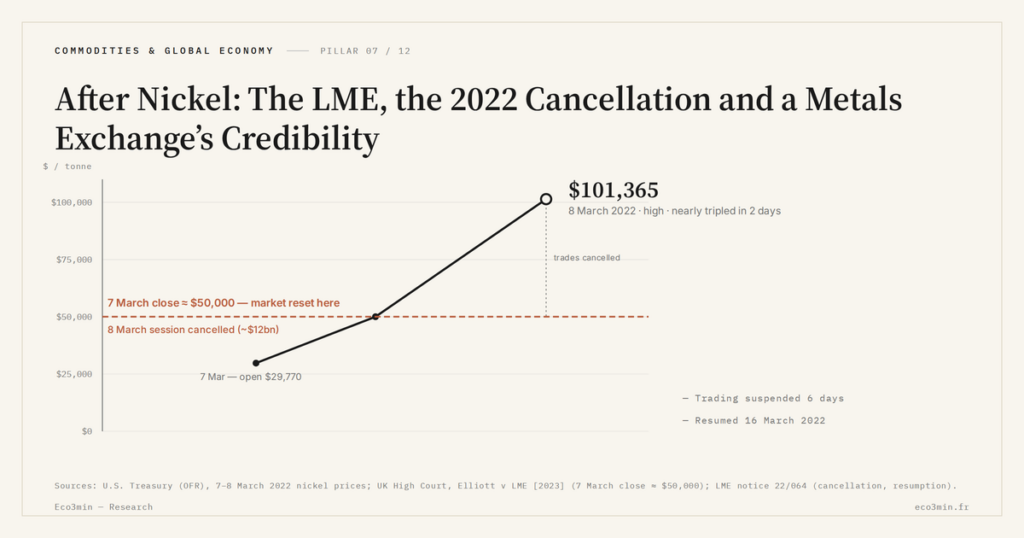
On 8 March 2022, after the nickel market’s breakdown in 2022 past 100,000 dollars a tonne, the London Metal Exchange took a step rare in the history of organised markets: it suspended trading, then retroactively cancelled all transactions executed that morning before the suspension, resetting the market to the previous day’s prices. The orders of magnitude are documented: having opened at $29,770 a tonne on 7 March, nickel closed that day near $50,000 and touched $101,365 on the morning of the 8th, close to a tripling in two sessions; the cancellation wiped out 5,000 to 9,000 trades worth $3.9 billion to $12 billion depending on the count (US Treasury Office of Financial Research, 2024), and LME Clear would have had to call $19.75 billion of intraday margin. The justification was a systemic threat. Had the morning’s margin calls been honoured at opening prices, several clearing members would have been unable to meet them, exposing the clearing house to a cascade of defaults. The cancellation was therefore less about correcting a price than about preventing the collapse of the infrastructure that underpins the whole market.
The intervention was unprecedented in scale. Erasing a full trading session of a central metal amounts to conceding that the price-formation mechanism had, that morning, produced a signal devoid of economic content. Yet this kind of runaway is not unique to nickel: it belongs to the family of a self-reinforcing market reversal, where the dynamic comes from constraints internal to the market rather than from a reassessment of fundamentals. What set the nickel case apart is that the market operator chose to intervene directly on the transactions, opening a debate that would occupy the courts for nearly three years.
The exchange’s history is not free of such ruptures. In the 1990s, a rogue trader’s attempt to corner the copper market and, in the 1980s, the collapse of a tin price-support scheme that halted trading for years, had already tested its institutions. None of those, however, had led to erasing a full session of so central a metal in the modern era, which is why the 2022 cancellation marked the gravest crisis to hit the exchange in decades.
2. The legal battle and the question of finality
Participants who had sold at the highs on 8 March, and found themselves deprived of substantial gains, challenged the cancellation. Two prominent financial actors, the fund Elliott and the trading firm Jane Street, brought judicial-review proceedings against the exchange and its clearing house, Elliott claiming around 456 million dollars in lost profits. The procedure was unusual: judicial review ordinarily targets public authorities, but the London Metal Exchange, as a recognised investment exchange, performs quasi-regulatory functions that expose it to such challenges. Other claimant groups filed parallel damages claims.
The heart of the dispute touched the principle of finality: must a transaction executed on an organised market be treated as definitive, or may the operator erase it in the name of market stability? In November 2023, the British court ruled for the exchange, finding the cancellation lawful, rational and in accordance with its own rules, and recognising its obligation to maintain an orderly market, including by cancelling trades. The Court of Appeal upheld that decision in October 2024, and the Supreme Court refused permission to appeal in January 2025; the remaining claimants then discontinued their claims. In strictly legal terms, the exchange therefore prevailed on every count, relying on the fact that its members had accepted its rules as a condition of access to the market. The wider context: the Eco3min framework on the structural signals from oil, gas and copper markets.
The judges’ reasoning rested on a telling technical distinction. Jane Street’s trades, which had reached an advanced stage of the clearing process, were recognised as possessions whose cancellation was an interference, though one held to be lawful; Elliott’s, which remained contingent agreements not yet cleared, were not treated as possessions in the same way. This nuance, which may seem byzantine, in fact goes to the core of the matter: at exactly what moment does a transaction become irrevocable? That the answer depends on stages internal to the clearing mechanism shows how far the finality of a trade, far from being an absolute, is itself defined by the rules of the exchange.
3. Reforms and the cost to credibility
The legal victory did not erase the reputational cost. During the suspension, which lasted more than a week, consumers and producers were left without a benchmark price for a strategic metal, directly harming an exchange’s primary function: to produce a reliable price signal. On resumption, on 16 March, trading had to be framed by daily price-movement limits, a sign that the exchange itself viewed its market as liable to break again. Confidence showed in the volumes: liquidity in the nickel contract receded after the episode, and the migration of part of the activity raised doubts about the exchange’s ability to keep serving as the world reference for the metal.
Several reforms followed. The exchange required members to report their clients’ over-the-counter positions on a weekly basis, closing the blind spot that had let a colossal exposure stay invisible before the crisis. Daily movement limits were made permanent, and margin and transparency requirements tightened. The British regulator also opened an investigation into the exchange’s conduct, and an independent review made recommendations on its governance and risk management. To place these moves in time, the nickel price record shows the 2022 rupture and the slow normalisation that followed.
The stakes reach beyond the London exchange, because its nickel price serves as a reference for countless physical contracts worldwide. When such a price stops, for the span of a crisis, reflecting the market, the whole chain of contracts indexed to it is left without a bearing. The crisis thus reopened the competition for the benchmark role: other venues studied alternative contracts, notably on the nickel sulphate used in batteries, without any managing to supplant the historical reference. The London exchange’s near-monopoly on nickel pricing, long an asset, appeared as a vulnerability the day this single point of price formation gave way.
4. Can an exchange be both market and referee?
The episode leaves a structural question open, one that reaches beyond nickel. A metals exchange fills two roles the crisis set against each other: it organises price formation, whose value rests on the finality of transactions, and it safeguards the stability of its clearing infrastructure, which may require intervening to cancel those same transactions. The two missions are compatible in normal times; they clash head-on when a lawfully formed price threatens to default its members. The court held that the second mission could prevail over the first, but that priority has a price: it introduces uncertainty over the definitive character of trades, which is nonetheless the foundation of confidence in an organised market.
This tension is sharpened in a market as thin and concentrated as nickel, where an imbalance of positions is enough to dislodge the price. It is precisely there that the mechanics of price discovery are most vulnerable, and where the dilemma between price integrity and infrastructure stability bites hardest. The lesson of 2022 is therefore not only about nickel: it questions the ability of exchanges to arbitrate shallow markets without compromising confidence in the signal they produce.
No reform fully resolves that dilemma. Position transparency and price limits reduce the odds of a repeat, but they do not answer the underlying question of whether an operator that can cancel trades can also guarantee their finality. For users of the price, the episode is a reminder that a benchmark is only as robust as the institution behind it, and that institution’s priorities when a crisis strikes.
It is often concluded from the exchange’s legal victory that the episode closed without damage. That confuses legality with credibility: the courts confirmed the cancellation complied with the rules, but confidence in the finality of trades and in the reliability of the quoted price is not restored by a judgment.
- By cancelling the 8 March 2022 session, the London Metal Exchange averted a cascade of defaults in its clearing house, but dented confidence in the finality of trades.
- The claims by Elliott and Jane Street were dismissed in 2023, on appeal in 2024 and at the highest stage in 2025: the cancellation was held lawful and in accordance with the exchange’s rules.
- Reforms (over-the-counter position transparency, movement limits, a regulatory investigation) and falling volumes accompanied a reputational cost no legal victory erases.
Conclusion
The nickel aftermath illustrates a frontier rarely made explicit: the point where an exchange’s market function collides with its role as guardian of stability. The London Metal Exchange chose the latter and was upheld by the courts, but the episode leaves open the question of the conditions under which a quoted price remains trustworthy if it can be erased. That question reaches beyond nickel and concerns all the commodity markets at large whose prices form on shallow markets, where the integrity of the signal and the stability of the infrastructure cannot always be served at once.
Last updated — 22 September 2026
Disclaimer – Financial Information: The analyses, commentary, and content published on eco3min.fr are provided for informational and educational purposes only. They do not constitute investment advice or a solicitation to buy or sell financial instruments. Past performance is not indicative of future results. All investment decisions involve risk and are the sole responsibility of the reader.
Read next
Full pillar →Reading the refinery utilisation rate: the threshold, the season, the turnarounds
A refinery runs full near ninety percent, not a hundred: the last slice of nameplate capacity is a…
IMO 2020: the regulatory shock that rewrote product spreads
An environmental rule on marine sulfur can move a refining spread more than a swing in crude. IMO…
The 2022–2023 refining golden age: anatomy of an episode
In 2022, refined fuel prices climbed faster than crude. That gap, measured by the 3-2-1 crack spread, reached…