Why Nickel Is the Most Fragile Base Metal: The 2022 LME Squeeze as Structural Evidence

In March 2022, the London Metal Exchange’s nickel contract doubled within hours past 100,000 dollars a tonne, forcing the bourse to suspend trading and then cancel an entire day of transactions. The episode distils the structural fragilities of a base metal unlike the others.
TL;DR
Thin nickel liquidity turned one trader's short into a March 2022 squeeze that nearly forced 20 billion dollars of single-day margin calls on the LME clearing house.
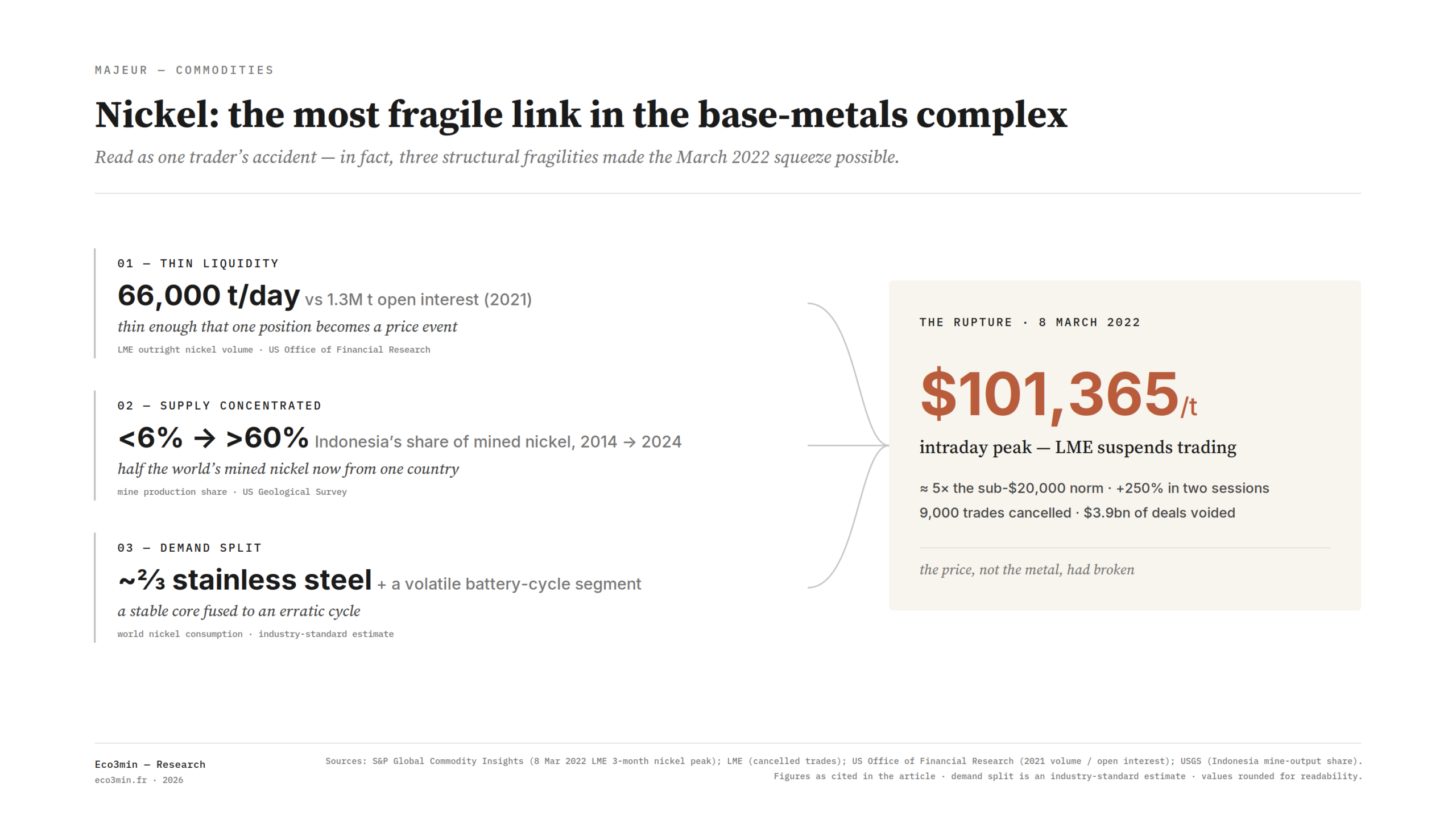
- On 8 March 2022 the three-month contract hit an intraday 101,365 dollars a tonne (S&P Global Commodity Insights), about 250 percent higher in two sessions after years below 20,000 dollars.
- The LME, founded in 1877, cancelled some 9,000 trades worth 3.9 billion dollars; honoured at 7 a.m. prices, margin calls would have hit around twenty-eight banks and brokers, more than ten times the prior daily record.
- The trigger was Tsingshan's short position of 100,000 to 200,000 tonnes, mostly over-the-counter, amplified by a self-reinforcing buy-back loop rather than any jump in stainless-steel demand.
- Average daily LME nickel volume ran near 66,000 tonnes in 2021 against 1.3 million tonnes of open interest, so a single position becomes a price event rather than being absorbed.
Rather than an isolated accident, the 2022 squeeze reads as the clearest evidence that thin liquidity, an extraordinarily concentrated supply base and demand tethered to the battery cycle make nickel the most unstable link in the base-metals complex.
1. The night the nickel market broke
On 8 March 2022, shortly after the Asian session opened, the London Metal Exchange’s three-month nickel contract lost all anchor to the physical market. Within hours the price more than doubled, reaching an intraday high of 101,365 dollars a tonne according to data from S&P Global Commodity Insights, after climbing roughly 250 percent across two sessions. The scale of the move is best measured against the prior trajectory: for years, nickel had traded mostly below 20,000 dollars. In less than forty-eight hours the market had multiplied its price reference fivefold, with no industrial upheaval to justify it.
This was no slow drift. Prices had begun to tense on Friday 4 March; by Monday they were breaching their usual ceilings; by Tuesday morning, as London desks opened, they were out of control. According to reconstructions later published by the specialist press, executives of the exchange and its clearing house, together with managers from its Hong Kong parent, held an early-morning conference call to decide on closing the market as fast as possible. No minutes were reportedly taken. A few hours later the decision came down: nickel trading suspended, with immediate effect.
The exchange, founded in 1877, then went further, taking a step without precedent in its recent history: retroactively cancelling every transaction executed that 8 March, some 9,000 trades worth around 3.9 billion dollars, and resetting the market to the previous day’s prices. The LME’s official justification fit in a single sentence: above 100,000 dollars a tonne, the quoted price had stopped reflecting the underlying physical market. In wiping out the session, the exchange was not only rescuing short sellers; it was conceding that its own price-formation mechanism had, that morning, produced a signal emptied of economic content.
The intervention was all the heavier because the chain of margin calls threatened to seize up. Had the morning’s margin calls been honoured at the prices prevailing around 7 a.m., the clearing house would have had to demand close to 20 billion dollars from some twenty-eight banks and brokers in a single day, more than ten times the previous daily record set before March 2022. Cancelling was therefore not a gesture of convenience: it was a measure meant to protect the clearing infrastructure itself, whose failure would have propagated the shock far beyond nickel alone.
Reuters, which covered the episode in real time, described the gravest crisis to hit the 145-year-old exchange in decades. The most cited precedent remains the Sumitomo affair of the 1990s, when a trader tried to corner the copper market, and the suspension of tin trading in the 1980s, halted for years after a price-support scheme collapsed. These antecedents are a reminder that market ruptures are not foreign to the LME’s history; yet none in the modern era had led to erasing an entire trading day of so central a metal. Nickel trading resumed only on 16 March, framed by daily price-movement limits, a sign that the exchange itself viewed its market as liable to break again.
The episode mattered well beyond the nickel pit. A clearing house is the node through which the obligations of all members pass; if it is forced to call sums it cannot collect, the failure does not stay contained to one metal but spreads to every participant linked to it. That is why the near-miss of 8 March — close to 20 billion dollars of margin calls that could not have been met — was not merely a nickel problem but a stress test of the market’s plumbing. The exchange chose to protect that plumbing by erasing the session, accepting a controversial intervention rather than risk a chain of defaults. The choice revealed how much the integrity of a commodity market rests on the solvency of its clearing chain, not only on the soundness of its prices.
Cancellation had consequences of its own. Several participants who had sold at the highs on 8 March, and thus found themselves deprived of substantial gains, contested the move; some of the most active funds launched proceedings against the exchange, arguing that an executed trade should not be reversible. The reach of these disputes extends beyond nickel: they touch the principle that an order filled on an organised market is final. That institutional dimension, and what it cost the authority of a century-old bourse, is treated separately; for this article’s argument, what matters is that the episode forced the exchange to admit its own market could produce prices devoid of economic meaning.
This episode is not to be read as an anomaly out of nowhere. Nickel belongs to the family of base metals listed on the LME, alongside copper, aluminium, zinc, tin and lead; it sits at the centre of the physical commodity markets read as markets in their own right rather than as mere price lines. Yet among these metals, nickel gathers a cluster of vulnerabilities rarely present together. The rest of this article details them one by one, because it is their conjunction, not a lone trader, that made 8 March 2022 possible.
2. The proximate cause: a short squeeze, not a fundamental
The direct trigger is now well documented. China’s Tsingshan Holding Group, the world’s largest producer of stainless steel and nickel, led by Xiang Guangda, was carrying a vast short position. According to press reconstructions and academic work on the episode, including a detailed study by the United States Office of Financial Research, that position ran to somewhere between 100,000 and 200,000 tonnes of metal. Only a fraction sat on the LME, on the order of 30,000 tonnes; the bulk, close to 120,000 tonnes, was held through over-the-counter contracts with a set of banks, among them JPMorgan, BNP Paribas, Standard Chartered and United Overseas Bank.
For a producer, selling forward is a textbook hedging move: locking in a future selling price to protect an industrial margin. But when the price rises instead of falling, that hedge turns into a source of huge unrealised losses and margin calls the treasury struggles to meet. That is precisely the trap that closed on Tsingshan. As nickel climbed, the group faced margin calls estimated at some 8 billion dollars; and had the 8 March trades stood above 100,000 dollars, some sources suggested a potential liability on the order of 15 billion dollars to its counterparties.
The resolution came through a coordinated intervention. To avert a cascading default that would have hit the exposed banks, a creditor consortium led by JPMorgan extended the Chinese group emergency credit and a standstill arrangement, buying time to unwind its positions. According to the press, Tsingshan subsequently negotiated swapping its less-refined nickel for warrants deliverable on the exchange, in order to honour its short obligations gradually. The group was able to absorb the loss thanks to annual revenues counted in tens of billions of dollars, whereas the financial counterparties booked direct losses: one large bank reported a nickel-related writedown in its quarterly accounts. The crisis was contained, then, but at the price of a rescue negotiated under duress, revealing the degree of interdependence between a physical producer, its banks and the market infrastructure.
The geopolitical backdrop did the rest. In early March 2022, the invasion of Ukraine and the threat of Western sanctions weighed on Russian supply, Russia being then the third-largest nickel producer and a leading exporter of high-grade refined metal. In an already tight market, the anticipation of physical scarcity fuelled a wave of buying. As the price rose, short sellers had to buy back to cap their losses, feeding a self-reinforcing loop: each buy-back pushed the price higher, which triggered fresh margin calls, hence fresh buy-backs. That is the very mechanics of a short squeeze, foreign to any reassessment of the metal’s fundamentals.
The role of the over-the-counter contracts deserves a pause, for it lights up a blind spot in the system. A hedge held off-exchange partly escapes the view of the exchange and its clearing house: neither the true size nor the degree of concentration of the commitments was fully visible before the crisis broke. When the LME subsequently required members to report their clients’ over-the-counter positions on a weekly basis, it was implicitly conceding that the opacity of those commitments had contributed to the rupture. Visibility, in a market, is not a detail of governance but a condition of stability: what cannot be seen cannot be managed before it breaks.
The distinction between proximate and structural cause is decisive for this article’s argument. At 101,365 dollars a tonne, nickel was not worth five times more than a week earlier for industrial reasons: stainless-steel demand had not quintupled, nor had physical scarcity. The price reflected an imbalance of positions and a liquidity constraint, not a state of the world. That disconnect between the quoted price and physical reality is exactly what one expects when the microstructure of a market, the fine machinery by which orders meet and form a price, is pushed to its limit. The same lens illuminates other runaway episodes where the plumbing of the market, not its fundamentals, dictates the outcome; our work on how prices form under stress sets out the mechanisms.
Still, the proximate cause does not exhaust the structural one. Tsingshan may have miscalibrated its hedge; but countless producers hedge forward without ever blowing up a market. If a single position was enough to dislodge nickel when it would merely have rippled copper or aluminium, it is because the ground was primed. That ground has a name: the conjunction of three fragilities the rest of this article examines. The institutional fallout of the episode for the exchange itself, for its authority and the confidence of its members, is the subject of a dedicated analysis of the exchange’s structural aftermath.
3. Fragility one: liquidity too thin
Nickel’s first vulnerability lies in the depth of its market. Compared with copper or aluminium, nickel trades on narrow volumes. According to figures cited by the Office of Financial Research, the average daily volume of outright nickel trades on the LME ran to around 66,000 tonnes in 2021, against open interest of roughly 1.3 million tonnes. Those numbers, modest by the standards of the major industrial metals, have a direct consequence: it takes relatively little flow to move the price. In a deep market, a large position is absorbed without a jolt; in a thin one, the same position becomes a price event.
That thinness is not accidental; it follows from the nature of the metal and the structure of its trade. Nickel is technically complex, fragmented into poorly substitutable grades — class 2 pig iron and class 1 refined metal are not equivalent and do not trade interchangeably. A significant share of transactions takes place over the counter, off the centralised order book, which reduces the liquidity visible on the exchange. The nickel contract finally attracts fewer market makers and arbitrageurs than the copper contract, one of the most liquid in the world, because its high volatility and the complexity of its grades make it a riskier underlying to quote continuously. The result is a loop: less liquidity invites more volatility, which in turn deters liquidity providers.
There is an apparent paradox here: nickel is a strategic metal, indispensable to stainless steel as to batteries, yet its market remains among the least deep in the complex. The economic importance of a commodity in no way guarantees the liquidity of its financial market, because that liquidity depends on the standardisation of the product, the number of participants and the share of trade that runs through the exchange rather than bilateral deals. Nickel carries handicaps on all three counts, which explains how so central a metal can trade under such narrow market conditions. Industrial centrality and financial depth are two distinct properties, and their decoupling is, in nickel’s case, a further source of fragility.
The consequence is written into the price history. A metal able to sit for years below 20,000 dollars, then leap past 100,000 dollars in two days, is by definition a market in which liquidity can evaporate abruptly. The monthly nickel price series shows this alternation of long calm phases and violent ruptures, the signature of shallow markets. Where a liquid market cushions shocks by spreading them across many counterparties, a thin market concentrates them: with no buyers on the other side, the price no longer finds an equilibrium and starts to run.
Microstructure provides the conceptual frame for why thin liquidity turns an ordinary imbalance into a rupture. An asset’s price is not an external datum: it emerges from the continuous confrontation of buy and sell orders in a book. When short sellers must buy back in a hurry and counterparties fail at the same moment, the book empties on the buy side. There is then no equilibrium price left, only a last-trade price that climbs with each order filled. It is this sudden vacuum of buy-side liquidity, more than the size of the underlying demand, that produces the aberrant levels seen on 8 March.
Thin liquidity also has concrete effects for anyone operating in this market. In a sparse book, the gap between the best bid and the best offer widens, and filling an order of any size moves the price on its own, a phenomenon traders call slippage. That slippage combines with the leverage inherent in futures markets: a position taken on slim margin can, when it turns, generate funding calls out of all proportion to the capital committed. Thin liquidity and high leverage thus form a dangerous pair, in which a modest price move is enough to trigger forced sales or buy-backs that amplify that move. It was this dynamic, not a shift in fundamentals, that carried nickel to levels unrelated to its use value.
The deeper lesson of these figures is that fragility can hide in plain sight during calm periods. For years nickel traded quietly below 20,000 dollars, and that very quiet was read as stability; in reality it masked a market whose depth had never been tested by a genuine shock. Liquidity that looks adequate in ordinary times can prove illusory the moment everyone needs the same side of the trade at once, because the participants who provide it withdraw precisely when it is most needed. A thin market is not one that is always turbulent, but one in which calm and rupture alternate without warning — which makes its fragility harder to price, and easier to ignore, until it surfaces.
The 2022 move shares this mechanics with other runaway episodes born not of a fundamental shock but of a feedback loop internal to the market. The textbook case in which products meant to diversify risk end up amplifying it, to the point of abruptly turning the market, is analysed in our study of the 2018 volatility feedback loop. The kinship is instructive, even though the assets differ: in both cases the dynamic comes from the structure of the market and the constraints bearing on its participants, not from a reassessment of the asset’s intrinsic value.
The fragility of a commodity market is read at the intersection of three axes: the depth of liquidity, which determines the size of the shock a position can produce; the concentration of supply, which measures dependence on a small number of actors or territories; and the volatility of demand, which depends on the metal’s tether to more or less stable cycles. Nickel sits at the unfavourable extreme of all three axes at once, which is what sets its instability apart from that of its neighbours in the base-metals complex.
4. Fragility two: supply concentration without precedent
The second vulnerability is geographic. No other base metal shows a supply concentration comparable to nickel’s today. According to the US Geological Survey, Indonesia accounted for about 7 percent of global mine production in 2014 (177,000 tonnes out of 2.45 million); its share reached 48 percent in 2022 (1.58 million tonnes out of 3.27), 50 percent in 2023 (1.8 out of 3.6), close to 60 percent in 2024 (2.2 out of 3.7) and 67 percent on the January 2026 estimate for 2025 (2.6 out of 3.9), some bodies citing higher levels still. In a decade, a single country moved from the margin to the domination of the market, to the point of supplying more than half of the nickel mined worldwide today — a trajectory few commodities have travelled at that speed.
The scale of the shift is captured by one figure: according to data drawn from US Geological Survey records, Indonesian output rose tenfold between 2014 and 2023, from 177,000 to 1.8 million tonnes, and nearly fifteenfold by 2025, taking the country from bit player to market maker in under ten years. This concentration exceeds even what is seen in oil, where the top producer represents only a minority of world supply and several large exporters with diverging interests share influence. In nickel, a single territory dominates, and capacity there is largely backed by a limited set of operators. The comparison is not trivial: it places nickel in a category of concentration few commodity markets reach, and which makes its supply trajectory exceptionally dependent on a narrow cast of actors. The wider context sits in how physical supply constraints shape commodity regimes.
That concentration gives Indonesia the status of a swing producer, able to influence the world price through its industrial-policy decisions alone. The tipping point dates to January 2020, when Jakarta banned exports of raw ore to force processing on its own soil. The boom that followed rested on two distinct technological routes: electric furnaces producing nickel pig iron, destined for stainless steel, and high-pressure acid leaching, able to convert lower-grade lateritic ore into battery-grade material. The mechanism by which a sovereign decision reshaped global supply, and why this concentration is the structural condition of the instability, is detailed in our analysis of Indonesia’s grip on nickel supply.
For the fragility argument, the essential point lies elsewhere: a concentrated supply is a supply whose trajectory depends on a small number of decisions. When a swing producer raises its volumes, it can flood the market; when it cuts them, it can tighten the market abruptly. That asymmetry is exactly what played out after 2022, when the Indonesian inflow turned the spike into a glut, then when quota restrictions began to reverse the move. A market whose supply responds to political trade-offs more than to price signals is, by construction, more exposed to ruptures than a market whose supply is dispersed across many countries and many actors.
The nature of that dominance sharpens the fragility further. Indonesia’s rise leaned heavily on Chinese capital, which financed both processing and the downstream chain, from stainless-grade nickel through to battery materials. Geographic concentration is thus compounded by ownership concentration: a substantial share of world capacity belongs to a restricted group of linked operators. Compared with other commodities whose supply is concentrated but split among several producers with diverging interests, this configuration leaves the market more exposed to the coordinated decisions of a small group of actors, whether public policies or industrial strategies.
A natural objection is that this concentration is transient, a phase of expansion that competition will eventually erode. The objection underestimates the durability of the position. Building processing capacity, securing ore reserves and integrating downstream takes years and heavy capital, which raises the barrier to any reversal; and the cost advantage of Indonesian operations, among the lowest in the world, leaves higher-cost producers elsewhere structurally exposed to closure rather than expansion. Concentration, once installed on this scale, tends to entrench itself: the very surplus it generates drives out the marginal producers who might otherwise have diversified supply. The fragility tied to concentration is therefore not a passing feature of the cycle but a lasting trait of the market’s architecture.
Supply concentration connects to the structure of demand, which must be mapped to understand which segment of the market is moving at any given moment. That is the subject of our analysis of what nickel demand is made of, the gateway that distinguishes stainless steel, the historical consumer, from the battery segment, newer and more volatile. Reading a nickel price move correctly always starts by identifying which side of that demand it comes from, for the two segments obey neither the same drivers nor the same cycles.
The 2022 squeeze is often read as the affair of a reckless trader, an individual accident of no general bearing. That reading is misleading: Tsingshan’s position was an ordinary hedge, and countless producers run similar ones without blowing up any market. If that particular position dislodged nickel, it is because the ground was already fragile; the accident revealed the structure, it did not create it.
5. Fragility three: split demand and a volatile battery cycle
The third vulnerability lies in the very nature of nickel demand, which is not a homogeneous block but a two-tier market. Close to two-thirds of world consumption still comes from stainless steel, where nickel provides corrosion resistance and is consumed as a lightly refined product, known as class 2. That demand is cyclical but relatively stable, geared to industrial production, capital goods and construction. On its own, it would not make nickel an exceptionally unstable market: stainless steel follows ordinary economic cycles, without outsized jolts.
That stainless-steel base is itself heavily concentrated in China, which dominates both production and consumption of the alloy, tying a large part of nickel demand to the Chinese industrial and construction cycle. This adds a second layer of concentration to the demand side, echoing the concentration already noted on the supply side: a slowdown in Chinese construction or manufacturing weighs directly on the larger, supposedly stable segment of the market. The two-tier structure therefore combines a China-centric cyclical core with a battery segment exposed to Western electric-vehicle policy and to chemistry competition — two distinct sources of variation that rarely move in step.
The added fragility came from batteries. Electric vehicles with nickel-manganese-cobalt cathodes require class 1 nickel, a high-purity refined product distinct from class 2 pig iron and drawn from different supply chains. Through the 2020s, as electric-vehicle adoption accelerated, this battery demand became a new driver of the price, layered on top of the historical stainless-steel demand. Its hallmark is to track the electric-vehicle cycle, itself sensitive to public subsidies, interest rates and technological shifts, hence markedly more volatile than steady industrial production. The detailed analysis of this segment, from cathode chemistry to the class 1 constraint, is carried out in our study of the battery end of demand.
The boundary between the two grades is not watertight, and its crossing has itself produced tremors. In 2021, Tsingshan announced a process to convert nickel pig iron into matte, itself convertible into sulphate usable for batteries. That announcement, by raising the prospect that abundant Indonesian class 2 might feed the supposedly tight battery segment, was enough to send prices tumbling, illustrating how sharply the market reacts to any news bearing on the substitutability of grades. A few months later the same metal soared to 100,000 dollars: the juxtaposition of those two episodes, less than a year apart, captures the instability of a market pulled between two uses and two value chains.
The conjunction is what matters. A metal whose demand blends a stable component with a volatile one, without the two substituting perfectly, inherits an instability of its own: a class 2 surplus does not mechanically relieve a class 1 tension, and vice versa. When the battery segment disappoints, as during the slowdown in Western electric-vehicle demand in 2024 and 2025, the market is left carrying a supply sized for growth that did not come. This desynchronisation between a concentrated supply, quick to adjust upward, and a demand part of which depends on an erratic cycle, deepens the fragility the 2022 squeeze laid bare.
The 2024 and 2025 episode offers the direct illustration. The slowdown in electric-vehicle demand in Europe and North America, after several years of rapid expansion, wrong-footed a nickel supply sized for sustained growth. Indonesian capacity, designed to feed a fast-rising battery market, found itself partly redirected toward a less dynamic outlet than expected, accentuating the glut. At the same time, lithium-iron-phosphate batteries, which contain no nickel, gained ground on entry and mid-range segments, cutting into the share captured by nickel-rich cathodes. Battery-segment demand therefore depends not only on the pace of electrification, but also on a shifting technological trade-off, which makes it a far more uncertain price driver than stainless-steel demand.
The competition between chemistries compounds the uncertainty. Against nickel-rich cathodes, lithium-iron-phosphate batteries, which contain none, have taken share, notably for entry and mid-range vehicles. The trajectory of class 1 nickel demand thus depends not only on the pace of electrification, but also on the technological trade-off between cathode families — a parameter neither producers nor markets control. This dependence on shifting technological choices sets nickel apart from a classic industrial metal, whose demand would simply track economic growth. A producer sizing capacity years ahead must bet not only on how many electric vehicles will be sold, but on what chemistry they will carry.
6. Why nickel is not copper
The claim that nickel is the most fragile of the base metals only makes sense by comparison. The natural reference point is copper, the industrial metal par excellence, whose market illustrates almost feature for feature the inverse of the three fragilities described above. Setting the two side by side is no idle ranking: it is the most direct way to show that nickel’s instability is not a matter of conjuncture, but a feature of structure, present on each of the three axes at once.
On liquidity first, the contrast is sharp. The copper contract is among the most liquid in the world, animated by a multitude of market makers, industrials and arbitrageurs; it absorbs sizeable volumes without strain, because the depth of the order book always leaves a counterparty on the other side. Nickel, by contrast, trades on narrow volumes, fragmented between the exchange and the over-the-counter market, with fewer participants ready to supply liquidity continuously. A position able to dislodge nickel would, transposed to copper, have only a marginal effect on the price. The same cause produces effects on entirely different scales depending on the depth of the market that absorbs it.
On supply concentration next, the gap is just as marked. Copper production is spread across many countries — Chile, Peru, the Democratic Republic of the Congo, China and others — with none dominating the whole; the top producer accounts for only a fraction of the total, and its decisions do not dictate to the world market. Nickel shows the reverse configuration: a single country supplies more than half of output, and its quota policy alone is enough to move the price. Where copper’s dispersed supply integrates a multitude of independent trade-offs, nickel’s concentrated supply hangs the market’s trajectory on a small number of sovereign decisions whose timing eludes participants.
On demand finally, copper enjoys a broad and relatively steady base, pulled by electrification, power grids, construction and electronics, a diversity of uses that smooths the jolts. Nickel demand, by contrast, splits between a cyclical stainless-steel core and a battery segment tethered to the erratic electric-vehicle cycle, itself threatened by competition from nickel-free chemistries. Robust and diversified on one side, bifurcated and partly speculative on the other: the comparison of demands confirms the asymmetry already seen on liquidity and supply.
Taken together, calling nickel the most fragile base metal is therefore not a turn of phrase: it is the observation of its cumulative position at the unfavourable extreme of all three axes, where copper each time occupies the opposite position. This structural fragility explains why the same kind of shock — an imbalance of positions, an industrial-policy decision — produces in nickel amplitudes the other metals in the complex do not experience. The next section supplies the proof from the facts, tracking the price path since the 2022 peak.
7. The proof in the aftermath: spike, crash, whipsaw
Had the 2022 squeeze been a mere accident, the market should afterwards have returned to an orderly path. The opposite happened, and that sequel is the best proof of the fragility’s structural character. After the 101,365-dollar peak, the price collapsed as Indonesian supply flooded the market. In 2024 and 2025, nickel traded near its lowest in four years, around 14,500 to 16,000 dollars a tonne, with LME inventories swelling by tens of thousands of tonnes. The same exchange that had been forced to erase a session for excessively high prices now watched its warehouse overflow with a metal turned abundant.
The crash left industrial scars. According to sector analyses, Australia’s BHP suspended its Nickel West operations, judged unprofitable at depressed prices; New Caledonia saw its output fall sharply, amid unrest and high costs; the Philippines and Australia cut their volumes. The US Geological Survey thus estimated that world mine production had ebbed to around 3.7 million tonnes in 2024, with Australia, the Philippines and New Caledonia contracting sharply while Indonesia still advanced. The market was purging, through the closure of the costliest capacity, the surplus that Indonesian concentration had created.
The build-up of metal was striking. According to market analyses, visible LME inventories swelled by some 90,000 tonnes over the course of 2025 alone, prolonging a surplus the market struggled to clear and holding prices near their four-year lows, around 14,500 dollars a tonne. Scepticism prevailed: many analysts doubted that the quota cuts announced by Jakarta would meaningfully tighten supply, given how abundant installed capacity was and how long it takes for a restriction on raw ore to feed through to smelter output. Over a longer horizon, some observers anticipated instead a swing toward deficit, once Indonesian growth matured and battery manufacturing scaled outside China. Between immediate surplus and deferred shortage, the market oscillated with no stable anchor.
Then the pendulum swung the other way. As a swing producer, Indonesia began announcing cuts to its mining quotas, bringing permitted output down from very high levels to markedly lower ceilings, in an avowed logic of scarcity meant to support prices. The market narrative then flipped from glut to tension. In early 2026, the drastic cut to the quota of the world’s largest mine — on the order of 70 percent from the prior year — supported a rebound in prices, which approached levels not seen since late 2024. For the first time in years, the reading shifted from “overwhelming surplus” to “imminent shortage”, forcing battery makers and stainless-steel producers to reassess their supply chains.
What strikes about this sequence is not so much the size of the moves as their origin. A deep, dispersed market continuously integrates a multitude of information and counterparties, so that no single actor can durably divert its trajectory. Nickel, by contrast, sees its price redirected now by a mis-sized hedge, now by a single state’s quota decision. In both cases price formation rests on a small number of determinants, whose individual weight is such that it can tip the market from a surplus regime to a tension regime in a matter of weeks. It is precisely this dependence on few determinants, rather than volatility in isolation, that defines a fragile market.
For industrial actors, this instability carries a cost beyond the mere reading of prices. A stainless-steel producer or a battery maker must secure supply in a market where the price can move by a considerable amount on decisions external to it, and where the hedging instruments themselves proved fallible in 2022, when the exchange erased trades meant to be final. The fragility of the nickel market is therefore not an abstraction reserved for financial operators: it translates into concrete uncertainty for the whole value chain, from ore to finished product, and complicates the planning of supply chains nonetheless deemed strategic for the energy transition.
Across four years, then, the same market has known a spike to 100,000 dollars, a crash to multi-year lows, and a rebound triggered by an administrative decision. That amplitude is not the noise of a normal market: it is the signature of a fragile one. Thin liquidity, supply concentrated in the hands of a swing producer, split demand part of which follows an erratic cycle: the three fragilities identified above combine to produce cycles of a violence unusual in the base-metals complex. The 2022 squeeze is not an exception in this history; it is its most spectacular illustration. The consequence for the exchange that hosts this market, and for confidence in quoted price formation in general, extends this reading directly and warrants following in its own right.
The 2022 squeeze did not reveal an isolated accident but the normal condition of a market too thin and too concentrated to absorb a shock.
Conclusion
Read through its fragilities, nickel emerges as the textbook case of what happens when the microstructure of a commodity market gives way. Thin liquidity permits a disconnect between the quoted price and physical reality; extreme supply concentration places the market’s trajectory in the hands of a small number of decisions; the tethering of part of demand to the battery cycle adds a source of volatility that stainless steel alone would not have generated. On 8 March 2022, those three traits met for the span of a morning, far enough to force a 145-year-old exchange to erase an entire day of price formation.
This reading by fragilities has a virtue: it shifts attention from the apparent culprit to the structure of the market. Looking for a single guilty party — a trader, a bank, a state — amounts to confusing the spark with the fuel. The spark varied from one episode to the next, but the fuel stayed the same: a market too thin to absorb a shock without breaking, too concentrated to escape the grip of a swing producer, and too dependent on an erratic demand cycle to offer a stable anchor. As long as these three traits coexist, nickel will remain prone to ruptures the other base metals do not experience, regardless of the next proximate cause.
None of this amounts to a verdict on where the price will go, which no reading of structure can deliver. It amounts instead to a claim about how this market behaves: nickel converts ordinary shocks into extraordinary moves because its architecture lacks the shock absorbers — depth, dispersion, diversified demand — that steady its neighbours. Watching nickel is therefore less about forecasting a level than about recognising a market built to strain under pressure, and reading each new episode, spike or collapse, as another expression of the same underlying design.
One open question remains, which the sequel to 2022 does not settle. Is a market whose supply concentrates and whose demand splits between two poorly substitutable uses condemned to these violent cycles, or will the greater position transparency and price-limit mechanisms introduced after the episode suffice to temper their amplitude? The answer depends as much on the evolution of Indonesian supply and the trade-off between battery chemistries as on the exchange’s infrastructure choices. To place nickel within the wider set of commodity markets and the physical constraints that govern them, one can step back to the pillar on physical-commodity regimes, where the dynamics common to copper, energy and strategic minerals can be read.
- The 8 March 2022 squeeze, with a peak of 101,365 dollars a tonne and the cancellation of 3.9 billion dollars of trades, stemmed from a liquidity and positioning constraint, not a reassessment of the metal’s fundamentals.
- Three fragilities combine in nickel: thin liquidity, supply concentrated above 60 percent in Indonesia, and demand split between stable stainless steel and volatile batteries.
- The sequel — a spike to 100,000 dollars, a crash to multi-year lows in 2024-2025, then a rebound on quota cuts in 2026 — confirms the structural rather than accidental character of the instability.
- Whether the position transparency and price limits introduced after 2022 will suffice to temper these cycles remains an open question.
Last updated — 20 September 2026
Disclaimer – Financial Information: The analyses, commentary, and content published on eco3min.fr are provided for informational and educational purposes only. They do not constitute investment advice or a solicitation to buy or sell financial instruments. Past performance is not indicative of future results. All investment decisions involve risk and are the sole responsibility of the reader.
Read next
Full pillar →IMO 2020: the regulatory shock that rewrote product spreads
An environmental rule on marine sulfur can move a refining spread more than a swing in crude. IMO…
The 2022–2023 refining golden age: anatomy of an episode
In 2022, refined fuel prices climbed faster than crude. That gap, measured by the 3-2-1 crack spread, reached…
Diesel versus gasoline: why the two crack spreads diverge
The 3-2-1 crack blends gasoline and distillate into a single number, and that convenience hides something the market…