Monetary Policy: Why Investment Reacts with a Lag
Productive investment does not adjust instantly to monetary conditions. Project irreversibility, fixed costs and macroeconomic uncertainty extend the lag between rate cuts and effective capital expenditure.

Productive investment reacts slowly to monetary policy. Capital commitment decisions are constrained by uncertainty, fixed costs and project irreversibility.
TL;DR
The EIB's December 2025 survey ranked uncertainty the top investment barrier for 41% of European firms, above financing cost at 27%, which is why rate cuts release capital spending gradually.
- French corporate fixed investment had fallen only 1.3% in volume from its 2023 peak despite 450 basis points of tightening (INSEE, Q3 2025), reflecting the inertia of already-committed projects.
- Euro area sovereign long rates stayed roughly 150 basis points above 2021 levels in early 2026 (Refinitiv), so term premium and inflation expectations damped the accommodative signal even as the ECB cut short rates.
- Real options theory (Dixit and Pindyck, 1990s) treats irreversibility as a reason to wait, giving budget cycles a structural six-to-eighteen-month lag between rate signals and capital flows.
- Long rates, not short ones, drive long-horizon investment trade-offs, and their path at times diverges from policy rates.
A change in the cost of capital alters economic trade-offs, but its effects diffuse gradually. This lag is not an abnormal inertia: it reflects the structural logic of investment decisions in an uncertain environment.

Investment responds slowly to monetary decisions because of uncertainty, fixed costs and irreversibility.
Productive investment does not adjust instantly to monetary conditions. Unlike financial assets, industrial projects require heavy capital commitments, long implementation lags and imperfect visibility on future demand. This structure mechanically slows the transmission of monetary impulses.
Irreversibility is the main constraint. A factory built, a logistics chain deployed or a technology installed cannot be dismantled without substantial costs. The thread is followed through in the Eco3min framework on yield curve inversions accompanied by equity gains. Firms therefore wait for durable signals before committing to capital expenditure, which extends the adjustment timeline.
Macroeconomic uncertainty amplifies this phenomenon. When growth, demand or financing prospects remain unstable, the value of waiting dominates: deferring a project can be economically rational. This mechanism, well documented by real options theory, explains why a rate cut does not immediately trigger an investment rebound.
The observed lag is therefore not a sign of ineffective monetary policy, but rather of gradual transmission in an environment where productive decisions commit capital durably.
Invest or wait: the weight of irreversibility
An industrial investment — factory construction, machinery acquisition, technology development — commits resources over five, ten or twenty years. Once capital is deployed, the exit cost is high, even prohibitive. This irreversibility gives waiting a real economic value, formalised by the real options theory developed by Avinash Dixit and Robert Pindyck in the 1990s.
Concretely, when the ECB lowers its rates, the cost of financing falls. But if macroeconomic uncertainty remains elevated — residual inflation, geopolitical tensions, supply chain fragmentation — firms postpone their decisions. The EIB Investment Survey (December 2025) reported that 41% of European firms cited uncertainty as their primary barrier to investment, ahead of the cost of financing (27%). A rate cut alone is not enough to release this constraint.
Planning cycles impose their own calendar
The evolution of global financial conditions influences investment trade-offs, but with an incompressible delay. Large firms plan their investment budgets over annual or multi-year cycles. A rate change in June does not modify a plan validated in January with execution running through December.
INSEE national accounts (Q3 2025) show that French corporate gross fixed capital formation had only declined by 1.3% in volume terms relative to its 2023 peak, despite a tightening cycle of 450 basis points. This relative resilience reflects the inertia of previously committed projects. New projects, by contrast, were already incorporating a higher cost of capital — but their actual execution will only become visible in the statistics with a lag of several quarters.
The link between monetary decisions and investment also runs through the bank credit filter. Financing access for firms outside listed markets constitutes an additional bottleneck: even when rates fall, bank selectivity can sustain effective rationing of investment-related credit.
Monetary signals blurred by uncertainty
Firms do not react to the policy rate as such, but to the full set of macroeconomic signals. The level of long rates in the transmission chain weighs more heavily on long-term investment decisions than short rates, because it embeds growth and inflation expectations over a five- to ten-year horizon.
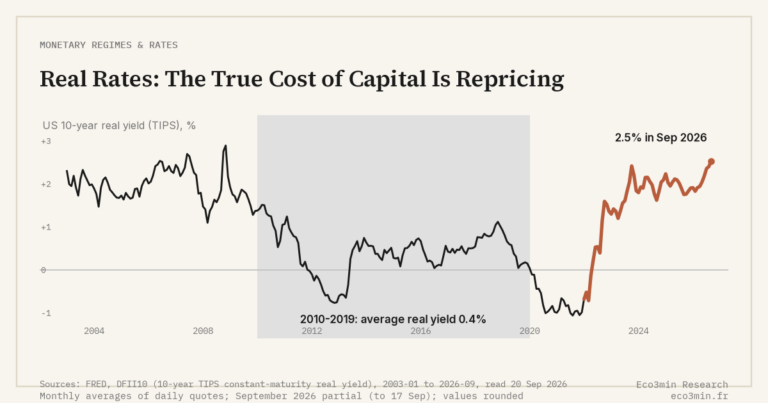
In early 2026, euro area sovereign long rates remained roughly 150 basis points above their 2021 levels, according to Refinitiv data. This persistence at an elevated level — despite the short-rate cuts initiated by the ECB — reflects term premium and persistent inflation expectations that dampen the accommodative signal. The time required for full diffusion of a monetary impulse is extended accordingly.
- Investment project irreversibility gives waiting an economic value that delays the response to rate cuts.
- Corporate budget planning cycles impose a structural lag of six to eighteen months between monetary signals and adjustments in capital flows.
- Long rates, more than short rates, drive long-term investment trade-offs — and their trajectory at times diverges from that of policy rates.
The dominant consensus in early 2026 anticipated a recovery in productive investment in the euro area starting in the second half. This projection rests on the assumption of fast transmission from rate cuts to the productive sphere. Analysis of irreversibility mechanisms, planning cycles and the persistence of long rates points to a more drawn-out timeline. The communication strategy of central banks seeks to shorten these lags by anchoring expectations, but investment remains subject to constraints that largely escape the monetary instrument. Regular monitoring of cyclical indicators makes it possible to identify the first signs of inflection in investment flows. Further reading: Our examination of how the rate cycle lands on company margins.
Last updated — 12 July 2026
Disclaimer – Financial Information: The analyses, commentary, and content published on eco3min.fr are provided for informational and educational purposes only. They do not constitute investment advice or a solicitation to buy or sell financial instruments. Past performance is not indicative of future results. All investment decisions involve risk and are the sole responsibility of the reader.
Read next
Full pillar →Real Rates: The True Cost of Capital Is Repricing
Why real rates are reasserting themselves as markets' anchor and how to recalibrate investment and financing decisions facing…
Real Interest Rates: The Quiet Signal Reshaping Markets
Real interest rates: why their persistence in positive territory in 2026 is reshaping the rules for bonds, equities,…
OAT-Bund Spread: A Quiet Gauge of French Sovereign Risk
OAT-Bund spread: how this yield gap has become a key signal on French sovereign risk, fiscal policy and…