Why the Real Economy and Financial Markets Tell Different Stories
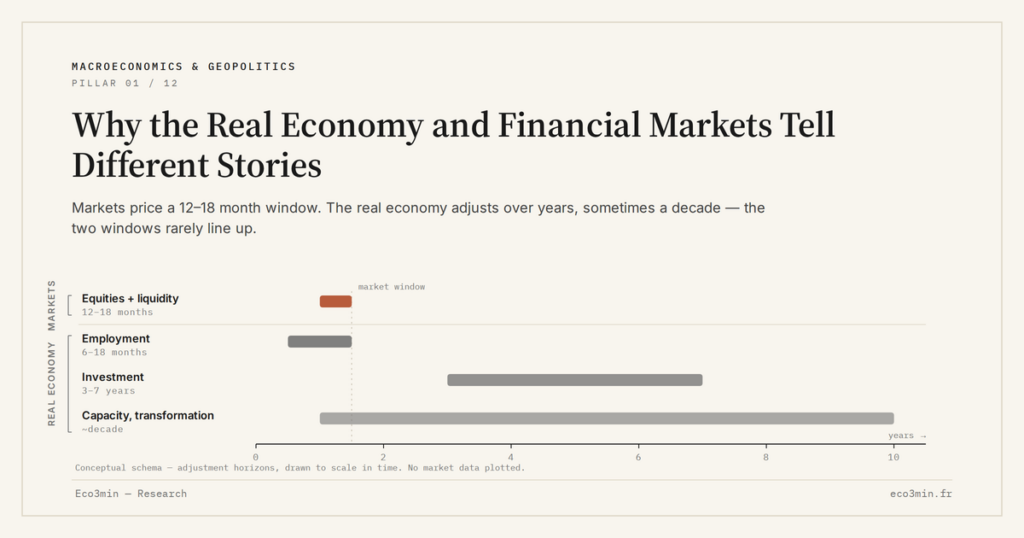
Markets price on a 12 to 18-month horizon while the real economy moves over years. The mismatch is structural, not cyclical — and it is the most reliable source of false cycle signals.

Financial markets and the real economy share the same environment but run on incompatible clocks. The mismatch is structural — and it explains why most contradictory cycle readings reduce to a horizon confusion.
TL;DR
In 2022 the S&P 500 fell 25% with no recession to follow, an illustration of markets and the real economy pricing on horizons that rarely align.
- The S&P 500 dropped 25% from January to October 2022 with no recession following, while in 2007 indices sat near record highs only months before the worst crisis since the 1930s.
- The seven largest S&P 500 capitalizations exceeded 30% of the index at the end of 2025, with the top ten Euro Stoxx 50 weights above 50%, so index performance tracks a handful of firms more than the broad economy (S&P Global).
- Equity records coexisted with euro-area growth struggling to clear 1% and European manufacturing's longest contraction in a decade (S&P Global PMI), two valuation logics reading different inputs on different horizons.
Markets reprice in real time on releases, monetary decisions and geopolitical shocks. The productive economy moves over months for investment, years for capacity adjustments, decades for sectoral transformations. The two clocks do not converge — they only briefly align, and the alignment is what most observers mistake for causation. Conflating market tempo with real-economy tempo is the single most reliable source of false signals — because financial markets and the real economy never move in sync.
The horizon mismatch is not a cyclical anomaly. It is a feature of how the two systems work, and it permanently shapes the reading of business cycles.
The decoupling between markets and the real economy widened after the 2020 crisis. This is traced in detail in this analysis of us china decoupling markets. Equity indices reached historical records through the mid-2020s while euro-area growth struggled to clear 1% and European manufacturing endured its longest contraction in a decade according to S&P Global PMI data. The apparent paradox is not one. It reflects two valuation logics with different inputs, weighted differently, on different horizons — and only one of the two reflects the activity of the real economy.
Two horizons that do not overlap
Equity markets price 12 to 18-month earnings expectations plus current liquidity conditions. The real economy moves on investment cycles of three to seven years, employment adjustments of six to eighteen months, and capacity transformations spanning a decade. The real business cycle and its structural sequencing unfold on a tempo that markets cannot mechanically replicate — which is why the recurring false signals are recurring rather than accidental.
The 2022 episode illustrates the pattern. The S&P 500 fell 25% between January and October, signaling an imminent recession according to most market commentary at the time. No recession followed: US growth continued above potential through 2023. The reverse asymmetry appeared in 2007, when equity indices sat near historical highs only months before the most severe financial crisis since the 1930s. Markets are not a reliable leading indicator of the cycle, and they are not a faithful mirror of activity. They are something else — a system pricing expected cash flows and current discount rates, on a window that rarely lines up with the real-economy window.
What feeds the current decoupling
Three factors widened the gap observed in 2025-2026. The first is the sectoral concentration of equity indices. In the United States, the seven largest S&P 500 capitalizations represented more than 30% of the index at the end of 2025 according to S&P Global — a historical concentration that means index performance reflects the trajectory of a handful of technology firms more than that of the broader economy. The same dynamic appeared in Europe to a lesser extent, with the top ten Euro Stoxx 50 weights accounting for over 50% of the index.
The second factor is the pre-emptive pricing of monetary policy. Markets discount expected rate cuts well before they materialize, which sustains valuations even as activity weakens. The monthly releases and their inherent volatility amplify this dynamic by triggering recurring repricings on each data point, independently of the underlying trend. The mechanism is rational at the level of each repricing and incoherent at the level of the trend it produces.
The third factor is the continuous information flow that mixes data and commentary. Rolling coverage amplifies micro-variations and creates an impression of economic volatility absent from the actual data series. Markets respond to that perception layer as much as to fundamentals, and the perception layer has thickened faster than the data layer over the past decade.
- Markets and the real economy operate on incompatible horizons: 12 to 18 months for asset prices, three to ten years for productive activity.
- Sectoral concentration of equity indices, pre-emptive pricing of monetary policy and media noise feed a structural — not cyclical — decoupling.
- An equity rebound does not mechanically signal a recovery, and an index drawdown does not automatically foreshadow a recession.
Markets nonetheless retain diagnostic value in narrower configurations. Credit spreads — the gap between corporate bonds and sovereign yields — capture systemic financial stress with a meaningful lead over real-economy data, because they reflect actual financing conditions rather than expected cash flows. The yield curve, despite a degraded track record over the most recent cycle, retains predictive content over longer windows. The broader analytical frameworks of the cycle describe markets as one complementary signal among several rather than a unified indicator. The signal is real when the question matches the window — and the window is rarely the one in the headline.
Last updated — 14 June 2026
Disclaimer – Financial Information: The analyses, commentary, and content published on eco3min.fr are provided for informational and educational purposes only. They do not constitute investment advice or a solicitation to buy or sell financial instruments. Past performance is not indicative of future results. All investment decisions involve risk and are the sole responsibility of the reader.
Read next
Full pillar →Monetary Tightening: How Central Banks Are Reshaping Financial Markets
After more than a decade of ultra-accommodative policy, monetary tightening has reintroduced the real cost of capital as…
Hidden Unemployment: Reading the Real Labor Market in 2026
Headline unemployment is stabilizing while broad underemployment still runs above pre-2020 levels. Reading the gap between official rates…
2026 Economic Outlook: Key Trade-Offs After the End of Cheap Money
2026 ushers in a more constrained macro regime where real rates stay positive, fiscal space narrows and geoeconomic…