The Value of Tax Deferral Depends on the Rate Regime

Tax deferral, the core advantage of a traditional 401(k), IRA or annuity, is usually praised as a flat benefit. It is not flat. The worth of postponing tax depends on the rate regime, because what deferral spares you, the tax on income earned along the way, scales with the level of rates.
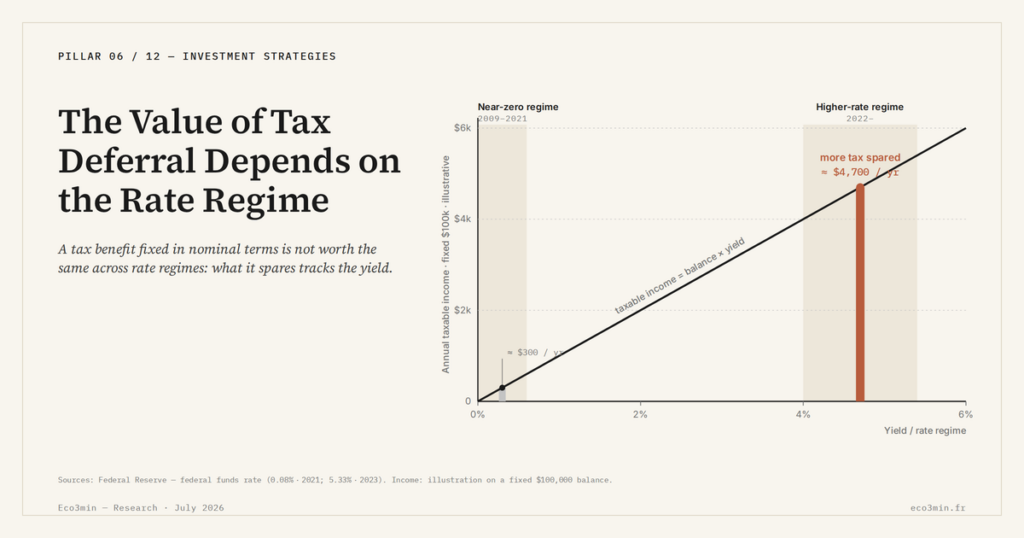
Through the near-zero decade after 2008, sheltered income was thin and deferral’s edge over a taxable account was modest. As rates rose, the same shelter began sparing larger annual tax, with no change in the rules. This piece reads deferral through the rate cycle.
Tax deferral’s value, measured against a taxable account, is the annual tax it spares on interest, dividends and realized gains, and that income scales with the rate regime.
- In a near-zero regime, yields and taxable income are small, so the tax drag a sheltered account avoids is slight.
- In a higher-rate regime, yields rise, annual taxable income grows, and the same deferral spares more tax each year.
- The cost side does not move with rates: a traditional account defers to ordinary-income rates at withdrawal, often above the capital-gains rate a taxable account would pay.
Tax deferral is the core advantage of a traditional 401(k), IRA or annuity: contributions and growth go untaxed until withdrawal. It is almost always described as a fixed benefit, a flat property of the account. Its worth, however, depends on the rate regime. This piece reads deferral not as a static gain but as a mechanic whose value moves with the rate cycle. It does not re-explain retirement accounts, whose floor is set in the ordinary rate deferral ultimately pays; it focuses on a single point: how the level of rates changes what deferral is worth. This is the timing of taxation a wrapper sets, read here through the rate environment.
1. Deferral, a benefit often treated as fixed
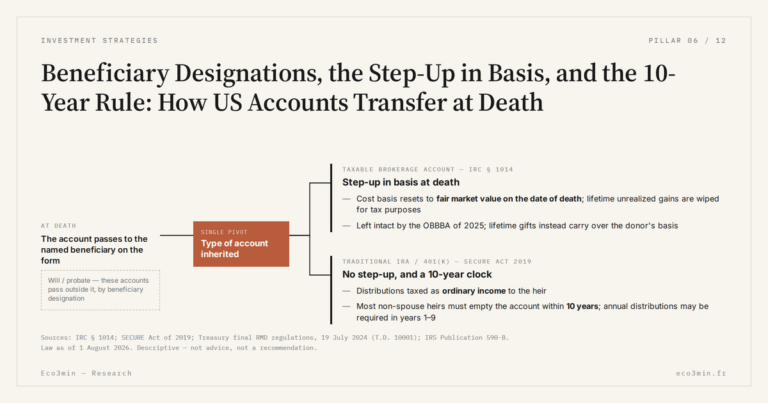
What deferral actually spares is best seen against the alternative. In a taxable brokerage account, interest and dividends are taxed in the year they are received, and realized gains are taxed when positions are sold. A sheltered account removes that annual charge: nothing inside it is taxed until withdrawal, so income compounds on a pre-tax base. The benefit is the tax not paid along the way, reinvested and compounding, year after year, until the account is tapped. What happens to the account once it passes to heirs, and how its taxable value resets at death, is set out in beneficiary designation and the step-up in basis.
This is why deferral is sometimes described as an interest-free loan from the Treasury: the tax you would otherwise have paid stays invested and works for you until withdrawal. But the size of that loan is not fixed. It equals the tax that would have fallen due in a taxable account, and that figure depends on how much taxable income the holdings throw off each year. A portfolio generating little income hands the Treasury little to lend back; a portfolio generating substantial interest and dividends hands back more. The benefit scales with the income sheltered, not with the account itself.
2. Why its value depends on the rate regime
The income a portfolio throws off is governed by the rate environment. Through the near-zero decade that followed 2008, cash and bond yields were minimal, dividend yields were compressed, and a typical balance generated modest annual taxable income. The tax a sheltered account spared was correspondingly small: deferral existed, but its edge over a taxable account was thin, because there was little annual tax to avoid in the first place. Spreading a balance across accounts taxed differently is one answer to that sensitivity, and it is the one weighed in why tax diversification matters across rate regimes.
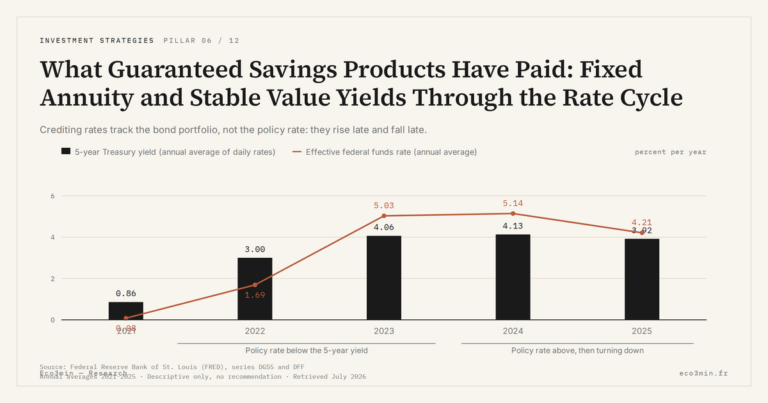
As the rate regime shifted higher from 2022, the picture changed. Bond and cash yields rose, lifting the annual interest a balance produces, and the same deferral began sparing materially more tax each year. The shelter did not change; the income it shelters grew. Deferral moved from a marginal advantage to a substantial one, driven entirely by the level of rates. The link runs straight to monetary policy: short-term yields track the Fed funds rate regime, so the value of sheltering interest income rises and falls with it. A $100,000 balance yielding 2% throws off $2,000 of taxable income a year; the same balance yielding 5% throws off $5,000, and a sheltered account spares the tax on the larger figure. What guaranteed savings of this kind have actually paid across past rate cycles is recorded in the crediting history of stable-value products.
Compounded over a working career, that difference is not trivial. The annual tax spared in a higher-rate regime is itself reinvested inside the shelter, so the gap between sheltering and not sheltering widens year after year, geometrically rather than linearly. A balance that spares roughly $1,200 of tax a year rather than $500 does not merely save $700 more annually: it reinvests that $700, which then compounds untaxed alongside the rest. Over decades, the rate regime that prevailed during the accumulation years leaves a visible mark on the final after-tax balance, through a channel the headline description of deferral never mentions. Also relevant: the taxation of REIT distributions as ordinary income.
3. The cost side and the rate trade
Deferral is not free, and its cost runs the other way. A traditional account defers to ordinary-income rates at withdrawal, frequently above the long-term capital-gains rate the same dollars would face in a taxable account. The net worth of deferral is therefore the annual tax drag it spares, set against the rate-conversion cost it imposes at the end, ordinary rates instead of capital-gains rates. The rate regime tilts the first term: a higher regime widens the drag avoided, strengthening the case for deferral, while the conversion cost on the other side does not move with rates. A parallel cost sits inside insurance products, charged layer by layer and quantified in the variable-annuity fee stack.
A second axis runs alongside the rate regime, and the two should not be conflated. The bracket gap, the difference between the marginal rate today and the rate expected at withdrawal, determines whether deferral converts income favorably or unfavorably. That gap between today’s and tomorrow’s rate is the hinge of the choice between Roth and traditional 401(k)s. A saver who expects a lower bracket in retirement gains on both counts; one who expects a higher bracket may find the conversion cost outweighs the sheltering benefit, whatever the rate regime. The rate regime governs how much annual tax the shelter avoids; the bracket gap governs the price of the deferral at the end. The two move independently, and a full reading weighs them together rather than collapsing one into the other. Directly related: the sheltering of REIT income across accounts.
The mirror image is instructive. A Roth account inverts the trade: tax is paid today, nothing is deferred, and qualified withdrawals come out tax-free. Where a traditional account’s deferral value rises with the rate regime, through the annual income it shelters, a Roth’s value rises instead with the expected future bracket, since it locks in today’s rate against a higher one later. The two wrappers answer different bets, and the rate regime tilts only one of them, leaving the Roth’s case to rest on the direction of future rates of tax rather than of interest. For the broader picture: deferring tax on retirement contributions.
Two qualifications sharpen the reading. For a pure buy-and-hold equity position, a taxable account also defers gains until sale, so deferral’s advantage there is narrower and concentrated on dividends; the advantage is widest for interest-bearing assets, whose income is taxed annually. And an annuity layers its own fees on top, which can erode the deferral benefit regardless of the rate regime; in a low-rate environment, where the sheltered income is small to begin with, those fees can swallow the deferral edge entirely, leaving the wrapper’s tax advantage largely nominal. The same age commitment applies as well: reaching the deferred balance early carries the penalty on early access, the price of the deferral itself.
Treating tax deferral as a fixed benefit ignores the rate regime. Deferral’s value, against a taxable account, is the annual tax it spares on income, and that income scales with yields: in a near-zero regime the shelter avoids little tax, while in a higher-rate regime it avoids materially more. The cost side, ordinary-income rates at withdrawal, does not move with rates, so the net case for deferral shifts with the cycle.
4. What this reading does not say
Reading deferral through the rate regime does not say which account to use. That deferral’s edge is wider in a higher-rate regime is not a timing instruction: the choice between a sheltered and a taxable account depends on the gap between today’s bracket and the rate at withdrawal, the holding horizon, the need for liquidity and the mix of income versus growth in the portfolio. The reading lights up the value of a benefit; it does not fix a decision.
The wider point is transferable: a tax benefit expressed as a deferral does not hold a constant value over time. Its worth moves with the environment, here the level of rates, just as the deferral question sits within the broader work of reading investments by rate regime. A benefit that looks flat on paper can be slight or substantial depending on the cycle.
One question remains, made visible without being settled: for a given portfolio, does the rate regime generate enough sheltered income for deferral’s edge to outweigh its ordinary-income cost at the end? The answer depends on the yield environment and the mix of holdings. It is because it depends on both that deferral reads as a benefit sensitive to the cycle, not a fixed property of the account.
Last updated — 29 August 2026
Disclaimer – Financial Information: The analyses, commentary, and content published on eco3min.fr are provided for informational and educational purposes only. They do not constitute investment advice or a solicitation to buy or sell financial instruments. Past performance is not indicative of future results. All investment decisions involve risk and are the sole responsibility of the reader.
Read next
Full pillar →Beneficiary Designations, the Step-Up in Basis, and the 10-Year Rule: How US Accounts Transfer at Death
At death, most US financial accounts pass outside the will, straight to a named beneficiary, under tax rules…
The Fee Stack in Variable Annuities: M&E Charges, Riders, and Subaccount Costs
A variable annuity does not carry one fee, but a stack of them. Mortality and expense charges, subaccount…
The Conventional 401(k)-Match-First Funding Order: Where It Comes From, How It Works
The question of what order to fund accounts in usually draws a fixed list, presented as a rule…