Financial Leverage and Personal Finance Education: The Diffuse Risk
Financial leverage and personal finance education: how widespread credit and leverage reshape financial decisions in ways that often go unnoticed.

Financial leverage and personal finance education: how widespread credit and leverage reshape financial decisions in ways that often go unnoticed.
TL;DR
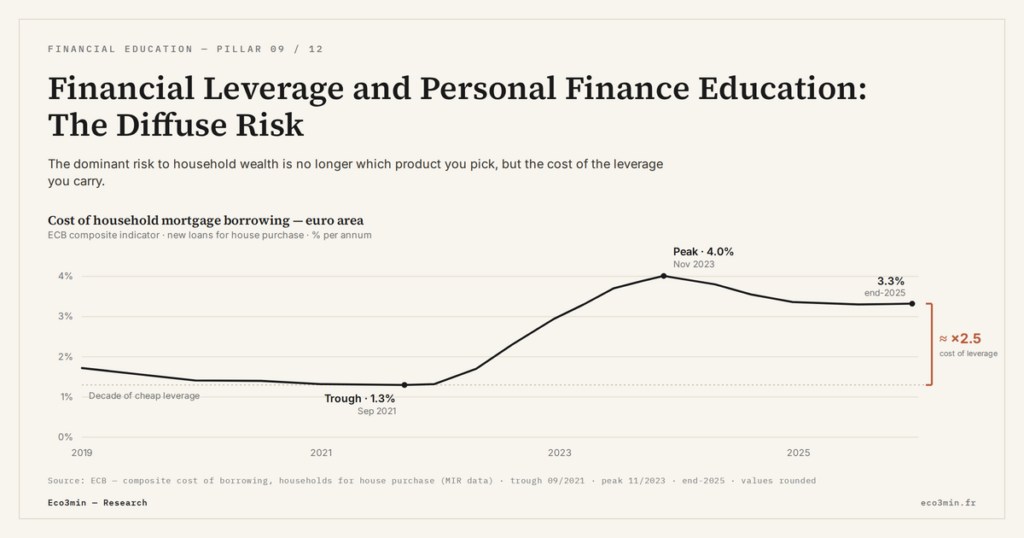
Euro-area mortgage costs more than doubled since 2021, from ~1.3% to ~3.2–3.5%, making the same debt load structurally riskier today than the identical level carried in 2018.
- Euro-area mortgage cost rose from ~1.3% to ~3.2–3.5% by end-2025 (ECB), after central banks lifted policy rates ~400–500 bps in two years against 2022 inflation above 8%.
- Aggregate leverage — mortgage, consumer credit, broker margin, BNPL — is where household risk concentrates, much of it unlabeled as leverage in marketing.
- A debt-service-to-net-income ratio above 30–35% is the commonly cited threshold beyond which minor shocks like job loss or rate resets turn hazardous.
- Access has democratized risk: platforms now offer 2x–5x leverage from €10, while credit-fuelled real estate has corrected ~5–15% since 2023.
Leverage is not just an exotic trading option. It also encompasses your mortgage, your consumer credit, your broker margin, and your business borrowing to invest. Since 2022, with policy rates rising to around 4–5% in major economies (Fed, ECB), leverage has become significantly more expensive — and significantly more dangerous. Yet personal finance education has lagged on this topic, even as it has modernised around ETFs and simple budget management.
A quiet but structural shift is underway: risk no longer originates solely from poor asset selection, but from the way households and small businesses accumulate leverage without measuring it.
This gap illustrates a central limit of the current approach: without financial education genuinely structured around the balance sheet, credit and aggregate leverage, many decisions appear rational in isolation yet become hazardous once aggregated within a single financial trajectory. When the trajectory tightens, that aggregation becomes harder to perform, a narrowing of attention that belongs to decision quality under financial strain.
Key takeaways today
- Since 2021, the average cost of mortgage credit has more than doubled in the euro area (≈1.3% to ≈3.2–3.5% at end-2025, ECB data) → each euro of leverage now weighs significantly more on cash flow.
- Leverage is rarely framed as such in marketing materials (revolving credit, BNPL, leveraged ETFs) → this blurs risk perception.
- Part of the personal finance education consensus focuses on “product selection” while the central issue increasingly becomes the aggregate quantity of risk taken via leverage.
- More restrictive monetary policies since 2022 have made leverage errors substantially costlier than during 2010–2019, when rates were near zero.
- Mastering financial leverage within personal finance education is, today, more consequential for household wealth than capturing an additional 0.5% of return on an ETF.
Detailed analysis
Between 2010 and 2019, with policy rates close to 0% across advanced economies (Fed, ECB, BoJ), leverage appeared nearly costless. Mortgages at 1%, cheap corporate credit and equity markets buoyed by liquidity built a collective narrative: “borrowing to invest is almost risk-free.” That decade shaped reflexes that persist today, even though the environment has shifted radically since 2022.
Since 2022, central banks have raised policy rates by ≈400 to 500 basis points within two years to counter inflation that exceeded 8% in some economies in 2022 (Fed, ECB, IMF data). Direct consequence: debt service now weighs more heavily on household and corporate budgets. Indirect consequence: asset valuations (real estate, equities, crypto) have become more volatile and therefore more sensitive to leverage. The same level of debt as in 2018 is structurally riskier today.
Worth noting: part of the dominant discourse in personal finance education remains focused on asset allocation (60/40, world ETFs, geographic diversification). These frameworks are useful, but they often implicitly assume leverage remains reasonable and stable. The analysis here diverges: the critical parameter in 2025–2026 is no longer just portfolio composition — it is the aggregate leverage one carries through credit, margin, collateral and off-balance-sheet commitments.
An angle often left aside: the longer monetary policy stays “higher for longer”, the more financial education must integrate leverage management as a core competency, on par with understanding interest rates or real returns. Failing to do so means continuing to teach a low-rate world that no longer exists. As long as textbooks stay organised around products, that blind spot remains one of the reasons advanced for the ineffectiveness of financial education.
This connects to a broader framework rarely made explicit in financial education: leverage is not an isolated decision but a sequencing decision. The deeper analysis on structuring financial decisions over time shows that the major risk emerges when leverage is activated before income stability and safety margins are genuinely secured.
Within this framework, the key question is not only “how much leverage can I use”, but how much stress my financial structure can actually absorb without triggering forced sales or irreversible decisions. The Eco3min financial resilience simulator extends this reasoning by allowing concrete scenarios to be tested — income decline, persistent inflation, expense shocks or credit tightening — to assess whether safety margins are sufficient before activating any additional leverage.
Concrete implications: what changes now
Behind the interest in financial leverage and personal finance education, the underlying question is straightforward: “How far can borrowing or leverage go without endangering my financial future?” Three areas for immediate action:
- For retail investors: financial leverage exposure (margin, derivatives, leveraged ETFs) is commonly observed to stay around 0–2% of net financial wealth among cautious profiles, 3–5% among experienced ones. A simple indicator: an “annual debt service / net income” ratio below 30% is typically considered manageable, with 35% often cited as a ceiling.
- For entrepreneurs and freelancers: corporate credit can be considered as a portfolio risk line. A common rule of thumb is at least 6 months of debt service in available cash. Beyond that threshold, leverage becomes explosive in revenue downturns, as observed in 2020–2021 during the lockdown periods.
- Across profiles: a “leverage error cushion” is often integrated into allocation rules. Example structure: 50% long-term core (unleveraged ETFs), 30% projects and liquidity, no more than 20% in real estate or credit-financed projects, while avoiding the additional layer of speculative leverage.
Conversely, what could invalidate this framing would be an aggressive and durable cut in policy rates from 2026, bringing real rates close to zero. This scenario is not the most probable in current projections (which lean toward slightly positive real rates), but it would reduce pressure on debt service. The market mainly watches strong economic slowdown signals and inflation returning toward 2% to revise this framework.
The micro-trends that matter
- Rising consumer credit defaults: across several developed countries, defaults on consumer credit and credit cards rose by ≈1 to 2 percentage points between 2021 and 2024 (national central bank data). This is a leading indicator of poorly managed leverage at the household level.
- Proliferation of “BNPL” (Buy Now Pay Later) products: these disguised micro-loans, prevalent in e-commerce, create discreet, fragmented leverage that is difficult to monitor. The signal is still buried in noise but could weigh on aggregate purchasing power if rates remain elevated.
- Rise of low-ticket margin trading: certain platforms now offer 2x or 5x leverage accessible from €10. The psychological barrier has fallen, but the risk has not.
- Pressure on heavily leveraged real estate: markets most fuelled by credit between 2015 and 2021 have shown price corrections of around 5–15% since 2023. Where debt is high, even a small price drop can erase years of savings.
- Demand for debt-tracking tools: the appetite for global wealth and debt management applications is rising. This gradual shift reflects a need for financial education that is more balance-sheet oriented than purely budget-focused.
Plausible medium-term scenarios
Dominant projections envision policy rates declining slowly from 2026, stabilising around 2–3% in the long run across major economies (IMF / central bank framework). On that basis, three plausible trajectories for financial leverage and personal finance education:
- Scenario 1 — Controlled normalisation (central scenario): rates decline moderately, incomes progress, households and businesses learn to balance their leverage. Personal finance education progressively integrates debt-management tools and simple rules (leverage caps, personal stress tests). KPIs to watch: credit default rates and household debt / disposable income ratio.
- Scenario 2 — Localised leverage accident: a heavily indebted segment (investment real estate, consumer credit, some leveraged crypto) absorbs a violent shock (price decline, unemployment, regulation). Losses are concentrated but instructive at scale. This is not the central scenario today, but markets do not fully price this possibility on the most speculative segments.
- Scenario 3 — Sharper macro reversal: pronounced recession, rising unemployment, declining incomes. Even if rates fall, leverage accumulated between 2015 and 2024 becomes unsustainable for some actors. Personal finance education then refocuses urgently on deleveraging rather than investing. KPI: unemployment rate trajectory and bank non-performing loans.
In every case, the short term (2025–2026) is a window for adjusting leverage before the more strained scenarios potentially materialise.
Frequently asked questions on leverage and financial education
- How to tell if leverage is excessive in personal finances?
A useful benchmark: sum all monthly credit payments (mortgage, auto, consumer, BNPL) and compare them to net income. Above 30–35%, even minor shocks (unemployment, variable rate increases) can become hazardous. Speculative exposures (margin, leverage) should be added for an aggregate view. - Is equity leverage always detrimental for a retail investor?
Not necessarily, but it has historically remained marginal in resilient portfolios. Leverage on a small share of the portfolio can fit very experienced investors operating with strict stop and position-sizing rules. For most, the risk of emotional behaviour (panic, over-buying) makes equity leverage more destructive than productive. - Is paying down debt preferable before investing?
When the net credit rate (after any tax benefits) exceeds the reasonable expected return on investments (e.g. 4–5%), repaying debt has historically been the most efficient option. Below that threshold, a mix can be relevant: gradual deleveraging plus regular investing. - How to integrate leverage into asset allocation?
Debt can be considered as a “short cash position”. A simple guideline: avoid having more than 80–90% of net wealth tied up in illiquid assets financed by credit. A meaningful share of liquid assets typically helps absorb shocks. - Do leveraged products (2x, 3x ETFs) belong in a long-term portfolio?
Generally not, because their daily mechanics (rebalancing, volatility decay) erode performance over long horizons. They can serve short tactical periods but rarely sit at the core of a long-term strategy.
Common reading errors
- Confusing borrowing capacity with repayment capacity: a bank’s willingness to lend does not guarantee shock absorption. The relevant criterion is room to manoeuvre during shocks (income decline, expense increases).
- Looking only at the rate, not the duration: a 25-year loan at 3% can be heavier than a 15-year loan at 4%. Total cost and flexibility matter more than the headline rate.
- Ignoring correlation between debts and assets: borrowing for an asset highly correlated with one’s income (e.g. local real estate plus local employment) concentrates risk rather than diversifying it.
At its core, what many readers seek here is to understand whether it is “too late” to reduce leverage, or whether to wait for hypothetical rate cuts. The relevant question is not whether rates rise or fall by another 0.25%, but whether one’s debt structure allows peaceful sleep over the next five years, regardless of central bank decisions. This is where financial education must evolve: less focus on the miracle product, more on the global architecture of risk. Background: our breakdown of everyday financial trade-offs across economic regimes.
For investors, integrating financial leverage into personal finance education means adjusting the global size of bets rather than chasing the next idea. For businesses, it means reconsidering the debt / equity mix before credit tightens again, as observed during episodes of heightened volatility in 2025. For households, it means accepting that wealth performance hinges as much on leverage discipline as on asset selection.
We’ll revisit tomorrow with a possibly different market backdrop.
Three key takeaways
- The key parameter in 2025 is no longer the “right product”, but the global level of leverage carried at durably higher rates.
- A simple “debt service / net income” ratio above 30–35% transforms each minor economic shock into a personal crisis risk.
- Mastering financial leverage within personal finance education means accepting reduced upside potential to substantially lower the probability of ruin.
Last updated — 30 July 2026
Disclaimer – Financial Information: The analyses, commentary, and content published on eco3min.fr are provided for informational and educational purposes only. They do not constitute investment advice or a solicitation to buy or sell financial instruments. Past performance is not indicative of future results. All investment decisions involve risk and are the sole responsibility of the reader.
Read next
Full pillar →Series I and EE Savings Bonds: Locked Formulas in a Moving Rate World
US savings bonds lock a rate formula at the moment you buy them, for the life of the…
Where the Livret A’s Money Goes: The Caisse des Dépôts Circuit and Social-Housing Finance
The savings held on Livret A accounts do not sit idle. A regulation-set share is centralised at the…
France’s LEP vs the Livret A: A Means-Tested Higher Rate, Explained
France’s Livret d’épargne populaire is often described as "the Livret A, only better". The description misleads: the LEP…