
Why the Real Estate Market Often Reacts Against Macro Expectations
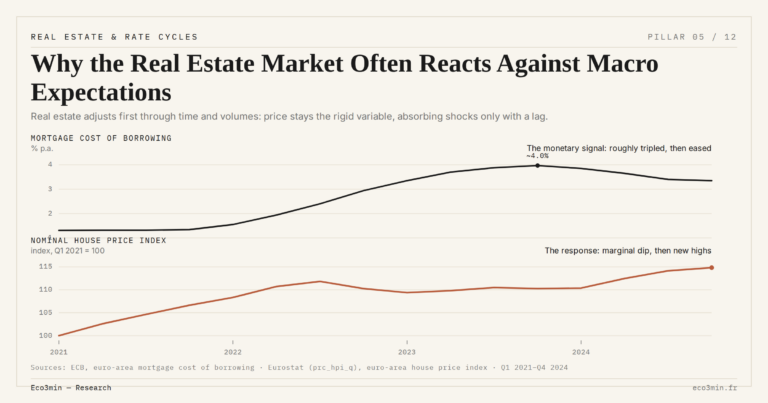
Price inertia, the central role of credit and supply constraints explain why the real estate market often reacts against the most visible macroeconomic signals.
Price inertia, the central role of credit and supply constraints explain why the real estate market often reacts against the most visible macroeconomic signals.
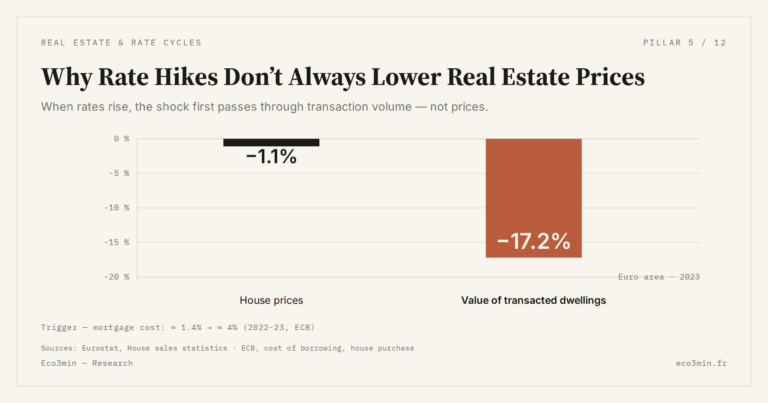
The credit channel, transaction inertia and supply rigidity explain why rising rates do not always translate into an immediate decline in real estate prices.

Gross cash flows, hidden costs and time horizons explain why rental yield frequently overstates the real economic performance of residential property investments.

Real estate combines long maturities, high household leverage and supply rigidities. This configuration makes property prices particularly sensitive to financing conditions and amplifies credit-cycle dynamics.

Monetary policy influences real estate primarily through credit and long-term rates. Its impact first reaches borrowing capacity, then transaction volumes, before showing up in prices — a gradual sequence that is often misread. TL;DR Monetary policy reaches housing in sequence:…
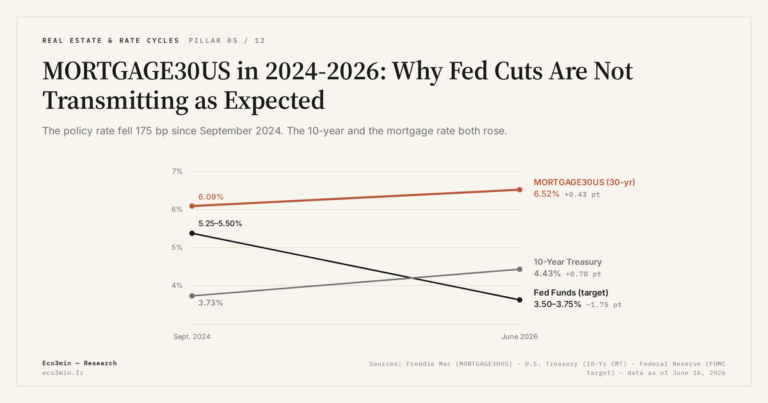
May 2026: MORTGAGE30US prints around 6.5-6.9% even though the Fed started its cutting cycle in September 2024 and Fed Funds has fallen roughly 150 basis points. Fed-to-mortgage transmission is not operating with historical elasticity. Three competing readings circulate — widened…
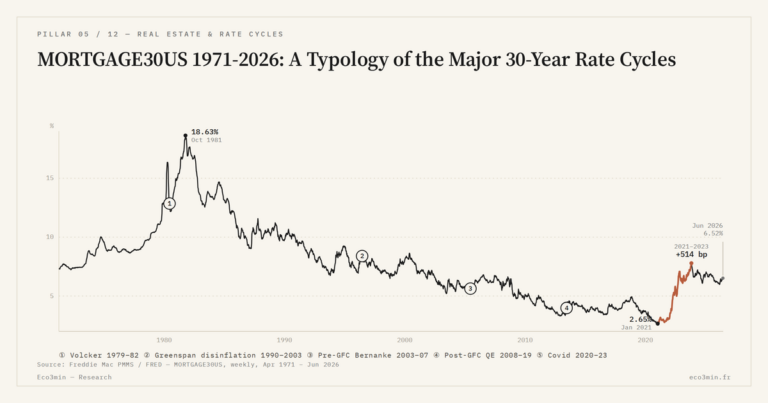
Five major cycles structure the MORTGAGE30US history since its 1971 inception: Volcker, Greenspan disinflation, pre-GFC Bernanke, post-GFC QE, COVID. Each has its trigger — monetary policy, inflation shock, financial crisis, pandemic — and a characteristic duration. TL;DR The 2021-2023 jump…
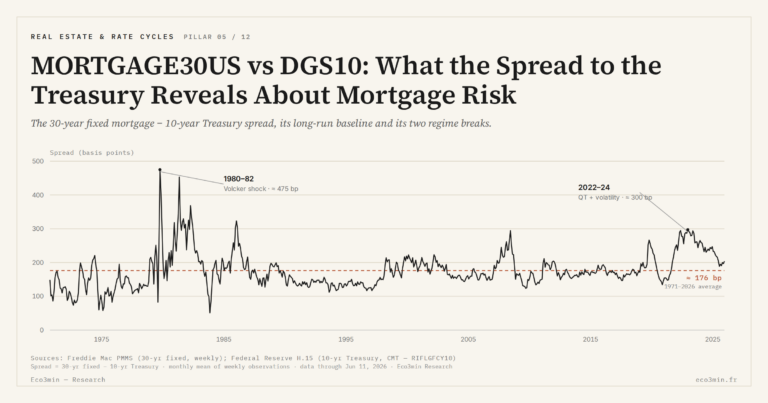
The MORTGAGE30US level says little without its distance to the 10-year Treasury. The spread, averaging around 170 basis points since 1971, breaks down into three premia — prepayment, rate volatility, MBS liquidity — making this gap the real diagnostic tool…
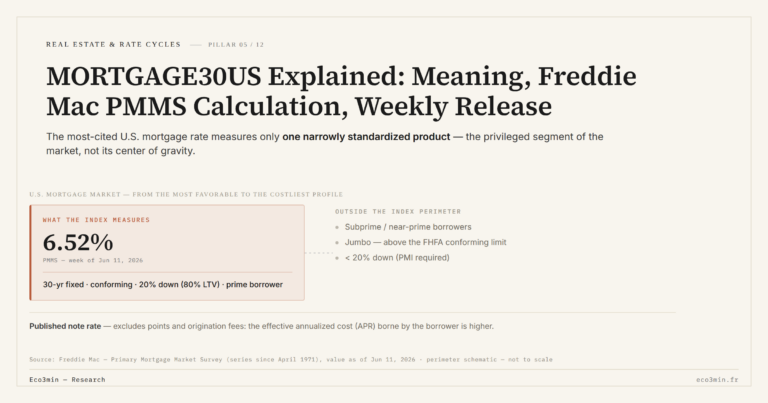
The most-cited U.S. mortgage rate, MORTGAGE30US, is a weekly aggregate Freddie Mac has built since April 1971 from a survey of national lenders. What it means depends as much on the standardized product underlying it as on the survey methodology.…

The primary residence is often classed among assets. In reality, it is a hybrid good — consumption, conditional store of value and liquidity constraint — whose valuation only crystallises through sale, with frictions and life consequences attached.