Why the Real Estate Market Often Reacts Against Macro Expectations
Price inertia, the central role of credit and supply constraints explain why the real estate market often reacts against the most visible macroeconomic signals.

Price inertia, the role of credit and supply constraints explain why the real estate market often reacts against macroeconomic signals.
TL;DR
Macro shocks reach the real estate market through transaction volumes and credit conditions first, and show up in prices only with a lag that can exceed 18 months.
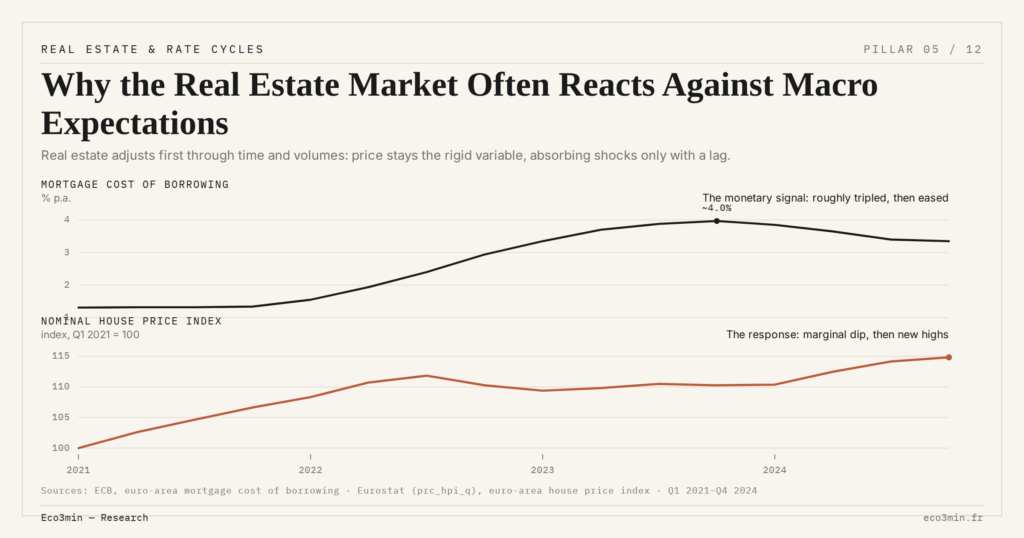
- Euro-area mortgage rates rose from roughly 1.5% in 2021 to about 4% by late 2024, yet nominal prices fell only modestly in several major cities, showing the monetary signal reaches volumes before prices.
- Price levels depend on credit-access conditions more than on the savings stock: when rates rise, the adjustment runs through stricter borrower selection and shrinking purchasing capacity while listed prices stay rigid.
- Euro-area inflation above 5% on annual average over 2022–2024 coincided with markedly slower rent growth, weakening the reading of real estate as automatic protection against inflation.
- Structurally constrained supply, from construction lead times to land scarcity and regulation, plus pro-cyclical public policy, shifts the timing of real estate cycles without removing their structural logic.
At first glance, the real estate market should react mechanically to the most visible macroeconomic signals. Yet its developments frequently contradict intuitive reasoning based on interest rates, inflation or public action. This apparent anomaly stems from structural mechanisms specific to real estate: price inertia, the central role of credit and durable supply constraints. The confusion often comes from an overly immediate reading of variables that act with delay or indirectly. Understanding these levers helps move beyond simplistic interpretations and analyse real estate as an economic system in its own right. Background: our overview of the real estate credit cycle and its price dynamics.
This gap between macroeconomic expectations and observed reactions sits at the heart of the current real estate paradoxes.
- Real estate adjustment runs first through volumes and credit before showing up in prices.
- Supply constraints turn macroeconomic shocks into persistent imbalances.
- Public action shapes the pace of real estate cycles without altering their structural logic.
What the Market Has Yet to Fully Price In
Part of the consensus assumes that monetary normalisation and the end of accommodative policies are enough to trigger a generalised real estate correction. This reading rests on a rapid transmission from rates to demand, as observed in financial markets. Real estate, however, operates on longer time frames and discontinuous adjustments. Transactions slow before prices adjust, creating an illusion of prolonged stability.
This illusion is reinforced by the use of incomplete indicators, such as price per square metre, which fails to capture underlying market tensions correctly, a bias analysed in the study on the limits of price per square metre.
In the euro area, mortgage rates moved from roughly 1.5% in 2021 to ≈4% in late 2024, according to banking statistical frameworks. Yet over the same period, the decline in nominal prices remained limited in several major urban zones. This gap suggests that the monetary signal acts first on volumes, then only on prices, with a lag sometimes exceeding 18 months.
This phase shift is precisely what explains why rate hikes do not mechanically translate into an immediate decline in prices, a mechanism detailed in the dedicated analysis on the lagged response of real estate prices to rate moves.
The Central Role of Credit in Real Estate Dynamics
Contrary to a purely wealth-based reading, real estate is above all a financed asset. Price levels depend less on the available stock of savings than on credit access conditions. When rates rise, the adjustment first passes through stricter borrower selection and a contraction of purchasing capacity, rather than through an immediate decline in listed prices.
This logic explains why markets can remain “stuck” for several quarters: sellers and buyers do not adjust their expectations at the same pace. Price becomes a rigid variable, while volume absorbs the shock. This mechanism is often underestimated in fast macro readings.
This dynamic is all the more pronounced as supply is structurally constrained. Construction lead times, land scarcity and regulatory constraints limit the market’s capacity to adjust through quantity. The result is a market slow to correct, even when macro conditions tighten.
Inflation, Income and the Illusion of Protection
Another frequent consensus consists of treating real estate as automatic protection against inflation. This idea rests on the equivalence between real assets and pricing power. Yet consumer goods inflation does not mechanically translate into an equivalent rise in rents or real estate revenues.
This dissociation is reinforced by the fact that standard indicators often overstate real economic performance, as shown in the analysis on the limits of rental yield as a measure of profitability.
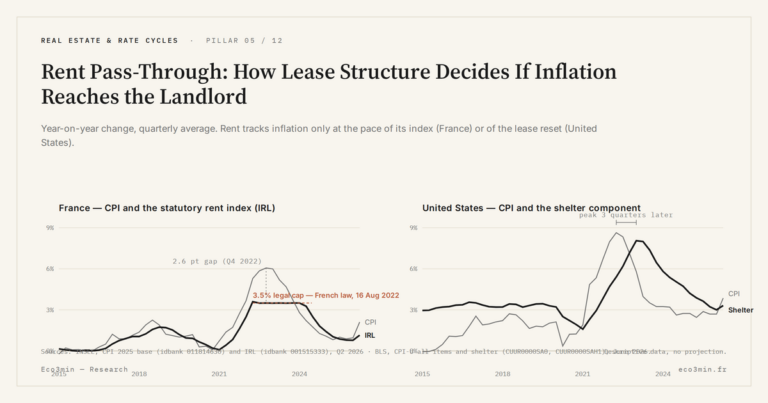
Between 2022 and 2024, euro area inflation exceeded 5% on annual average, while rent growth remained markedly lower in many countries, under the effect of regulatory frameworks and household solvency. This divergence weakens the inflationary reading of real estate and reinforces the counterintuitive nature of its developments.
What the Reader Really Wants to Know
The real question is not so much whether real estate prices will rise or fall, but whether current macro signals are being correctly interpreted. Behind this lies a deeper concern: the risk of basing decisions on indicators that react with delay or indirectly. The point is less to follow an isolated indicator than to understand the sequence in which macroeconomic signals transmit to real estate.
This reading aligns with the detailed analysis showing why real estate is not a systematic protection against inflation, owing to the gaps between prices, incomes and financing.
Public Policy and Persistent Cycles
Public policies are often perceived as a powerful stabiliser of the real estate market. Yet their action operates within long cycles and frequently produces unintended pro-cyclical effects. Tax incentives, support schemes and credit regulation shape behaviour, but rarely the deep structure of the market.
This perception obscures the fact that public policies do not abolish cycles but mainly alter their timing, a point analysed in greater detail in the study on the persistence of real estate cycles despite public intervention.
Some current estimates favour the hypothesis of a soft landing of the market thanks to these mechanisms. This hypothesis rests on the stability of employment and nominal incomes. It nevertheless overlooks the cumulative effects of credit tightening and the gradual erosion of solvent demand.
Variables That Could Invalidate This Reading
This analysis assumes a relatively stable macroeconomic backdrop. A negative demand shock, more prolonged monetary tightening than expected or an abrupt regulatory change could accelerate the adjustment of prices. Conversely, a rapid easing of financing conditions or targeted fiscal support would meaningfully alter the expected trajectory.
These factors would mainly act by breaking the current equilibrium between solvent demand and structural supply rigidity.
Confusing the response of volumes with that of prices leads to overstating the speed of real estate adjustment and to misreading macroeconomic signals.
Key Indicators to Watch
- Evolution of transaction volumes relative to listed prices.
- Bank credit conditions: average rates, durations and lending standards.
- Gap between general inflation and rent growth.
These indicators offer a finer reading than tracking nominal prices alone. They help detect inflections before they become visible in aggregate statistics.
To place these mechanisms within a broader reading of the real estate cycle and credit, the framework set out in the macro reading of the real estate cycle and rates helps distinguish cyclical effects from structural constraints.
In this context, the persistence of contradictory signals reflects less an anomaly than a feature of the real estate market: its ability to absorb shocks through time rather than through prices.
Real estate first reacts through adjustments in volume and credit, with prices integrating macroeconomic shocks only with a delay. This volume-then-price sequence is empirically documented in our analysis of the lag with which real estate prices respond to rate shocks. For context: our analysis of REIT cap-rate mechanics.
Final Outlook
This is not the central scenario today, but a sharper correction could emerge if financing constraints persist without a relay from demand. Conversely, the current apparent stability may mask imbalances that resolve slowly. The point is not to predict a precise move, but to understand why the real estate market regularly defies immediate readings.
- Macro signals affect real estate with long delays.
- Credit shapes the dynamic more than listed prices do.
- Apparent stability can hide adjustments under way.
Last updated — 12 July 2026
Disclaimer – Financial Information: The analyses, commentary, and content published on eco3min.fr are provided for informational and educational purposes only. They do not constitute investment advice or a solicitation to buy or sell financial instruments. Past performance is not indicative of future results. All investment decisions involve risk and are the sole responsibility of the reader.
Read next
Full pillar →US Rental Property Real Yield: What Cap Rate and NOI Actually Leave You
A rental listing leads with a yield. Divide the annual rent by the price and the number looks…
Cap Rate Spread: What Rental Yield Pays Over the 10-Year Treasury
A 5% cap rate sounds attractive. But 5% against what? A risk-free 10-year Treasury yields near 4.5% in…
Vacancy and Turnover: The Cost That Erodes a Landlord’s Real Return
A listing shows full rent, twelve months a year. The owner knows the gaps between tenants, the make-ready…