
How Real Rates Shape Long-Term Growth
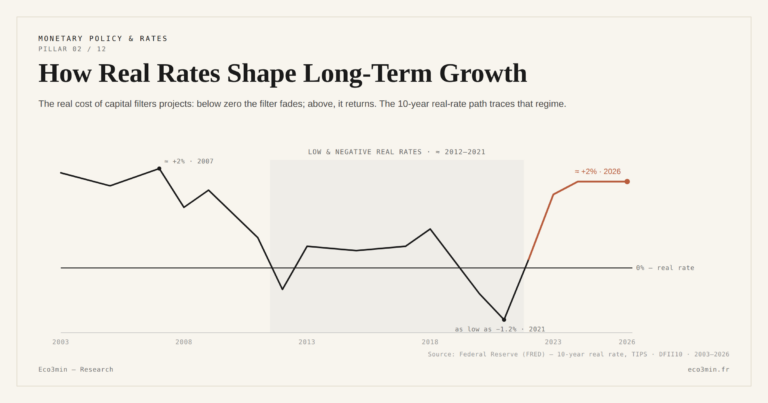
Beyond cyclical fluctuations, real rates condition the pace of capital accumulation and the quality of investment — two direct determinants of potential growth in advanced economies.
This tag is central to the Eco3min framework. The real rate — the nominal rate adjusted for expected inflation — is the pivotal variable of modern macro-finance. It determines the true cost of capital, drives the valuation of all assets and reflects the effective stance of monetary policy. When real rates move, everything moves.
Beyond cyclical fluctuations, real rates condition the pace of capital accumulation and the quality of investment — two direct determinants of potential growth in advanced economies.
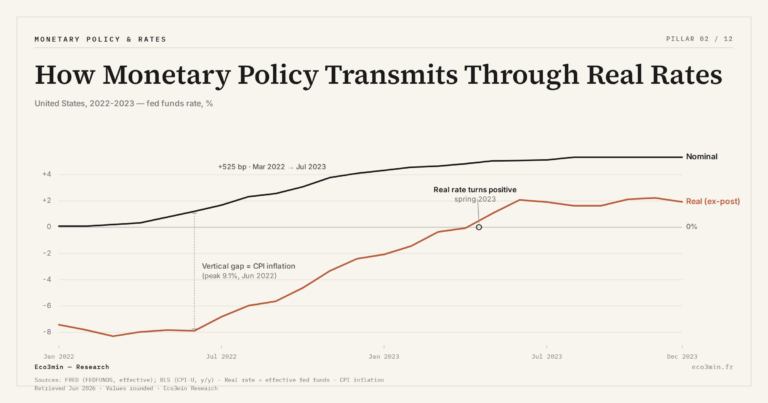
Central banks set nominal rates, but the economy responds to real rates. This gap explains why identical policy moves produce divergent effects across inflation contexts, with transmission lags of 12 to 24 months.
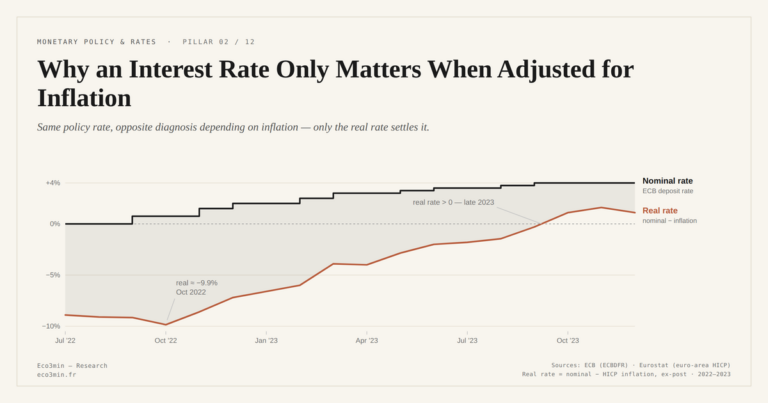
An interest rate displayed at 5% can look high — but if inflation runs at 6%, savers lose purchasing power each year despite the apparent yield. This piece distinguishes nominal from real rates and shows how money illusion distorts the diagnosis of monetary conditions.
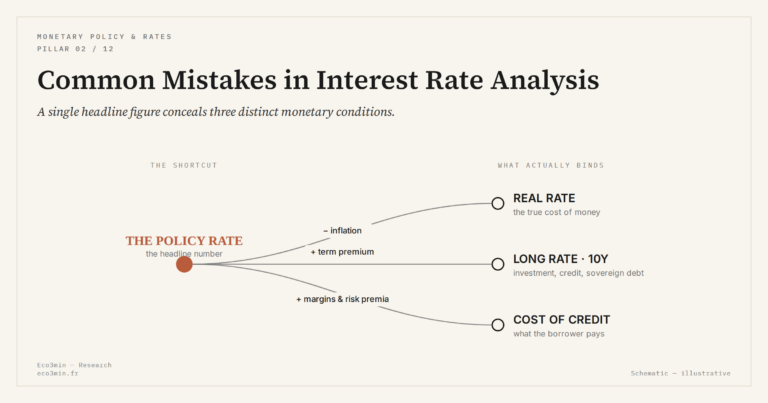
Confusing nominal with real, short with long, policy rate with credit cost: three analytical shortcuts that systematically distort the diagnosis of actual monetary conditions in economic commentary.
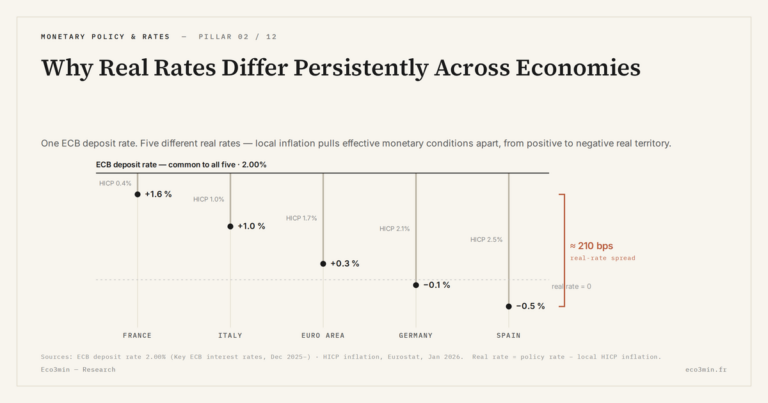
An identical policy rate produces different real rates across economies. Local inflation, monetary credibility, and financial structure generate persistent divergences that nominal-rate analysis cannot capture.
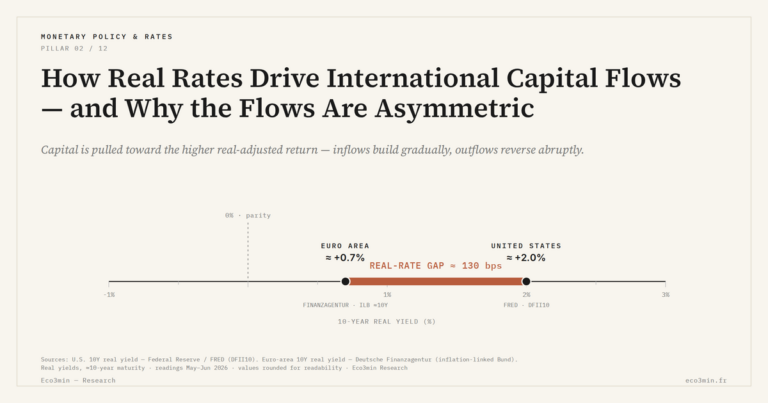
Real rate gaps between regions act as the main driver of cross-border capital allocation. Inflows ease local financing conditions gradually; outflows can reverse abruptly. The asymmetry is what makes the mechanism amplifying rather than stabilizing.
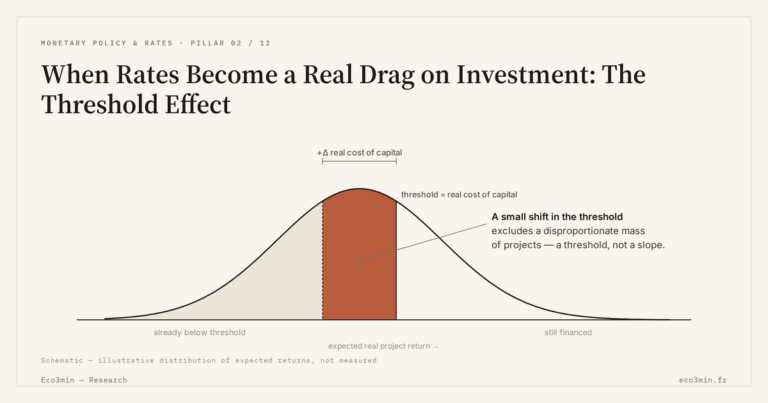
The drag of rates on investment is not linear. It depends on where the real cost of financing sits inside the distribution of expected project returns — and uncertainty about future rates amplifies the threshold sharply.
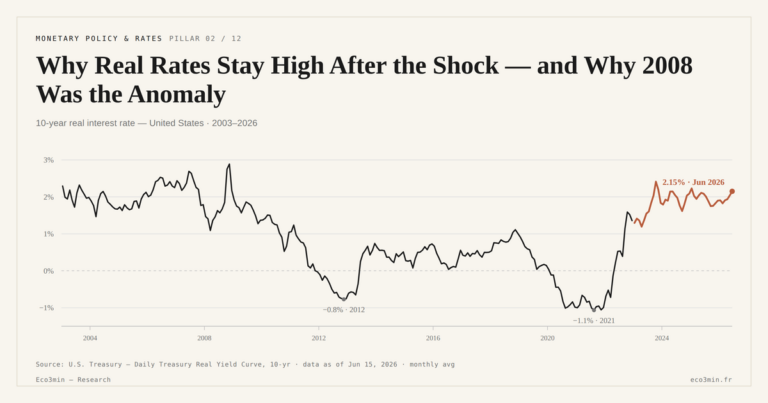
Real rates do not always fall back after an economic shock. The persistence of positive real rates after 2021-2023 is not a glitch in the cycle — it points to a structural shift in capital supply and demand that the post-2008 decade obscured.
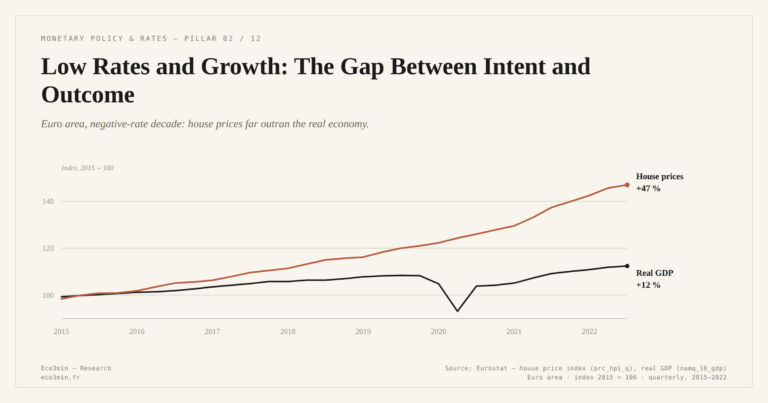
Low rates were meant to expand credit, lift investment and re-anchor growth. The eurozone decade of 2012-2022 shows what the channels actually delivered — and why the gap between intent and outcome matters more than the rate level itself.
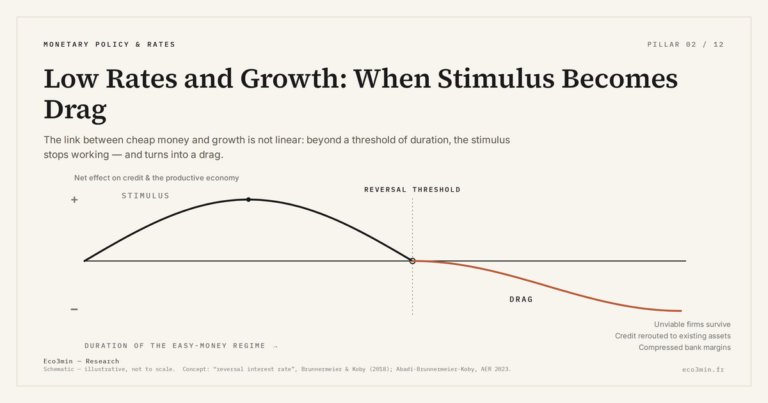
Persistent low rates do not mechanically deliver growth. Beyond a certain duration, they preserve unviable firms, divert credit toward asset markets and erode bank intermediation — turning the stimulus into its opposite.