From Wheat to Bread: How Wheat Prices Pass Through to Food Inflation

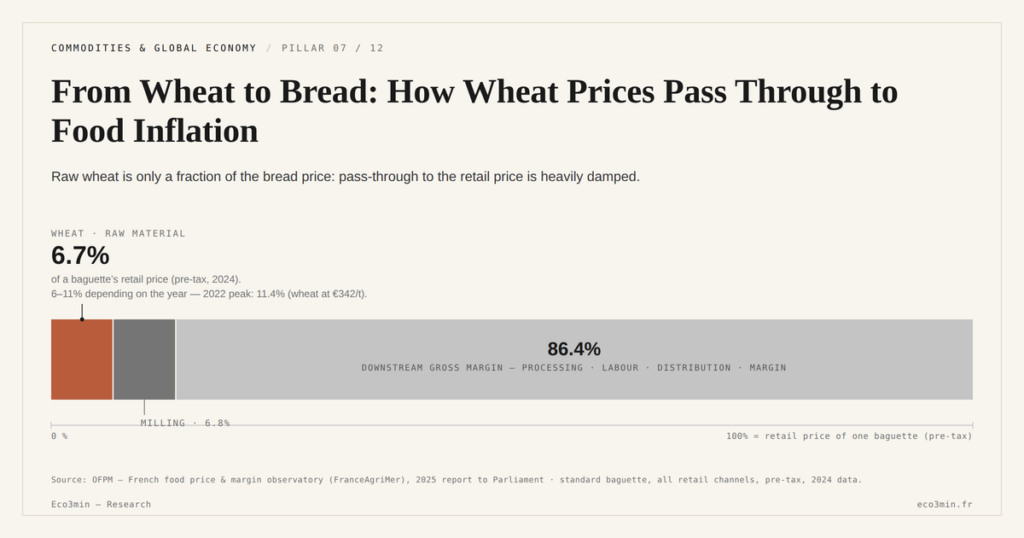
A rise in the price of wheat passes through to the price of bread neither fully nor immediately. The transmission is partial, lagged and often asymmetric, because raw wheat represents only a fraction of the final cost paid by the consumer.
TL;DR
The same wheat surge can be a minor statistical blip in one economy and a threat to staple-food access in another, depending on how local cost structures absorb it.
- Raw wheat is only a minority share of the retail bread price, so even a doubling of the world price moves the food-inflation component by a few tenths of a point, spread over several months.
- Pass-through is lagged and ratchet-like: retail prices climb fast with the world price but recede slowly and incompletely, leaving each surge a residue that later declines do not erase.
This article analyses the transmission chain that runs from the world wheat price to food inflation: why it is dampened, why it is delayed, and why it strikes very unevenly across economies.
The transmission from the price of wheat to that of staple foods is the link connecting an abstract world market to the daily life of households, and it is through it that wheat prices and stability are tied together. Understanding this chain, its buffers and its delays, is necessary to read correctly what a price surge really means for inflation.
From grain to loaf: a partial transmission
The first thing to grasp is that raw wheat makes up only a minority share of the price of bread bought in a shop. Between the grain and the loaf sit many stages — milling, processing, labour, distribution, retail margin — that form the bulk of the final price. The cost of the raw agricultural input represents only a fraction of it. This cost structure has a direct consequence: even a sharp change in the wheat price translates into only a dampened change in the price of bread. More context: 2007-2008: The First Modern Global Food Crisis.
Concretely, a doubling of the wheat price does not double the price of bread. If grain accounts for a limited share of the final cost, then a rise in the world price, once diluted across all the other components that stayed stable, moves the retail price by a proportionally far smaller amount. It is one of the most widespread reading errors to equate a surge in the world price with an equivalent surge in the price of bread: the former is spectacular, the latter remains, in developed economies, much more contained. Dampening through the cost structure is the first factor that separates the market shock from the shock felt by the consumer.
This dampening is not uniform, however. The closer the consumed product is to the raw input — a flour, a lightly processed bread — the higher the share of wheat in its price, and the stronger the transmission. Conversely, a heavily processed product, in which wheat weighs almost nothing, sees its price little affected. Transmission therefore depends on the degree of processing and the composition of the local food basket. This is why it is markedly more sensitive where bread weighs on budgets, both in household spending and in calorie intake, than in economies where food is diversified and heavily processed.
This dilution has an important implication for reading inflation figures. When a wheat-price surge makes headlines, one sometimes expects to see it reflected identically in food-inflation statistics; yet the real effect, once filtered through the cost structure, is generally far smaller. A major shock to the raw material may move the food component of the index by only a few tenths of a point, spread over several months. This does not mean the shock is negligible — it rarely is for the most exposed households — but that its aggregate footprint must be interpreted at the right scale. Confusing the size of the price move with the size of its effect on inflation leads to overstating the former or understating the latter, depending on the direction of the error. The same thread runs through our analysis of imported inflation via the euro.
Asymmetry and delays
The transmission is not only partial, it is also lagged. Between a rise in the world price and its eventual pass-through to the retail price elapses a delay that can be substantial. Several factors explain it: processors and distributors often work from stocks bought in advance, forward contracts fix supply prices for a period, and the adjustment of retail prices itself carries a degree of inertia. The consumer therefore does not feel a price shock immediately; they feel it with a lag, once supplies bought at the old price are exhausted and the new costs feed through.
To this delay is frequently added an asymmetry. Cost increases tend to pass through to the retail price faster and more completely than decreases: when the wheat price rises, the price of bread follows fairly promptly; when it falls, the retail price takes longer to recede, if it recedes at all. This behaviour, observed across many food markets, means a surge often leaves a durable imprint on consumer prices, even after the price that triggered it has fallen back. Transmission is therefore not a simple mirror: it filters, delays and distorts the initial price signal.
This asymmetry is not an anomaly, but the product of identifiable economic behaviour. When costs rise, processors and distributors seek to preserve their margins and pass on the increase fairly quickly, which they can justify by the conjuncture. When costs fall, the incentive to pass it on is weaker: as long as competition does not force it, keeping the price high rebuilds the margins eroded during the rising phase. The result is a transmission resembling a ratchet: the retail price climbs with the world price but recedes more slowly and less completely. Over time, a succession of shocks can install a structurally higher price level, each surge leaving a residue that later declines do not fully erase. This is one reason food inflation, once set off, can prove more persistent than the mere retreat of prices would suggest.
It is precisely in this interplay between the world price and the retail price that the debate on price formation sits. The respective parts of fundamentals — supply, demand, stocks — and of market behaviour in determining the world price are disputed, and this discussion illuminates how the signal forms even before it transmits, as examined in speculation and price formation. Whatever the origin of the price move, its transmission to the consumer then obeys the same mechanics of dampening, delay and asymmetry.
- Raw wheat is only a fraction of the retail price of bread: a surge in the world price translates into a far more contained rise for the consumer.
- Transmission is lagged — stocks, contracts, price inertia — and often asymmetric: increases pass through faster than decreases.
- Its intensity depends on the degree of processing and the weight of bread in budgets: strong where food is lightly processed, dampened elsewhere.
An uneven transmission across economies
The same move in the world price thus produces very different effects from one economy to another. Several factors combine to determine the scale of local transmission: the share of bread and cereal products in the consumption basket, the degree of processing of food, the existence of subsidies cushioning the retail price, and, for importers, the exchange rate that modulates the cost of wheat bought in foreign currency. The conjunction of these factors explains why an identical surge translates into marked food inflation in one place and barely perceptible inflation in another.
In developed economies, where food is diversified and heavily processed and where bread weighs little in budgets, transmission is doubly dampened: by the small share of wheat in the final price and by the small share of food in total spending. Food inflation there reacts to wheat shocks, but in a contained and delayed way. Euro-area consumer-price data allow this muted, lagged reaction to be observed, as documented by euro-area food inflation data, where the effect of a cereal shock reads in a specific component of the index rather than in its overall level.
For importing countries, an additional factor modulates transmission: the exchange rate. Wheat is bought on the world market in foreign currency, so the cost to an importer depends as much on the price as on the value of its currency. A depreciation can make imported wheat dearer even when the world price stays stable, and conversely a firm currency can absorb part of a world rise. For these economies, transmission reads not only in the price denominated in international currency, but in the effective cost once converted into local currency. This exchange-rate channel adds a layer of variability: two countries facing the same world surge can experience very different cost increases depending on how their currencies move. It also explains why food vulnerability and currency vulnerability tend to reinforce one another among the most fragile importers. A broader view: The Global Wheat Market: Breadbaskets, Exporters and Dependent Importers.
At the other end of the spectrum, in economies where bread is central, lightly processed and weakly subsidised, transmission is rapid and marked. The same world price translates there into a sharp rise in the price of the staple, which immediately weighs on constrained budgets. It is this heterogeneity that means a single indicator — the wheat price — must always be read through the filter of local structures: it signals a potential strain, but the real scale of its effect depends on how each economy absorbs and transforms that signal.
Understanding transmission therefore means understanding why the wheat price is an indicator to handle with care. It signals pressure on the upstream of the food chain, but does not prejudge the scale of its outcome downstream, which depends on buffers, delays and structures specific to each economy. The same surge can therefore be, simultaneously, a minor statistical blip in one economy and a threat to staple-food access in another — a divergence that any monitoring of global food security has to keep in view. Reading the wheat price as a single global signal, without this filter, risks two opposite mistakes: treating a contained move in developed economies as evidence that the shock is harmless everywhere, or treating a severe outcome in vulnerable economies as the universal norm. The value of the indicator lies precisely in being read alongside the structures that determine where, and how hard, it lands. This transmission sits within the broader dynamics of the agricultural commodities space, where the passage from the world price to the consumer price obeys, for each product, comparable mechanics of dampening.
Last updated — 12 July 2026
Disclaimer – Financial Information: The analyses, commentary, and content published on eco3min.fr are provided for informational and educational purposes only. They do not constitute investment advice or a solicitation to buy or sell financial instruments. Past performance is not indicative of future results. All investment decisions involve risk and are the sole responsibility of the reader.
Read next
Full pillar →Reading the refinery utilisation rate: the threshold, the season, the turnarounds
A refinery runs full near ninety percent, not a hundred: the last slice of nameplate capacity is a…
IMO 2020: the regulatory shock that rewrote product spreads
An environmental rule on marine sulfur can move a refining spread more than a swing in crude. IMO…
The 2022–2023 refining golden age: anatomy of an episode
In 2022, refined fuel prices climbed faster than crude. That gap, measured by the 3-2-1 crack spread, reached…