AI Data Centres: How Power Demand Is Reviving Nuclear

Electricity demand from artificial-intelligence data centres, continuous and fast-growing, is rehabilitating nuclear and pushing demand upstream to uranium; its scale and its already-contracted nature set it apart from past forecasts.
TL;DR
Inference, the continuous serving of AI models to hundreds of millions of users, has overtaken training as the steadier electricity draw, sharpening the case for nuclear's around-the-clock baseload.
- Inference scales with usage rather than research cycles, so it runs continuously and is both more predictable and harder to serve with intermittent generation alone than scheduled training bursts.
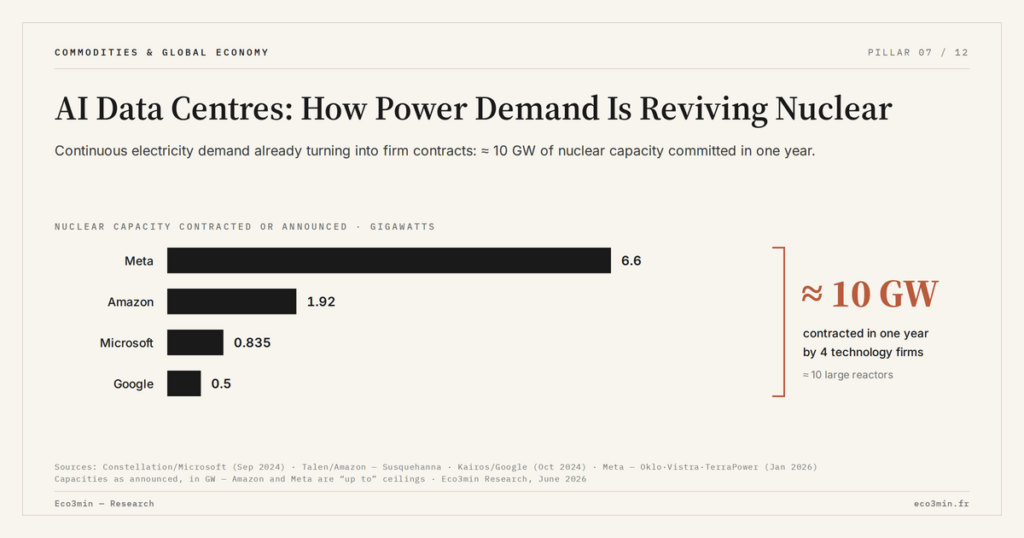
- The roughly ten gigawatts of nuclear capacity contracted by four firms in a year equals about ten large reactors, incremental against a fleet near 440, but consequential because it arrives alongside restarts and life extensions drawing the same fuel.
This page quantifies that demand, its terawatt-hours, its load profile and the deals signed, and shows why it specifically calls for a nuclear baseload, at two speeds.
A new kind of electricity demand
For two decades, data-centre electricity consumption grew slowly. Equipment efficiency gains and infrastructure optimization almost entirely offset the rise in digital usage, so that the sector’s electricity bill remained, at the scale of a grid, a stable quantity. Training and inference for large artificial-intelligence models break that regime. A data centre dedicated to intensive computing draws continuous power that can approach that of a small city, and power density per server rack has risen by a considerable factor in a few years.
Specialist agencies translate this shift into orders of magnitude. Global data-centre electricity consumption is projected to rise from roughly 460 terawatt-hours in 2024 to nearly 1,300 terawatt-hours by 2035, on the estimates cited by sector analysts. It is the pace of that revision, as much as its absolute level, that seized energy markets: within a few quarters, demand trajectories thought to be flat were rewritten upward, forcing utilities and planners to reconsider their capacity assumptions. These projections nonetheless warrant caution: their range is wide, they depend on assumptions about the pace of model deployment, the respective share of training and inference, and possible hardware-efficiency jumps that could bend the trajectory. The robust point is not a precise ten-year figure, but the direction and speed of the revision, and the fact that this demand, unlike many others, already comes backed by firm contracts.
Beyond volume, it is the profile of this demand that matters. A data centre training a model cannot modulate its load with the weather: it consumes high, steady power, twenty-four hours a day, and any interruption is paid for in lost compute and underused hardware. Above all, the efficiency gains that had long absorbed usage growth have ceased to suffice: the power required by specialized processors grows faster than the energy savings made elsewhere, so efficiency no longer offsets, it barely slows the rise. To this is added a geographic concentration. Compute sites cluster where land, fibre and electricity are available, creating local pressure points on the grid, as in Northern Virginia, where the density of installations has made data-centre demand a planning matter in its own right. A further shift compounds the load. Where the first wave of AI compute was dominated by model training, concentrated bursts of intensive calculation, the serving of models to hundreds of millions of users, known as inference, has become the larger and steadier draw. Inference runs continuously, scaling with usage rather than with research cycles, which makes the resulting electricity demand both more predictable and more relentless. A load that never pauses is harder to serve with intermittent generation alone than one that can be scheduled, which sharpens the case for firm capacity. When a load cannot be scheduled, matching it falls to whoever owns the wires — the origin of the bottleneck position electric utilities now occupy.
From announcements to contracts
This demand did not remain a spreadsheet projection: it became firm commitments, signed by actors whose business has nothing to do with nuclear. In September 2024, Microsoft concluded a twenty-year power purchase agreement with Constellation Energy to restart Unit 1 of the Three Mile Island plant, renamed the Crane Clean Energy Center, an 835-megawatt capacity targeted to return in 2028; the US Department of Energy closed a one-billion-dollar loan in November 2025 to lower the cost.
The other technology giants followed adjacent paths. Amazon paid 650 million dollars for a data centre adjacent to the Susquehanna nuclear plant, with a supply agreement of up to 1.92 gigawatts, and invested 700 million in the small-reactor developer X-energy. Google signed the first corporate agreement for a fleet of small modular reactors, with Kairos Power, in October 2024, targeting 500 megawatts by 2030. Meta announced a nuclear procurement strategy of up to 6.6 gigawatts, spread across several partners. Taken together, these moves represent on the order of ten gigawatts of nuclear capacity contracted by four companies in the span of a year. Ten gigawatts contracted in a year is a meaningful figure and a small one at once, which is why the question of whether the nuclear revival will materialise stays open.
The significance of this accumulation goes beyond any single deal. That technology companies commit billions and twenty-year horizons to secure carbon-free, constant electricity is a demand signal of an unprecedented kind: no longer a forecast of reactor construction issued by public authorities, but a need expressed by solvent, time-pressed customers prepared to pay for certainty of supply. These commitments take two forms that should not be conflated. Some are power purchase agreements running through the grid, by which the buyer finances generation injected into the shared system; others follow a co-location logic, where the data centre is directly adjacent to the plant. In both cases, the limiting factor is not only generation: grid connection and the interconnection queue can delay commissioning as much as construction itself. This is why announced schedules are regularly revised, sometimes forward when an operator declares itself ready early, often backward when interconnection drags. It is this demand, placed within the broader dynamic of uranium’s shift toward compute, that sets the current cycle apart from its predecessors.
What lends these commitments weight is their structure. A twenty-year power purchase agreement, often underpinned by federal loan support and tied to specific reactors, is not a press-release pledge but a financial obligation that anchors a plant’s economics over the long term. That durability is part of why the current demand signal is read as structural rather than speculative: the buyers have placed long-dated balance-sheet commitments behind their need for firm, carbon-free power, which is far harder to unwind than a forecast.
Why this demand calls for nuclear, at two speeds
The requirement for round-the-clock availability explains nuclear’s return to electricity planning. Carbon-free but constant generation, what is called dispatchable baseload, matches the load profile of a compute site exactly. The debate does not pit nuclear against renewables: it combines them, the latter providing cheap marginal energy when wind and sun are available, the former guaranteeing the floor of the system the rest of the time. The physics of that complementarity, and the reason a grid with heavy continuous load sets nuclear against renewable intermittency, is the subject of a piece in its own right and is not repeated here.
The resulting uranium demand reads at two speeds, and conflating them leads to misjudging the schedule. The first is immediate: extending the operation of existing reactors or restarting idled units, such as Three Mile Island or Palisades in Michigan, backed by a 1.5-billion-dollar federal loan, mobilizes fuel in the short term, without waiting for new construction. The second is deferred but potentially large: new capacity, and in particular small modular reactors, pitched as factory-built and deployable near demand. Most of these projects, however, will not produce electricity before the early 2030s, and their economics remain uncertain; the drivers and timeline of that segment are examined in the analysis devoted to small modular reactors.
Separating these two horizons is essential so as not to confuse announced capacity with committed demand. A gigawatt contracted for 2030 does not weigh on the fuel market in the same way as an extended reactor that reloads its core next year. This demand sits within a wider frame in which energy is again a first-order constraint, within the geoeconomics of resources, and in which the nuclear share of electricity generation, long in decline, is being reassessed as the US electricity mix must integrate a carbon-free, continuously available floor.
To give a sense of scale, ten gigawatts of nuclear capacity is the equivalent of about ten large reactors, a meaningful share of the incremental fuel demand the market must anticipate. Set against a global fleet of about 440 reactors, ten gigawatts is incremental rather than transformative on its own; what makes it consequential is that it arrives alongside reactor restarts and life extensions, all drawing on the same fuel supply at the same moment. But that capacity will translate into uranium consumption only at the rate the reactors concerned actually enter service, spread over a decade. The contribution of this page is precisely that: to separate the announced volume, spectacular, from the physically committed demand, more modest in the short term but unusually solid, and to provide the orders of magnitude that make the supply and price analyses of the rest of the cluster legible.
- Global data-centre electricity consumption is projected to rise from roughly 460 terawatt-hours in 2024 to nearly 1,300 by 2035; it is the pace of that revision, and the continuous, around-the-clock load profile, that set this demand apart.
- Four major technology players contracted on the order of ten gigawatts of nuclear capacity in a year, from Microsoft-Constellation to Amazon, Google and Meta, turning a projection into firm twenty-year commitments.
- Uranium demand reads at two speeds: immediate for extended or restarted reactors, deferred but large for new capacity; confusing announced capacity with committed demand distorts the reading of the schedule.
Last updated — 22 July 2026
Disclaimer – Financial Information: The analyses, commentary, and content published on eco3min.fr are provided for informational and educational purposes only. They do not constitute investment advice or a solicitation to buy or sell financial instruments. Past performance is not indicative of future results. All investment decisions involve risk and are the sole responsibility of the reader.
Read next
Full pillar →Reading the refinery utilisation rate: the threshold, the season, the turnarounds
A refinery runs full near ninety percent, not a hundred: the last slice of nameplate capacity is a…
IMO 2020: the regulatory shock that rewrote product spreads
An environmental rule on marine sulfur can move a refining spread more than a swing in crude. IMO…
The 2022–2023 refining golden age: anatomy of an episode
In 2022, refined fuel prices climbed faster than crude. That gap, measured by the 3-2-1 crack spread, reached…