Nuclear Baseload vs Renewable Intermittency in the Energy Transition

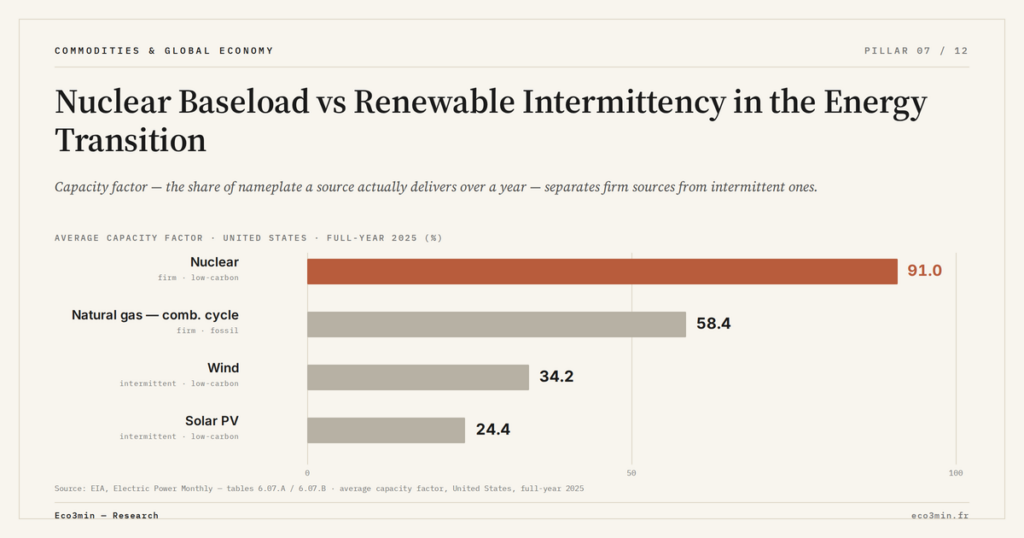
Nuclear’s distinctive value lies not in low carbon alone but in firmness: dispatchable, round-the-clock output with a capacity factor above 90 percent, where intermittent renewables struggle to cover a constant demand.
TL;DR
Comparing nuclear's firmness with renewables' headline price weighs two different services: a renewables-heavy grid also funds the storage and reserves that a steady, slow-to-build nuclear output does not.
- US battery capacity reached tens of gigawatts by late 2025, the fastest near-term bridge to continuous supply, but it shifts power within a day rather than replacing firm generation.
- Firmness also underpins grid stability, the frequency and inertia that large thermal and nuclear turbines maintain and that a renewables-dominated system recreates only by other means.
This page explains intermittency, firmness and capacity factor, why the transition and AI data centers create a structural need for firm low-carbon power, and the debate over nuclear’s role.
Intermittency, firmness, capacity factor
Three notions frame this debate. Intermittency describes the variability of output that depends on weather and time of day: solar produces nothing at night, wind depends on the breeze. Firmness, by contrast, denotes a supply that is stable over time, with little variability. Between the two, the capacity factor measures an installation’s actual output against its maximum capacity over a period. It is the decisive indicator: a nuclear reactor runs at a capacity factor above 90 percent, against roughly 35 percent for wind and 25 percent for solar.
From this gap follows an often-misunderstood consequence: an installed gigawatt is not an installed gigawatt regardless of source. A gigawatt of nuclear produces, over a year, several times more electricity than a gigawatt of solar, because it runs almost without interruption while the panel sits idle most of the time. Gas can show a high capacity factor, but it emits carbon; solar and wind are low-carbon but intermittent. Nuclear occupies a rare position by combining the two sought-after qualities, an output both near-continuous and largely decarbonized, which explains the interest it attracts despite its constraints. Sources thus fall into two families: dispatchable means, schedulable on demand, such as nuclear, gas or hydro, and intermittent means, such as solar and wind, whose output follows the natural resource rather than the need.
The mismatch is not only quantitative, it is temporal. Solar output peaks at midday and collapses in the evening, just as demand climbs back, creating a profile grid operators know well. To that daily variability is added a seasonal dimension, as sunlight and wind regimes shift over the year. Smoothing these gaps means storing energy, yet today’s batteries shift electricity over a span of a few hours, not several days or seasons. The problem of intermittency is therefore not a lack of energy on average, but a failure of coincidence between when it is produced and when it is needed. In practice, this is why a renewables-heavy system can show ample capacity on paper yet still fall short at dusk or during a windless cold snap, the moments when demand is often highest. Capacity on paper and delivery at dusk are two different quantities, and the gap between them is what the intermittency problem in renewable power designates.
Comparing sources gigawatt for gigawatt of installed capacity distorts the picture. An intermittent gigawatt delivers only a fraction of the energy of a dispatchable gigawatt, and its value to the grid is lower, since reserves or storage must be maintained for periods without wind or sun. Headline figures of added capacity therefore overstate the real contribution of renewables if the capacity factor is ignored.
Why firmness matters again
The energy transition adds intermittent capacity on a massive scale, but a grid cannot run without a share of firm output guaranteeing supply at every instant. Reliability has always required a backbone of firm generation; what is new is the speed and scale at which constant industrial loads are being added on top of an already tightening grid. That need is now amplified by a new demand: data centers run continuously, around the clock, and cannot absorb intermittency without storage that scales poorly above a few hundred megawatts. The strain this consumption places on the grid is detailed in the analysis of the power appetite of data centers.
The financial analysts’ diagnosis converges on this point. According to Goldman Sachs, wind and solar could serve about 80 percent of a data center’s demand if paired with storage, but some baseload generation is needed to meet the round-the-clock requirement, and nuclear is the preferred option. The bank has sized that need at several tens of gigawatts of new nuclear capacity by 2030 to meet data-center demand alone. Battery storage remains the fastest bridge to continuous supply, but it manages hours, not seasons: low-carbon baseload options, nuclear foremost, take years to deploy.
US battery capacity has grown fast, reaching tens of gigawatts by late 2025, which makes storage the quickest near-term bridge to continuous supply. But its role is to shift power within a day, not to replace the firm generation a round-the-clock load ultimately requires; the bridge buys time rather than removing the need.
Firmness is not only about supplying energy: it also contributes to the grid’s physical stability, its frequency and inertia, which the large turbines of thermal and nuclear plants maintain naturally. A system resting overwhelmingly on power electronics and renewables must recreate that stability by other means. This is one reason the question is not only producing enough megawatt-hours over the year, but having them available steadily, every second, where a continuous industrial load tolerates no interruption.
Nuclear as low-carbon firm power
In this equation, nuclear offers a singular profile: a near-continuous, low-carbon, large-scale output that answers directly the digital giants’ commitments to carbon-free electricity available at any hour. These players still source mostly renewables, with nuclear supplying only a fraction of their low-carbon power contracts; but it is precisely that firm share, scarcer, they now seek to lock in to meet their continuous-supply pledges. Several have sought to plug directly into existing plants, as with the connection of a data center to the Susquehanna station in Pennsylvania. This behind-the-meter siting is not without obstacles, however: the federal energy regulator rejected an expansion of one such arrangement, illustrating the frictions raised by wiring a massive load straight onto a plant.
The appeal of the existing nuclear fleet lies in its immediate availability. Rather than wait for new builds, utilities and operators seek to extend the lifespan of reactors in service and to connect new loads to output already there, running close to nine thousand hours a year. For an installation drawing power continuously, having a source whose profile matches the need exactly, with no trough to fill, carries a value that cost-per-megawatt-hour figures do not fully capture. A campus running at full utilization needs a matching generation source delivering on demand; for that profile, a source that runs flat out, year-round, fits in a way an intermittent one, however cheap, does not.
Small modular reactors are often presented as the coming form of this firm output, co-located next to data centers. But their schedule remains distant, as the analysis of the deployment of small modular reactors details: the promise of decarbonized firmness right next to the load will not materialize before the decade’s end. In the near term, then, it is gas and renewables paired with storage that fill the gap, with nuclear playing the role of durable foundation rather than immediate solution.
The debate: baseload or flexibility?
Nuclear’s place in a renewables-dominated grid is, however, the subject of a real debate it would be dishonest to obscure. Nuclear is a baseload source designed to run continuously; it adapts poorly to rapid swings in demand, where a gas plant can modulate in minutes. Yet as intermittent renewables scale up, the grid’s need shifts partly from baseload toward flexibility: it needs means able to offset quickly the lulls of wind and sun, a function better filled by gas, peaking hydro and storage. On this reading, nuclear’s steady, hard-to-modulate output is sometimes judged less suited than a combination of renewables and flexible means.
There is also the question of cost. Taken in isolation, the solar or wind megawatt-hour is among the cheapest to produce, while nuclear bears high construction costs. But this direct comparison ignores the system cost: a grid built on intermittency must additionally fund the storage, reserves and reinforcements needed to guarantee supply, charges that mount as the renewable share rises. Comparing nuclear’s firmness with the headline price of renewables alone is thus comparing two different services, not the same one twice. Pricing the missing service — storage, backup, network reinforcement — is where the investment bill the transition still has to fund stops being a single headline figure. This is why the debate increasingly turns on the value of firmness rather than the price of energy: as grids decarbonize, the scarce and valuable commodity becomes power available on demand, not power produced cheaply when conditions allow.
The two readings are not mutually exclusive. Nuclear’s firmness is a structural advantage for a constant demand like that of data centers, but its slow construction and limited flexibility mean it complements renewables rather than replaces them. This nuance places uranium demand for what it is: a durable need, anchored in the energy transition, but one that does not substitute for the renewables buildout. It sits within the uranium market as a whole, falls under the physical resources of the energy transition, and depends on the makeup of the electricity mix each country settles on, shaped by its resources, its grid and its political choices. How large that firm share should be, and how fast it can realistically grow, will vary from one grid and one policy to the next. Nuclear is not the single answer; it is the firm share, slow to build but durable, of a system that needs one.
Last updated — 22 July 2026
Disclaimer – Financial Information: The analyses, commentary, and content published on eco3min.fr are provided for informational and educational purposes only. They do not constitute investment advice or a solicitation to buy or sell financial instruments. Past performance is not indicative of future results. All investment decisions involve risk and are the sole responsibility of the reader.
Read next
Full pillar →Reading the refinery utilisation rate: the threshold, the season, the turnarounds
A refinery runs full near ninety percent, not a hundred: the last slice of nameplate capacity is a…
IMO 2020: the regulatory shock that rewrote product spreads
An environmental rule on marine sulfur can move a refining spread more than a swing in crude. IMO…
The 2022–2023 refining golden age: anatomy of an episode
In 2022, refined fuel prices climbed faster than crude. That gap, measured by the 3-2-1 crack spread, reached…