Small Modular Reactors (SMRs) and Uranium Demand: A 2030s Story

Small modular reactors concentrate the nuclear revival’s hopes, backed by the tech giants, yet almost none are built: their uranium demand is a 2030s matter, not an immediate reality.
TL;DR
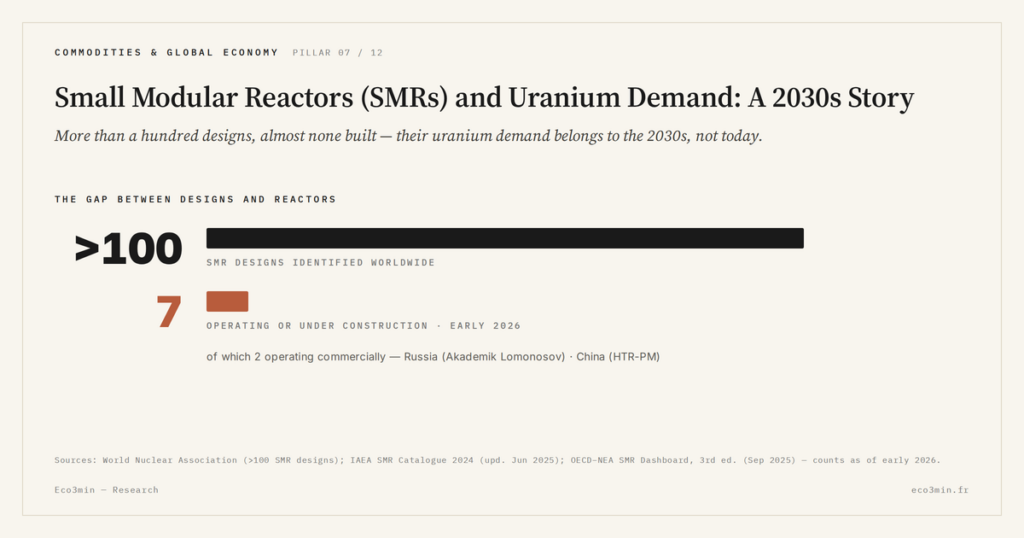
More than a hundred small modular reactor designs exist, yet only seven were operating or under construction in early 2026; their uranium demand belongs to the 2030s, not today.
- Only NuScale's 77-megawatt design is certified in the US, since January 2023, yet its flagship project was cancelled in late 2023 over cost overruns, showing the gap between certifying a design and building one.
- The first US construction-permit application, the TVA's 300-megawatt reactor filed in May 2025, does not target commissioning before 2032.
- The digital majors' commitments total more than ten gigawatts but span the decade as options and power-purchase agreements rather than firm orders.
- Several advanced designs depend on HALEU fuel, whose commercial production was until recently Russia's alone and whose Western capacity remains embryonic, adding a fuel bottleneck to license and cost.
This page explains what SMRs are, why hyperscalers bet on them, the gap between designs and reactors, and what they really mean for uranium demand.
What small modular reactors are
A small modular reactor, or SMR, is a nuclear reactor with an electrical output generally below 300 megawatts, against 550 to 1,500 for a large conventional reactor. Its distinctiveness lies less in size than in design: its main components are modular, factory-built and serially produced, then shipped to the site. From this approach, its proponents expect a standardization able to cut costs, shorter construction times, passive safety and greater siting flexibility. Worldwide, more than a hundred modular reactor designs are now identified. Their appeal rests on a simple bet: that making reactors smaller and repeatable can do for nuclear power what assembly lines once did for other heavy industries, trading bespoke scale for repeatable volume.
These designs do not form a homogeneous block. Some take the light-water technology of today’s plants in a smaller, more standardized version. Others explore so-called advanced lines, cooled by gas or molten salts, which promise higher temperatures and new industrial uses but rest on less proven technologies. A subcategory, microreactors, drops below 20 megawatts and targets remote sites or specific installations. This technical diversity means that not all SMRs are equal in maturity or timeline: behind a single acronym lie very uneven degrees of progress. The light-water designs, closest to proven technology, tend to be the nearest to deployment, while the advanced lines that promise the most also carry the most technical and regulatory unknowns.
This flexibility explains the interest of the digital giants. An SMR can, in theory, be sited right next to a data center and supply it with carbon-free, around-the-clock electricity, answering directly the strain on the grid analyzed on the page devoted to data-center electricity demand. The appeal also lies in speed of access to power: a dedicated, co-located reactor can, in principle, bypass the grid-connection queues that delay supply to large data centers. Google, Amazon and Meta have thus announced commitments running to several gigawatts, transforming in months the perception of a long-niche technology. For an operator racing to power AI clusters, a reactor it controls looks more predictable than a grid connection it must wait years to obtain.
The gap between designs and reactors
Enthusiasm runs, however, into a stubborn industrial reality: between the number of designs and the number of reactors actually in service, the gap is wide. Of more than a hundred models identified in early 2026, only seven were operating or under construction, the rest sitting at pre-licensing or study stages. In the United States, a single design, NuScale’s 77-megawatt module, has obtained design certification from the safety regulator, in January 2023; yet its flagship project was cancelled in late 2023 over cost overruns, an illustration of the gap between certifying a design and actually building it.
The most concrete projects remain distant. The Tennessee Valley Authority filed in May 2025 the first construction-permit application for an SMR in the United States, for a 300-megawatt reactor; commissioning is not expected before 2032. The startup Kairos Power aims to start up a small test reactor as early as 2026, but its commercial version would arrive only in the 2030s. X-energy’s flagship project, at a Texas industrial site, will not face a final investment decision until around 2028. China, for its part, has already installed the components of an SMR, taking a lead in actual construction where the West is still at the permitting stage. Smaller still, Oklo’s microreactor is slated for an Air Force base in Alaska, aiming for one to five megawatts around 2027, while the Department of Energy backs several demonstrations on federal land.
The promise of lower costs also remains to be proven. Standardization and serial production cut costs only once mass production is reached; yet the first units, the first-of-a-kind, bear the full development and commissioning expense and are costly per megawatt. The length of procedures does not help: obtaining a construction and operating license for a conventional reactor runs to five to seven years, and the accelerated frameworks for advanced reactors are only beginning. Until the series is launched, the economic case for SMRs remains a projection more than an established fact. Large nuclear’s long record of cost overruns and delays does not help the case, and is part of why investors treat first-of-a-kind SMR budgets with caution.
The tech giants’ announcements should therefore be read for what they are. In detail, these commitments span the decade. Google has formed a partnership with Kairos targeting about 500 megawatts by 2035, Amazon has invested in X-energy and contracted capacity, and the total of the digital majors’ announcements exceeds ten gigawatts. These volumes are considerable against a single SMR’s output, but they trace a supply trajectory for the 2030s, contingent on the actual delivery of reactors rather than secured. These are options and power-purchase agreements as much as orders: they de-risk a developer’s pipeline and signal demand, but they do not compress the licensing and construction timelines that govern when, or whether, the reactors arrive.
The HALEU fuel dependency
A further constraint, often overlooked, weighs on part of these projects: the fuel. Many advanced designs, including those of Kairos and X-energy, require high-assay low-enriched uranium, or HALEU, enriched to a level above that of conventional reactors. Yet until recently only Russia had commercial HALEU production capacity, and the Western chain is only at its beginnings. The deployment of advanced SMRs thus runs into the scarcity of HALEU fuel, and doubles an enrichment bottleneck already tight: new demand can only materialize if this fuel capacity follows, adding a condition to an already uncertain schedule. The fuel of some of these reactors also takes a particular form, such as TRISO particles, requiring specific fabrication chains still little developed outside a few players. This recourse to HALEU is not a technical detail: it allows more compact cores and longer refueling intervals, but it shifts dependence onto a link the Western chain does not yet cover, making fuel availability as structuring a condition as the license or the cost. Building that capacity is slow on every front: enrichment to higher assays, the fabrication of specialized fuel forms, and the regulatory clearances each step requires.
- More than a hundred SMR designs exist worldwide, but only seven were operating or under construction in early 2026; in the United States, a single design is certified, and its flagship project was cancelled in 2023.
- The first meaningful US reactors are not expected before the early 2030s; the tech giants’ deals are commitments for that decade, not imminent reactors.
- Part of the advanced SMRs depend on HALEU, whose Western production capacity is embryonic: the uranium demand they represent is real but deferred and conditional.
What SMRs mean for uranium
For uranium demand, the effect of SMRs is therefore real, but time-shifted and incremental in nature. Each unit stays small, but fleet ambitions are vast: some developers claim visibility on more than ten gigawatts over time. This demand would add to that of the large existing reactors, without replacing it, and would thicken an already deficit market. But it remains suspended on three cumulative conditions: cost control, the completion of licenses, and the availability of suitable fuel. US public authorities are supporting the move, with several hundred million dollars of cost-shared funding and demonstration programs, but public support erases neither the lead times nor the technological uncertainties. Until these conditions are met, the effect of SMRs on uranium demand remains a promise rather than a flow: it will weigh on the market of the late decade, not on today’s. The size of that future demand is itself uncertain. A sub-300-megawatt unit consumes far less fuel than a 1,000-megawatt reactor, so the per-unit contribution is modest; only a large built fleet would move the market materially, and how large that fleet becomes depends on the same costs, licenses and fuel that gate the first units. The demand is best read as a plausible upside for the 2030s, not a figure to bank on today. Read as an upside rather than a baseline, that figure sits at the centre of the debate over the nuclear renaissance and its timing.
Whether SMRs will keep their promise of stable, dispatchable output, capable of anchoring the grid, is itself the subject of a separate debate, taken up regarding dispatchable nuclear baseload. The SMR story is thus only one thread of uranium demand driven by compute: a potentially important outlet, but one whose horizon lies at the decade’s end, and which sits within the geoeconomics of energy resources as much as within the wave of AI capital spending that funds it, measured in trillions of dollars over 2025 and 2026 alone. The point, reading these announcements, is not to confuse the scale of the commitments with their actual timeline, which is measured in years rather than quarters. The enthusiasm is warranted; the horizon, however, is not immediate.
Last updated — 22 July 2026
Disclaimer – Financial Information: The analyses, commentary, and content published on eco3min.fr are provided for informational and educational purposes only. They do not constitute investment advice or a solicitation to buy or sell financial instruments. Past performance is not indicative of future results. All investment decisions involve risk and are the sole responsibility of the reader.
Read next
Full pillar →Reading the refinery utilisation rate: the threshold, the season, the turnarounds
A refinery runs full near ninety percent, not a hundred: the last slice of nameplate capacity is a…
IMO 2020: the regulatory shock that rewrote product spreads
An environmental rule on marine sulfur can move a refining spread more than a swing in crude. IMO…
The 2022–2023 refining golden age: anatomy of an episode
In 2022, refined fuel prices climbed faster than crude. That gap, measured by the 3-2-1 crack spread, reached…