Uranium: The First Commodity Whose Cycle Is Driven by Compute, Not Industry

Uranium briefly crossed 100 dollars a pound in January 2026, pushed not by an industrial cycle but by electricity demand from data centres: nuclear fuel is becoming the first commodity whose cycle appears governed by computing power rather than industry.
TL;DR
Data-centre power demand pushed uranium past 100 dollars a pound in January 2026, the long-term contract price reaching an 18-year high, firmer than the spot spikes of 2007 and 2011.
- Each prior uranium rally reversed: spot topped 130 dollars a pound in 2007 before collapsing, and the March 2011 Fukushima accident sank it below 20 dollars by the mid-2010s.
- Enrichment is the tightest link: Russia controls roughly 43 percent of world capacity, spot SWU reached about 190 dollars in early 2026 (up some 239 percent from 56 dollars at the end of 2021), and a 2024 US law bars Russian uranium imports from January 2028.
- Supply cannot follow: Kazakhstan provides about 40 percent of mined output, Kazatomprom cut its 2026 target rather than expand, and Chinese imports near 70 million pounds divert a large share away from Western markets.
This analysis sets out why the nature of that demand, continuous and concentrated in a handful of suppliers, sets uranium apart from other energy commodities, and why a record of disappointment imposes caution from the outset.
A threshold crossed, then handed straight back
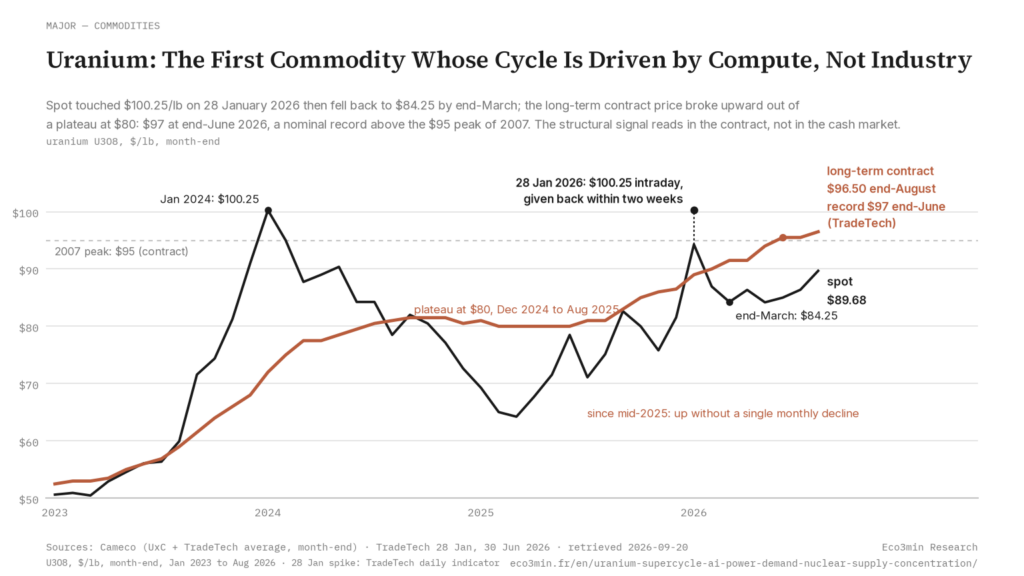
On 28 January 2026, TradeTech’s daily spot indicator jumped 8.90 dollars in twenty-four hours to 100.25 dollars a pound of uranium oxide (U3O8), taking the weekly gain to 14.75 dollars, the largest one-week percentage rise since March 2022. The next day, according to figures reported by Investing News, spot peaked near 101 dollars. It was the first time the 100-dollar mark had been breached since January 2024, when it held for just four weeks.
The move did not last. By 5 February spot had fallen back to 85.50 dollars, and it ended the first quarter of 2026 around 84 dollars, erased by a bout of risk aversion and geopolitical shocks. This volatility in the cash market is not incidental: it sits at the centre of what uranium does, and does not, signal. For while spot round-tripped around 100 dollars, the long-term contract price kept climbing: TradeTech’s long-term indicator reached 93 dollars a pound at the end of March 2026, its highest level in more than eighteen years.
Update, September 2026: TradeTech’s long-term indicator reached 97 dollars a pound at the end of June 2026, an all-time high in nominal terms, above the 95 dollars of 2007; the industry average published by Cameco (UxC and TradeTech month-end prices) put the long-term contract at 96.50 dollars and spot at 89.68 dollars at the end of August 2026. Kazatomprom, for its part, lowered its 2026 range again, to 27,500-29,000 tonnes on a 100 percent basis, below the 29,697 tonnes announced in August 2025.
Two prices, two paths, one underlying direction. The conventional read would tie the whole thing to an ordinary industrial cycle: recovering demand, restarting heavy industry, a synchronised global upswing. That frame does not explain uranium in 2024-2026. The driver is not industry. It is compute.
The demand break: compute, not industry
For two decades, data-centre electricity consumption grew slowly, as efficiency gains offset the rise in digital usage. Training and inference for large artificial-intelligence models break that regime. A modern compute cluster draws continuous power approaching that of a small city, and specialist agencies have revised the trajectory upward: global data-centre consumption is projected to rise from 415 terawatt-hours in 2024 to around 945 terawatt-hours in 2030 and roughly 1,200 terawatt-hours by 2035 in the International Energy Agency’s base case (Energy and AI, April 2025). The pace of that revision, more than its absolute level, is what seized energy markets.
Above all, this load has a specific requirement. It must be available around the clock, which wind and solar alone do not guarantee. A data centre training a model cannot shed load when the wind drops or the sun sets: it needs a dispatchable, carbon-free baseload running twenty-four hours a day. It is precisely this constraint that brings nuclear back into the equation, and uranium with it. The precise quantification of that demand, its terawatt-hours and load profile, is the subject of a dedicated piece on datacenter electricity demand; what matters here is the chain consequence: a new kind of electricity demand transmits, moving upstream, all the way to the fuel.
This demand did not remain a projection. It became contracts. In September 2024, Microsoft signed a twenty-year power purchase agreement with Constellation Energy to restart Unit 1 of the Three Mile Island plant, renamed the Crane Clean Energy Center, an 835-megawatt capacity targeted to return in 2027, a year earlier than first planned, once the federal loan closed, with the US Department of Energy closing a one-billion-dollar loan in November 2025 to lower the cost. Amazon, for its part, paid 650 million dollars for a data centre adjacent to the Susquehanna nuclear plant and led a 500-million-dollar funding round in the small-reactor developer X-energy in October 2024. Google concluded the first corporate agreement for a fleet of small modular reactors with Kairos Power in October 2024, targeting 500 megawatts by 2035, with the first reactor expected in 2030. Meta announced in early 2026 a nuclear procurement strategy of up to 6.6 gigawatts. In all, the four technology giants contracted close to ten gigawatts of nuclear capacity between September 2024 and January 2026.
Two measures of this phenomenon are routinely conflated. The first is financial: the capital expenditure of the technology giants on artificial-intelligence infrastructure runs to hundreds of billions of dollars, an effort whose scale rivals the largest industrial programmes in history, and which is put in perspective in the analysis of Big Tech AI capex. The second is physical: those dollars must convert into megawatt-hours, and those megawatt-hours into fuel. It is this second vector that uranium measures. Capital describes intent; electricity and fuel describe the constraint. A data centre can be financed in months, but the reactor that will power it, and the enriched uranium that will power the reactor, obey physical lead times that no balance sheet can shorten. It is this asymmetry, between the speed of capital and the slowness of matter, that makes nuclear fuel the most revealing pressure point of the cycle.
The significance of this accumulation goes beyond any single deal. Companies whose business has nothing to do with nuclear are committing billions and twenty-year horizons to secure carbon-free, constant electricity. That is a structural demand signal, and it resembles none of those that animated uranium in the past.
Why nuclear becomes the answer again
The energy transition was long framed as a shift to wind and solar. These sources have become cost-competitive, but they share a physical limit: they are intermittent. A grid that must continuously supply non-negotiable loads needs generation available regardless of weather. Nuclear fills exactly that role, carbon-free but constant, what is termed dispatchable baseload. The debate therefore does not pit nuclear against renewables: it combines them, with the latter providing cheap marginal energy and the former guaranteeing the floor of the system. This combination, and the reason demand for continuous power is rehabilitating nuclear as dispatchable baseload, structures the entire story linking AI to the fuel.
The promise must still be separated from the schedule. Part of the nuclear answer rests on small modular reactors, pitched as factory-built and deployable near demand. But most of these projects will not produce electricity before the early 2030s, and several analyses, including one from the research house Jefferies, note that these reactors will likely remain more expensive than existing pressurised-water designs, whose construction already takes six to eleven years. The announcement effect must be separated from demand that is genuinely committed. This is why restarting existing reactors, such as Three Mile Island or Palisades in Michigan, backed by a 1.5-billion-dollar federal loan, offers a far faster path to power than new construction. A faster path to power is also what separates a credible revival from a set of intentions, and that separation is what the prospects of a nuclear renaissance turn on. The resulting uranium demand is therefore twofold: immediate for reactors that are extended or restarted, deferred but large for new capacity. Adjacent reading: Small Modular Reactors (SMRs) and Uranium Demand: A 2030s Story.
This demand sits within a wider frame in which energy is again a first-order constraint on the economy, a theme that recurs whenever one treats energy as a systemic constraint. Nuclear is not a nostalgic return: it is the logical consequence of an electricity system required to supply, continuously and without carbon, power that renewables alone cannot guarantee.
A thin, concentrated, slow supply base
Against this new kind of demand, uranium has one of the thinnest supply bases of any commodity. Mine production is dominated by a single country: Kazakhstan supplies, according to the World Nuclear Association’s 2025 Nuclear Fuel Report, on the order of 40 percent of global output, roughly 38 percent of it through the state group Kazatomprom alone when its joint ventures are counted at 100 percent (21 percent on an attributable basis). Together, Kazakhstan, Canada and Namibia account for close to three-quarters of world production. The geography of that supply, its risks and its inelasticity, is mapped in detail in the study devoted to the concentrated supply base.
Such concentration has two consequences. The first is exposure to localized political risk: an export decision, a nationalization, or a logistics disruption in any of these countries moves the entire market. The second is slow response. Bringing a uranium mine online takes years, sometimes more than a decade from discovery to first production, and even incumbent producers run into material constraints: Kazatomprom has repeatedly cited difficulties sourcing sulphuric acid to explain delays in its expansion.
The most revealing fact of the moment lies elsewhere, however. Rather than raising output to meet demand, the dominant producer is restraining it. Kazatomprom announced a roughly 10 percent cut to its 2026 target, lowering it from 32,777 to 29,697 tonnes of uranium, judging that the level of prices did not justify a return to full capacity. That cut alone removes on the order of eight million pounds, close to 5 percent of global primary supply, precisely as reactor additions accelerate contracted demand. The market was already running a deficit: in 2025, world production of about 173 million pounds fell short of primary demand of about 204 million, with the gap of some thirty million pounds covered by secondary supply, that is, inventories. To this is added the pressure of Chinese demand, whose imports, on the order of 70 million pounds in the most recent period, divert a substantial share of supply away from Western markets. Related reading: Eco3min’s mapping of physical commodity supply signals.
Scarcity in uranium is therefore not a price level: it is a structural feature of how and where the metal is produced. Demand that changes in nature runs into supply that cannot adjust quickly, and whose principal actor chooses not to.
The tightest link: enrichment
Mining uranium is not enough. Before it can fuel most reactors, the metal must be converted and then enriched, and that step, measured in separative work units (SWU), is even more concentrated than mining. The enrichment market is dominated by four players: Russia’s Rosatom, China’s CNNC, France’s Orano and Europe’s Urenco. In the United States, only Centrus and Urenco are licensed. Russia holds a dominant position, inherited from the Cold War, controlling on the order of 43 percent of world enrichment capacity in 2025 according to the World Nuclear Association. The mechanics of that bottleneck and the effort to rebuild a Western supply chain are the subject of a piece in its own right on the enrichment bottleneck.
The price of enrichment has turned this dependence into a market signal. The spot cost of SWU stood at around 190 dollars on reported market prices in early 2026, up roughly 239 percent from the 56 dollars of late 2021, before the invasion of Ukraine; the average price paid by US utilities under their mostly older contracts was still 97.66 dollars per SWU in 2024 and 108.70 dollars in 2025, according to the EIA. The trajectory began with the invasion of Ukraine in February 2022, spot SWU having risen by more than 160 percent since then. That rise is not a simple reflection of mining scarcity: it reflects the political risk of a chain whose central link is exposed.
The regulatory horizon sharpens the constraint. A law passed by the US Congress in 2024 will prohibit imports of Russian uranium from 1 January 2028, even as suppliers such as Centrus still source heavily from Russia. Several analyses anticipate an acute shortfall in non-Russian enrichment capacity over 2026-2028, forcing drawdowns from strategic inventories while Europe and the United States rebuild domestic capacity, an effort that is itself measured in years. Enriched fuel is thus the point where geopolitical dependence is most acute, and where a supply shock would propagate fastest through the reactor fleet.
There is no single uranium price, but three, corresponding to three distinct links in the chain: the U3O8 spot, which pays for concentrated ore; the SWU, which pays for enrichment; and the long-term contract price, through which utilities secure supply over time. Reading the market means knowing which of the three is moving, and why. This mechanics, from yellowcake to fuel assembly, is laid out step by step in the nuclear fuel cycle.
Reading the right price: spot, contract and noise
The spot price, the one the media quote, represents only a fraction of traded volume. Most of the market runs through long-term contracts, signed years ahead between producers and utilities. This structure is not a technical footnote: a plant operator cannot afford a fuel interruption, the cost of which is only a small share of its operating expenses, so it locks in supply over time, even at the cost of a visibility premium. This is why the long-term contract price, by reaching an eighteen-year high in March 2026 while spot fell back toward 84 dollars, carries more information about structural expectations than swings in the cash market. The reason these two prices coexist and diverge is the subject of a dedicated analysis of the gap between spot and long-term contract prices.
Spot warrants all the more caution because it is thin, illiquid and sensitive to non-industrial flows. In recent years, physical funds, the best known being the trust managed by Sprott, have bought fuel and pulled it off the market by storing it. Their logic is financial, not industrial. In the first quarter of 2026, that trust returned to buying aggressively after several months of inactivity, acquiring more than five million pounds and helping briefly to push spot back toward 100 dollars. The uncomfortable question for anyone reading price as a fundamental signal is therefore permanent: when spot rises, does it reflect genuine scarcity from utility demand, or the mechanical effect of financial buying on a thin market? The price signal is never entirely clean. Further reading: uranium financialization and the distortion of spot pricing.
Reducing the thesis to spot crossing 100 dollars confuses the noisiest symptom with the firmest signal. The cash market is thin, volatile and sensitive to financial flows, and it duly fell back as early as February 2026. The market saw past rallies that disappointed precisely because observers took a spot surge for proof; the structural signal reads instead in the long-term contract price and in the persistent gap between primary supply and demand.
The precedent that imposes caution
Enthusiasm for uranium is not new, and that is precisely what deserves attention. In 2007, the spot price spiked dramatically, exceeding 130 dollars a pound, before collapsing. The Fukushima accident in March 2011 then sank the market for a decade, with spot falling below 20 dollars by the mid-2010s. Each cycle followed the same pattern: a compelling scarcity thesis, a violent rally, then disappointment. Several mechanisms explain these reversals, from delayed secondary-supply response to underestimated demand elasticity to financialization that deflates. The critical synthesis of those reasons, tested against the current cycle, is developed separately and is not repeated here in detail.
The useful question is not to predict but to separate what is different this time from what is not. What is different: the nature of the demand. Previous cycles rested on forecasts of reactor construction that did not materialize at the announced pace, or on stockpiling effects. The 2024-2026 cycle rests on electricity demand already committed by solvent, time-pressed actors, of which data centres are the expression, and on supply that the principal producer chooses to restrain. What is not different: the decisive weight of the schedule. New nuclear capacity will take years to materialize, secondary supply can absorb part of the tension, and spot remains a misleading indicator. Caution is not a denial of the thesis: it is the condition for reading it honestly.
A commodity unlike the others
Uranium, oil and gas are filed under the same heading, energy, yet they behave very differently as macro assets. Oil is a deep, liquid, global market, sensitive to the business cycle and to OPEC decisions, with a price that reacts in near real time; its role as a leading indicator is analysed in the market for crude oil as a macro signal. Uranium is a thin market, dominated by long-term contracts, where fuel is only a fraction of the cost of producing electricity, which makes demand largely price-inelastic. When oil rises, consumption eventually adjusts; when uranium rises, a reactor already built keeps running, because it is far more costly to shut it down than to pay for its fuel.
This difference in elasticity is what makes the 2024-2026 uranium cycle without a clean analogue in oil or gas. A new kind of electricity demand, continuous and carbon-free, meets a thin, concentrated and slow supply base, in a market where price does not discipline consumption in the short term. No framework built for oil captures this configuration correctly. Understanding that singularity is the line between reading a commodity and mistaking it for another.
It is also what justifies not framing uranium as a simple position in an aggregate commodities supercycle. Nuclear fuel tells a structural story of its own, made of a demand break and a supply concentration, that does not reduce to a broad move in commodities. Placing uranium back within physical commodity markets situates it among other strategic resources without erasing what makes it singular. Its raw price record, the monthly spot series since 1992, is compiled separately in the uranium spot price history.
Uranium is the first commodity whose scarcity meets electricity demand governed by computing power rather than by industry.
Conclusion
Spot crossing 100 dollars in January 2026 is neither the start nor the proof of a supercycle; it is a noisy symptom of a deeper reconfiguration. Electricity demand from data centres is rehabilitating nuclear as dispatchable baseload, and that rehabilitation transmits, moving up the chain, to a fuel whose mine supply is dominated by one country, whose enrichment depends on Russia, and whose lead times to new output run to years. The conjunction of structurally new demand and structurally thin supply defines the most unusual configuration uranium has known. Structurally thin supply against structurally new demand is, in the end, a textbook case of the physical constraints at the heart of the regime approach to commodities.
An irreducible measure of uncertainty remains. The market has already taken rallies for proof, and the schedule for new capacity remains the principal source of restraint. What distinguishes the current cycle is not the size of the price move, but the identity of the driver: for the first time, it is computing power, not industrialization, that governs demand for a commodity. It is that shift, more than the level of spot on any given day, that is worth watching.
- Uranium spot briefly crossed 100 dollars a pound in late January 2026, the first time since January 2024, before falling back toward 84 dollars; the long-term contract price, by contrast, reached an eighteen-year high, a sign that structural expectations read in the contract more than in the cash market.
- The demand driver is electricity consumption from artificial-intelligence data centres, which requires dispatchable, carbon-free baseload and rehabilitates nuclear; the major technology players contracted close to ten gigawatts of nuclear capacity since 2024.
- Supply is doubly thin: Kazakhstan accounts for about 40 percent of mining and is restraining output in 2026, while enrichment, whose SWU price has more than tripled since late 2021, depends roughly 43 percent on Russia, against a ban on Russian imports into the United States from 2028.
- The precedent of 2007 and the post-Fukushima years imposes caution: what is different this time is the committed nature of demand, what is not different is the weight of the schedule for new capacity and the misleading character of the spot price.
Last updated — 20 September 2026
Disclaimer – Financial Information: The analyses, commentary, and content published on eco3min.fr are provided for informational and educational purposes only. They do not constitute investment advice or a solicitation to buy or sell financial instruments. Past performance is not indicative of future results. All investment decisions involve risk and are the sole responsibility of the reader.
Read next
Full pillar →IMO 2020: the regulatory shock that rewrote product spreads
An environmental rule on marine sulfur can move a refining spread more than a swing in crude. IMO…
The 2022–2023 refining golden age: anatomy of an episode
In 2022, refined fuel prices climbed faster than crude. That gap, measured by the 3-2-1 crack spread, reached…
Diesel versus gasoline: why the two crack spreads diverge
The 3-2-1 crack blends gasoline and distillate into a single number, and that convenience hides something the market…