Arabica, Climate and Altitude: Why Warming Threatens Coffee Supply

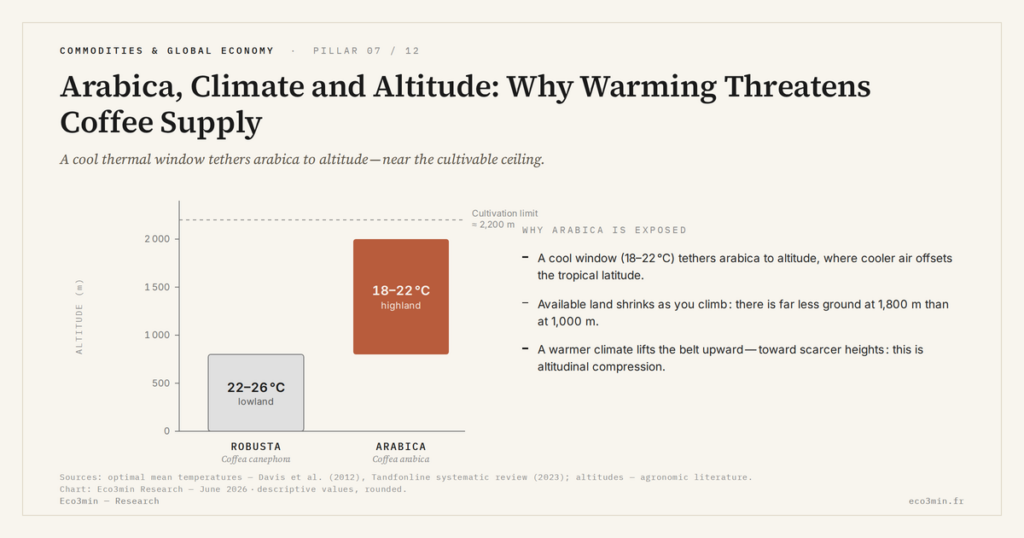
Arabica is a species with a narrow thermal window, tethered to altitude. Warming does not merely shift its growing zone — it shrinks it, which underpins the hypothesis of a structural fragility in supply.
TL;DR
Arabica's reliance on cool, high-altitude ground makes warming a durable pressure on supply, raising the cost of cultivation while a shrinking suitable area need not translate into outright scarcity.
- Grown between 800 and 2,000 metres, arabica responds non-linearly to heat: past a threshold, flowering aborts and yields drop sharply rather than declining gently.
- As warming lifts the comfort zone, less land is available at each higher tier, so the coffee belt narrows; plots on its lower edge tip from viable to unusable first.
- The most-cited projections see suitable area contracting by about half by 2050, but these remain scenarios, and higher yields or new varieties on remaining land can partly offset lost acreage.
- Volcafe projected a 2025/26 global arabica deficit near 8.5 million bags in summer 2025, which would mark a fifth consecutive deficit year.
This agronomic fragility is the engine of the coffee market’s climate thesis. Examining it means weighing the mechanisms without mistaking an underlying trend for a dated certainty.
1. A species with a narrow thermal window
Not all plants respond the same way to a warming climate, and coffee offers a textbook case of that inequality. Arabica is a demanding species: it needs a narrow thermal window, cool nights, sufficient altitude, and it fears frost as much as heatwaves. This physiology has a direct economic bearing, because it exposes arabica to a risk that robusta, more tolerant, does not run to the same degree. It is this asymmetry that feeds the spread as a supply-tension signal and that forms, over the long run, its most structuring driver.
The agronomic mechanism runs as follows. Arabica thrives within a relatively narrow band of mean temperatures; beyond it, photosynthesis degrades, flowering is disrupted, cherry development suffers. This is why it is grown at altitude, generally between 800 and 2,000 metres, where coolness offsets the tropical latitude. This dependence on altitude is precisely what distinguishes it from lowland robusta, as what separates arabica and robusta sets out on the botanical and commercial level.
2. Altitudinal compression
The geographic core of arabica’s fragility lies in a phenomenon of altitudinal compression. A plant adapted to a narrow thermal window sees, as temperatures rise, its comfort zone slide upward. But the surface available at each altitude tier diminishes as one climbs: there is far more arable land at 1,000 metres than at 1,800 metres. Warming therefore does not merely shift the “coffee belt,” it narrows it, pushing arabica toward heights where physical space runs short.
Add to this that higher-altitude land is often already occupied, protected, or unfit for cultivation. Arabica’s fragility is therefore not only a matter of average temperature: it is a matter of the geometry of the land. A moderate rise in temperature can be enough to tip a plot from viable arabica toward the unusable, especially on the lower edge of the current belt. This mechanic turns a gradual warming into a loss of arable surface, and it is this loss that constitutes the real threat to supply.
Arabica’s sensitivity also stems from the non-linearity of its response to heat. The plant performs best within a relatively low band of mean temperatures; beyond a certain threshold, the effects are not proportional but accelerate — flowering aborts, cherries ripen poorly, yield drops sharply rather than declining gently. It is this non-linearity that makes arabica vulnerable to temperature increases that would seem modest in absolute terms: what matters most is not the average but the crossing of critical thresholds during the sensitive phases of the growing cycle. A heat episode at the wrong moment can weigh more than a steady rise spread across the year.
3. What agronomic research shows
Agronomic research has quantified this threat, with the caveats proper to any projection exercise. Several scientific studies converge on one finding: under certain warming scenarios, the land climatically suited to arabica cultivation could contract sharply — on the order of a half in the most-cited projections by 2050 — while the favourable zones would shift toward cooler altitudes and latitudes. These estimates remain scenarios, sensitive to the assumptions chosen and to the actual pace of warming; they are not a certainty.
A further distinction matters: a shrinking suitable area does not mechanically translate into a collapse in production. Yields can be raised on the land that remains suitable, new varieties can extend the viable range, and intensification can partly offset a loss of acreage. The relationship between climatic suitability and actual output is therefore loose, mediated by farming practices and investment. This is why the structural thesis is best read as a pressure on supply rather than a forecast of scarcity: it raises the cost and the difficulty of producing arabica, and tilts the long-run odds toward recurring tension, without dictating any particular price path. The honest reading holds the risk and its uncertainty together.
This nuance is essential, but it does not empty the finding of its substance. The direction of the risk is barely in dispute — a warming unfavourable to a highland plant — even if its scale and timing remain debated. On the short-term side, the trader Volcafe projected in summer 2025 a global arabica deficit on the order of 8.5 million bags for the 2025/26 crop year, which, if confirmed, would mark a fifth consecutive year of deficit. Such a run raises the question of the cyclical versus structural share of the imbalance. Arabica’s fragility is therefore an underlying trend to observe over time, as the broader study of the agricultural commodity cycles reminds us.
4. The geography of the coffee belt
This compression has concrete geographic consequences. Arabica is grown in a belt of tropical highlands — the Brazilian Cerrado and mountain ranges, the Colombian Andes, the East African plateaus, Central America’s volcanic slopes. These regions share a dependence on altitude to compensate for tropical latitude, and it is precisely this altitude buffer that warming erodes.
Relocating crops toward cooler zones, often presented as the obvious remedy, runs into concrete obstacles. Moving up in altitude requires suitable soils, compatible rainfall and access to land that is not guaranteed, the heights being frequently occupied, protected or unfit for coffee. Migrating toward higher latitudes means rebuilding know-how, processing infrastructure and export channels where they do not exist. These frictions mean arabica supply cannot move as fast as its optimal climate zone, which widens, at least transitionally, the gap between theoretical potential and actual production.
As the favourable thermal band rises, the lowest arabica plots lose their suitability first, while the higher land that could replace them is limited and often already spoken for. The threat is therefore not uniform but graded: the most exposed arabica is that grown on the lower edge of the current belt, where a few tenths of a degree can tip a plot from marginal to unviable. This climate dependence is moreover concentrated on the large producing countries, foremost among them Brazil, whose weather shocks are analysed by Brazilian weather and arabica.
5. Robusta more tolerant, but not immune
It would, however, be wrong to portray robusta as climate-insensitive. More heat-tolerant, it is not for that immune: the recent Vietnamese deficits trace precisely to drought episodes. The difference between the two species is not that one suffers and the other thrives, but that robusta’s adaptation margins are wider — a broader thermal window, a productive geography less constrained by altitude.
Warming therefore weighs on both coffees; it simply weighs more, and sooner, on arabica. It is this difference of degree, not of nature, that underpins the hypothesis of a durable deformation of the spread in robusta’s favour. The point is not that arabica is doomed and robusta safe, but that the two species sit at different distances from their climatic limits, and warming closes that distance faster for arabica. This structural hypothesis nonetheless runs up against a competing, purely cyclical explanation that must be taken seriously: the alternate bearing proper to the coffee tree, examined in the coffee tree’s alternate bearing.
6. A falsifiable hypothesis
The climate thesis must be framed with rigour, as a falsifiable hypothesis and not as a prophecy. It implies observable consequences: a rising frequency of arabica supply shocks, a measurable contraction of suitable zones, a robusta share that advances in production and blends, a succession of deficit crop years for arabica. It is this coherent accumulation of signals, over several cycles, that would validate the thesis — or invalidate it if the opposite signals dominated.
For the trade is not passive in the face of this constraint. Several adaptation levers exist and are being actively explored: selection of arabica varieties more resistant to heat and drought, recourse to agroforestry and shade to lower ground temperature, gradual shifting of cultivation toward cooler altitudes and latitudes, improved irrigation and soil management. Each of these levers, if it spreads at scale, eases the agronomic constraint and pushes back the deadline for a structural shift. The speed at which these adaptations generalise, against that of warming, is the unknown separating the thesis from the counter-thesis. It is within this logic of physical constraint on supply that coffee sits, among the major commodity markets, whose price formation depends on the limits of the physical world. Arabica’s fragility belongs, finally, to the broader category of the tropical soft commodities, where climate is a first-order determinant.
Reading a climate projection as a certainty is misleading. Stating that “arabica’s suitable area will halve by 2050” presents as settled what is only a scenario, dependent on warming assumptions and on the pace of the trade’s adaptation. The direction of the risk is firmly established; its scale and timing are not. Conflating a probable trend with a dated fact distorts the reading of the market.
Last updated — 30 June 2026
Disclaimer – Financial Information: The analyses, commentary, and content published on eco3min.fr are provided for informational and educational purposes only. They do not constitute investment advice or a solicitation to buy or sell financial instruments. Past performance is not indicative of future results. All investment decisions involve risk and are the sole responsibility of the reader.
Read next
Full pillar →Reading the refinery utilisation rate: the threshold, the season, the turnarounds
A refinery runs full near ninety percent, not a hundred: the last slice of nameplate capacity is a…
IMO 2020: the regulatory shock that rewrote product spreads
An environmental rule on marine sulfur can move a refining spread more than a swing in crude. IMO…
The 2022–2023 refining golden age: anatomy of an episode
In 2022, refined fuel prices climbed faster than crude. That gap, measured by the 3-2-1 crack spread, reached…