The Coffee Biennial Cycle: Why Alternate Bearing Makes Prices Swing

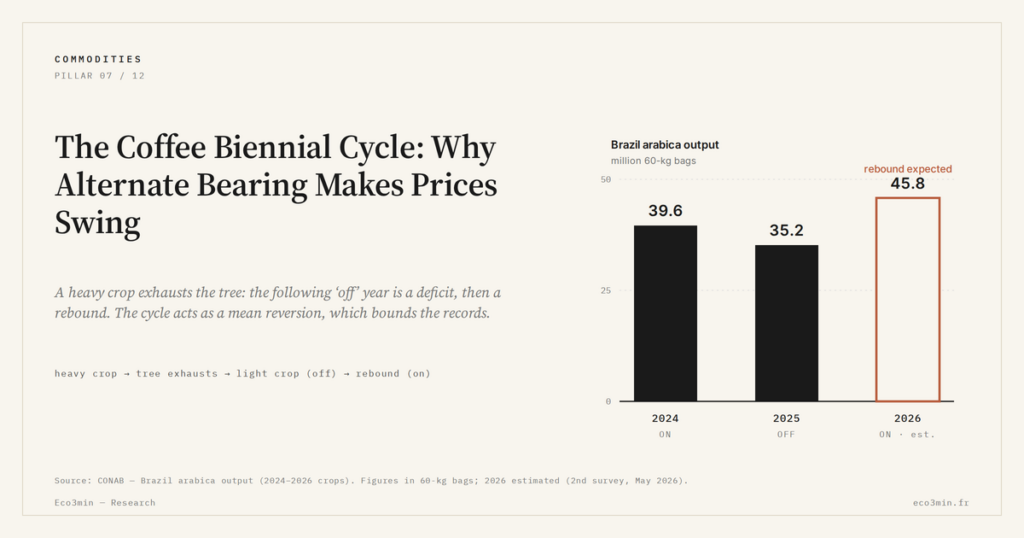
The coffee tree bears in alternation: a heavy crop exhausts the plant, which yields less the following year before rebounding. This biennial cycle offers a purely cyclical explanation for price records, competing with the climate thesis.
TL;DR
Alternate bearing layers a two-year on/off rhythm over a longer replanting cycle, so a single coffee price swing often blends several overlapping cycles of different lengths.
- A supply shock lifts prices, spurs new plantings, and yields a glut as they mature three to four years later; this multi-year cycle sits atop the biennial on/off rhythm most visible in Brazil.
- Arabica's 2025 correction was widely anticipated: the New York benchmark fell to about $2.72 per pound in early July, down nearly a third from its February peak, with the World Bank seeing the coffee index off roughly 9% over 2025.
Understanding alternate bearing explains why a price peak is often followed by a correction, and why an oscillation must be distinguished from an underlying trend.
1. The coffee tree’s alternate bearing
An analysis that posited arabica’s climate fragility without confronting its main objection would be incomplete. That objection has a precise agronomic name: alternate bearing, or the coffee tree’s biennial cycle. The tree, and arabica in Brazil especially, bears in alternation — a high-production year exhausts the plant, which produces less the following year before rebounding. This biennial rhythm is written into the tree’s physiology, and it offers a competing, purely cyclical explanation for price records. It is a reading that runs head-on against the coffee climate thesis without refuting it.
The biological mechanism is simple. When a coffee tree bears abundantly, it mobilises its reserves to develop a large number of cherries, which weakens it. The following year, exhausted, it produces less while it rebuilds those reserves, before returning to a stronger crop. Across a region where most trees are synchronised, this individual alternation translates into a two-beat production cycle: a “large” crop followed by a “small” one. This mechanic is superimposed on weather hazards without being conflated with them.
The alternation stems from the biology of fruiting. The coffee tree bears its cherries on the current year’s wood, and an abundant crop diverts the plant’s resources toward fruit at the expense of the vegetative growth that will carry the next crop. The tree thus arbitrates, despite itself, between bearing heavily today and preparing for tomorrow. Cultural practices — pruning, fertilisation, irrigation — can dampen the cycle’s amplitude without erasing it. This perennial, cyclical character sets coffee apart within the agricultural softs category, whose rhythms depend on the plants’ growing cycle far more than on short-term production decisions. Where an annual crop readjusts each season, the coffee tree sets its own tempo, which neither price nor demand can hurry.
2. The biennial cycle in Brazil
Brazil, the world’s largest producer and the heart of arabica, is where this cycle is most visible at the scale of the market. A large share of Brazil’s arabica growing follows this alternating rhythm, to the point that operators reason in “on” and “off” years. A low-crop year does not therefore necessarily signal a structural problem: it may be only the expected trough of an oscillation, set to correct the following year with a rebound harvest. The concentration of production in this country is precisely what makes the alternation legible at the world level, as Brazil’s arabica production analyses more broadly.
The interpretive stake is this: to read a price shock without accounting for this cycle is to risk mistaking the trough of an oscillation for the start of a trend. If part of the recent deficits stems from the trough of a biennial oscillation, then a rebound harvest is mechanically expected, and the price record that accompanied the trough heralds nothing of a structural crisis. Alternate bearing acts as a natural mean-reversion mechanism: a deficit one year often calls forth a surplus the next.
One peculiarity of this cycle is that it is partly predictable. Unlike a frost or a drought, whose occurrence is uncertain, the alternation follows a known rhythm: operators roughly know whether the coming year will be “on” or “off.” This predictability has an important price consequence. An expected production trough, because it is anticipated, is partly already priced in: the market reacts strongly only to the gap between the actual harvest and the expected cyclical trough. It is when a weather hazard deepens a deficit beyond the normal cyclical dip that prices truly surge. Distinguishing the expected from the unexpected is therefore at the heart of reading a coffee price shock.
3. A mean-reversion mechanism
This mean-reversion property is what most clearly distinguishes the cyclical counter-thesis from the climate thesis. A biennial oscillation naturally brings production back toward a central value, without that implying any drift in that value. It is a stabilising factor, over the short run, that bounds the size and duration of a deficit tied to the cycle alone.
This short-run stabiliser sits atop a longer boom-bust pattern familiar across coffee history. A supply shock drives prices to a peak, prompts a wave of new plantings, and then — as those plantings mature three to four years later — produces a glut that pulls prices back down. The biennial cycle and this multi-year replanting cycle therefore layer on one another, so that what looks like a single price swing is often several overlapping cycles of different lengths. Reading the coffee price means separating these layers rather than attributing every move to one cause.
The difficulty is that the biennial cycle and weather hazards are superimposed and can reinforce or mask each other. A drought striking an “off” year amplifies an already-expected trough and can suggest a structural crisis, where part of the deficit was merely cyclical. Conversely, good weather in an “on” year can swell a rebound harvest and exaggerate the impression of a return to normal. Disentangling the cyclical share from the weather share of a given deficit is one of the trickiest exercises in reading the coffee market — a challenge common to many physical markets, as the reading of commodity markets recalls, where several cycles of differing amplitudes and frequencies permanently overlap.
The facts of 2025 lend weight to this counter-thesis. After the February peak, the arabica price underwent a marked correction: the New York benchmark fell to around $2.72 per pound in early July 2025, down nearly a third from its spring high, before partially rebounding. Several analysts attributed this easing to improving Brazilian crop prospects and to flowering conditions judged more favourable. The World Bank, for its part, anticipated a fall in the coffee price index on the order of 9% across 2025, and a Reuters poll published in late 2024 pointed to an arabica decline that could approach 30% by the end of 2025. The post-record reversal was therefore widely anticipated, which illustrates the strength of the cyclical mechanism. This correction feeds the examination of the harvest rebound after a record, and the oscillation it traces is visible in the long arabica price series.
4. Cycle and trend: two time scales
The temptation would be to conclude that the cyclical counter-thesis refutes the climate thesis. That would be too quick. The two readings do not mechanically exclude each other: alternate bearing explains why records mean-revert — why a peak is generally followed by a correction — without saying anything about the underlying trend on which those oscillations are grafted. A biennial cycle can perfectly well oscillate around a mean that itself drifts slowly under a growing climate constraint. The oscillation and the trend operate on different time scales.
This difference of scales carries a strong methodological implication: one can neither refute a long-term trend with a single short-term correction, nor confirm a structural crisis with a single record. Two symmetric errors lie in wait for the analyst. The first is to extrapolate a peak — “coffee has never been this expensive, so it will stay this way” — ignoring the mean-reversion of alternate bearing. The second is to trivialise every record — “just another cycle” — ignoring the possibility of a drift in the mean around which the cycle oscillates. Rigour requires holding both mechanisms together. It is precisely this alternation between trough and rebound that drives the deformation of the arabica-robusta spread over the short run. More broadly, this dynamic belongs to the cyclicality of commodities, of which the biennial coffee cycle is only one particular agricultural instance.
What would one need to observe to adjudicate between the two readings? On the structural side, ever-deeper cycle troughs, ever-higher peaks, a rising frequency of arabica deficit years, and an arabica-robusta spread whose low point rises from one cycle to the next. On the cyclical side, a return of prices toward prior levels after each peak, rebound harvests that rebuild stocks, and a stable long-term mean. None of these signals is conclusive on its own; it is their coherent accumulation, over several cycles, that will tip the balance. Adjudication therefore belongs to patient observation of the series, not to commentary on a single peak. In the meantime, the honest stance treats a record as a dated symptom rather than a forecast.
- The coffee tree bears in alternation: a heavy crop exhausts the tree and leads to a smaller crop the following year, followed by a rebound.
- This biennial cycle, very visible in Brazil, acts as a mean-reversion: a deficit often calls forth a surplus, which bounds the size of a purely cyclical trough.
- Arabica’s 2025 correction (falling to around $2.72 per pound in July after the February peak) was widely anticipated, illustrating the strength of the cycle.
- Cycle and trend operate on different scales: a biennial oscillation can turn around a drifting mean — the two readings do not exclude each other.
Last updated — 28 June 2026
Disclaimer – Financial Information: The analyses, commentary, and content published on eco3min.fr are provided for informational and educational purposes only. They do not constitute investment advice or a solicitation to buy or sell financial instruments. Past performance is not indicative of future results. All investment decisions involve risk and are the sole responsibility of the reader.
Read next
Full pillar →Reading the refinery utilisation rate: the threshold, the season, the turnarounds
A refinery runs full near ninety percent, not a hundred: the last slice of nameplate capacity is a…
IMO 2020: the regulatory shock that rewrote product spreads
An environmental rule on marine sulfur can move a refining spread more than a swing in crude. IMO…
The 2022–2023 refining golden age: anatomy of an episode
In 2022, refined fuel prices climbed faster than crude. That gap, measured by the 3-2-1 crack spread, reached…