The Arabica–Robusta Spread: When a Price Gap Becomes a Supply-Stress Signal

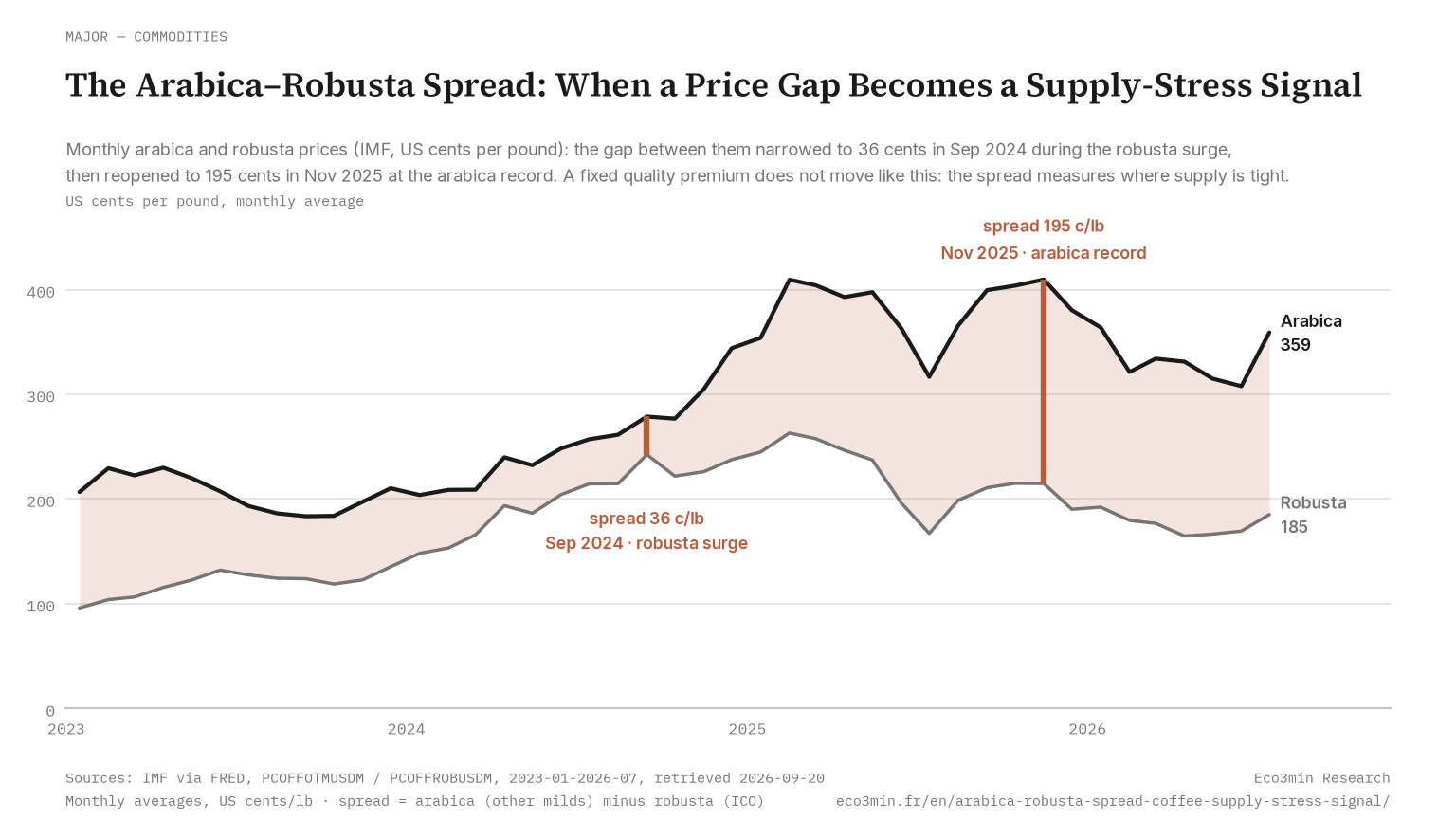
Coffee trades at two prices, arabica and robusta, on two separate exchanges. The gap between them is not a fixed quality premium: it deforms with supply stress and behaves as a thermometer of agricultural tension.
TL;DR
Coffee's two prices, New York arabica and London robusta, react to separate shocks, and the gap between them works as a thermometer of where supply stress is striking.
- New York's 'Coffee C' cleared $4 per pound for the first time on 5 February 2025, reaching about $4.41, more than double a year earlier and beyond the 1977 high of $3.375.
- London robusta broke through $4,000 per tonne on 16 April 2024, a 45-year high on the ICO indicator (its highest since July 1979), then about $5,821 in February 2025, briefly pushing some Vietnamese lots close to parity with low-grade arabicas.
- Specialty buyers pass higher green-bean costs through more readily, while commodity blenders reformulate toward cheaper robusta when arabica spikes, concentrating the substitution response in the instant and blend segment.
This analysis reads that gap as a variable rather than a constant, and weighs two interpretations of the 2024-2025 records: a passing weather cycle, or the rise of a structural fragility in arabica.
1. Two coffees, two exchanges: the anatomy of a split market
The coffee market rests on a fact that public conversation almost always erases: there is not one coffee but two commercial species, grown differently, priced separately, and whose quotes do not move together. Arabica (Coffea arabica) and robusta (Coffea canephora) are not two grades of a single product but two plants with opposite agronomic requirements, responding to distinct shocks and feeding different uses. Grasping this split is the precondition for any reading of the coffee price — and it is precisely the distinction laid out by the two coffee species in their basic workings.
Arabica grows at altitude, generally between 800 and 2,000 metres, in cool climates with moderate temperature swings. It supplies the aromatic cups sought by specialty roasting, contains relatively little caffeine — on the order of 1.5% — and accounts for the majority of world output. According to the U.S. Department of Agriculture’s Foreign Agricultural Service data released in December 2023, global coffee production in the 2023/24 crop year reached roughly 171.4 million 60-kilogram bags, of which about 97.3 million bags were arabica, or a little under 57% of the total. Arabica is therefore the dominant species by volume, but also the most demanding and the most vulnerable.
Robusta occupies the other half of the market. Grown in tropical lowlands, it tolerates heat, resists disease better, and contains nearly twice the caffeine — up to about 2.7%. Its cup is harsher, more bitter, long judged inferior; it feeds most instant coffee, cheap pods and industrial blends. The same USDA source put world robusta production for 2023/24 at roughly 74.1 million bags, down 3.3% year on year. This asymmetry — a majority but fragile arabica, a minority but rugged robusta — structures the entire price dynamic.
The split runs through demand as well as supply. The two species feed largely distinct end-markets: arabica anchors the specialty and premium segment, where origin, cup quality and traceability command a price; robusta anchors the commodity segment, where caffeine content, shelf stability and cost dominate, and where instant coffee and economy blends absorb the bulk of volume. These two demand pools respond differently to a price shock. Specialty buyers, selling a differentiated product, can pass higher green-bean costs through to consumers more readily; commodity buyers, competing on price, are quicker to reformulate blends toward cheaper inputs when arabica spikes. This difference in pass-through and substitution capacity is itself a determinant of how far and how fast the spread can move, and it explains why the behavioural response to an arabica shock is concentrated in the blend and instant segment rather than spread evenly across the market.
1.1 Two benchmark contracts, two financial centres
This botanical duality is mirrored by a financial one. Arabica trades primarily in New York, on the Intercontinental Exchange’s “Coffee C” contract (ICE Futures US), the global reference for the species. Each contract covers 37,500 pounds of green coffee and accepts physical delivery of beans from around twenty origin countries, from Brazil to Colombia and across Central America. Robusta, by contrast, trades in London on ICE Europe, in a contract denominated in dollars per tonne. Two exchanges, two pricing units, two reaction functions.
This separation is more than a market convenience: it reflects the fact that the two species absorb largely independent shocks. A frost in the highland zones of south-eastern Brazil hits arabica without directly touching Vietnamese robusta; a drought in Vietnam’s highlands tightens robusta supply without mechanically contracting arabica’s. The two quotes can therefore diverge sharply and durably. It is this divergence — the shifting space between the arabica price and the robusta price — that is the object of this analysis. We call it the arabica-robusta spread, and it says more about the state of global supply than either price taken in isolation.
A framing note on coffee’s place within commodities is warranted. Coffee belongs to the family of agricultural commodities, the tropical “softs” whose price formation obeys physical constraints — climate, productive geography, the harvest calendar — far more than any logic of strategic resource. This membership is not neutral: it places coffee among the climate-sensitive indicators, and makes it a case study in how an agronomic constraint turns into a price signal, within the commodities pillar.
Coffee shares with the other tropical softs — cocoa, sugar, orange juice — one common trait: its price formation depends on a narrow set of producing zones, exposed to climatic hazards that nothing genuinely diversifies away. This kinship ties it to the wider family of agricultural commodities, whose cycles answer to the harvest calendar and the weather more than to financial arbitrage. Within that family, coffee carries a further peculiarity: it comes in two species with opposite risk profiles, which makes the spread between them an object of analysis in its own right.
The “quality premium” narrative took hold for understandable reasons. For decades arabica did trade well above robusta, and that price hierarchy overlapped with a perceived quality hierarchy: arabica for the fine cups, robusta for the low end. Habit turned an empirical regularity into a supposedly immutable law. But a regularity is not a constant. The spread has always fluctuated, and the 2024-2025 episodes showed it could compress to near-parity on certain lots. The quality reading is not wrong — it captures a real component of the spread — but it is incomplete, because it ignores the supply component, which is precisely the one that moves.
The most common reading treats the price difference between arabica and robusta as a stable quality premium: arabica is “worth more” because it is better, and that gap belongs to a more or less constant order of things. This reading is misleading. The spread is not a quality constant; it is a supply variable, widening and narrowing to the rhythm of the agronomic stresses that strike one species or the other. To read the spread is to read the relative state of the two coffees’ supply.
The mechanism runs as follows. When arabica supply tightens — drought or frost in Brazil, the dominant producer — its price climbs while robusta barely moves, and the spread widens. Conversely, when robusta supply contracts — a Vietnamese deficit, climate damage on the lowlands — its price recovers part of its discount, and the spread narrows. A third, behavioural mechanism is layered on top: faced with arabica that has become too expensive, some roasters shift purchases toward robusta to fill the cup more cheaply, supporting robusta demand and compressing the spread further. Substitution runs in both directions depending on relative prices, but it always acts as a restoring force.
Recent episodes illustrate this dual mechanic perfectly, and show that the spread can deform in both directions within a few months. In 2023 and 2024, it was robusta that first surged. Drought in Vietnam, the world’s largest producer of the species, opened a deficit that several trading houses quantified: the trader Volcafe noted in May 2024 a Vietnamese 2024/25 crop cut to around 24 million bags, its lowest level in thirteen years, and a global robusta deficit running into several million bags — the fourth consecutive year of deficit for the species. London robusta broke through $4,000 per tonne on 16 April 2024 ($4,003 intraday on the May contract), and the ICO robusta indicator reached that month its highest level since July 1979 — a 45-year high — before the contract extended its rise to the February 2025 record.
That robusta surge had a counter-intuitive effect: it narrowed the gap with arabica, to the point where some Vietnamese robusta lots ended up close to parity with low-grade arabicas. The traditional hierarchy — arabica clearly above robusta — temporarily flattened. Then, in 2024-2025, the centre of gravity shifted to arabica: Brazilian droughts and frost threats propelled New York’s “Coffee C” above $4 per pound for the first time in its history on 5 February 2025, up to a record of roughly $4.41 per pound — more than double its level a year earlier, and well beyond the previous high of $3.375 dating from 1977. The spread then widened abruptly once more.
Robusta was not left behind: the London contract printed a record of about $5,821 per tonne in February 2025, driven both by its own supply tensions and by arabica’s pull. Across two crop years, the arabica-robusta spread therefore swung violently: first compressed by robusta’s overheating, then re-widened by arabica’s record. It is this amplitude, not a fixed level, that makes the spread a signal. When it deforms, it tells which of the two supplies is under stress and with what intensity.
Reading the spread as a variable changes the interpretive grid. Arabica at $4 per pound is not merely “expensive”: set against a robusta that follows or lags, it maps a geography of supply stress. If the spread widens, the tension is arabica-specific and points to Brazil and altitude; if it narrows, the tension is robusta-specific and points to Vietnam and the lowlands. This ability to locate the stress makes the spread a richer reading instrument than either quote.
Substitution between the two species deserves detail, because it is the mechanism by which the spread narrows. It does not run one way. When arabica becomes prohibitive, blend and instant roasters raise the robusta share in their recipes, within the limits the target taste allows: a specialty coffee cannot swing to robusta without losing its identity, but a mass-market blend has real room. Conversely, when robusta tightens to the point of meeting entry-grade arabicas — as in 2024 — the cost arbitrage that usually pushed toward robusta fades, and some buyers shift to arabica. This cross-elasticity bounds the spread: it can neither widen indefinitely, because substitution toward robusta eventually supports it, nor invert durably, because arabica’s quality premium reasserts itself as soon as robusta tension recedes.
This restoring mechanism explains why the spread oscillates around a zone rather than drifting without bound, and why an extreme narrowing is itself a signal. An arabica premium collapsing toward parity does not signal that arabica has become cheap, but that robusta has become exceptionally dear — and therefore that a supply tension is striking the tropical lowlands. The direction of the deformation matters as much as its size. A reader watching only the arabica quote would miss this; it is by relating one price to the other that the market reveals where the constraint sits.
One must finally guard against a purely instantaneous reading. The spread at a given moment reports on the tension of the moment, but it is its trajectory across several crop years that distinguishes an accident from a trend. An isolated widening may be no more than a one-off weather shock; a succession of ever-sharper widenings, spaced by ever-shorter narrowings, would point to an underlying transformation. This distinction between the one-off and the structural runs through the whole analysis that follows, and it is what separates the cyclical counter-thesis from the climate thesis. The spread is most informative not as a snapshot but as a sequence.
The arabica-robusta spread is often presented as a stable quality premium, fixed once and for all by arabica’s superior taste. That is a misleading reading, because it treats as a constant what is a supply variable: the spread widens when arabica tightens, narrows when robusta surges, and its amplitude reports precisely on the relative state of the two markets.
3. Brazil’s weight: when a local accident becomes a global shock
No country weighs on a global agricultural market the way Brazil weighs on coffee. The leading producer and exporter, it supplies on its own roughly a third of world coffee output, and a decisive share of the arabica traded across the planet. This dominance concentrates risk: the reaction function of the arabica price runs first through the skies of south-eastern Brazil. The detail of this dependence — how Brazil’s grip on arabica turns a local weather anomaly into a global price move — warrants a dedicated examination.
The concentration is not only national, it is regional. The state of Minas Gerais alone accounts for about 70% of Brazil’s arabica crop (29.8 million bags out of 42.1 in 2024/25, according to Conab). This geographic density means that a circumscribed weather event — a frost on the highland zones, a drought during flowering — can contract a whole crop year’s arabica supply. Where other agricultural markets spread risk across several continents, arabica coffee concentrates it on a handful of Brazilian states. The consequence is amplified volatility: the slightest anomaly becomes a price shock.
The 2024-2025 episodes offer a sharp demonstration. Brazil’s coffee zones strung together hydric stresses: the Cooxupé cooperative, one of the country’s largest, flagged in 2024 coffee trees durably affected by the absence of meaningful rain over long stretches, while private weather services warned of frost risk on some growing regions. A drought during the flowering phase reduces the next crop’s cherry count; a frost can directly damage the trees. In both cases it is a year’s arabica supply that contracts, with a lag between the shock and its effect on the harvest.
The distinction between frost and drought is not incidental, because the two shocks share neither timing nor reversibility. Frost acts abruptly: a night of sub-zero temperatures on highland zones can scorch foliage, even kill whole trees, amputating production for several years when bushes must be stumped or replanted — a coffee tree reaches full bearing only after three to four years. Drought acts more insidiously, disrupting flowering and cherry development, cutting the coming crop’s yield without necessarily destroying the tree. The first is a durable stock shock, the second a flow shock that is often recoverable.
Coffee history keeps the memory of Brazil’s great frosts. The “black frost” of 1975, which devastated Paraná’s plantations, and the twin frosts of 1994 rank among the episodes that durably marked the market, propelling prices and redrawing the production map — Brazil has since shifted part of its coffee growing toward zones less exposed to frost. These precedents are a reminder that a localised climate accident can have multi-year effects on global supply, and that the memory of such shocks sustains the market’s nervousness at every cold alert. It is this asymmetry — a market that reacts violently and pre-emptively to risks whose materialisation is uncertain — that characterises arabica price formation.
The degree of concentration sets coffee apart even among agricultural markets. Grains are grown across several continents, which spreads weather risk and dampens the impact of any single regional shock; a drought in one breadbasket can be partly offset by a good harvest in another. Arabica enjoys no such natural hedge. Its dependence on a narrow set of Brazilian highland zones means that producing regions cannot offset one another, so a localised event propagates directly to the world price. This structural feature — supply resting on a handful of origins with no internal diversification — is what makes arabica one of the more volatile soft commodities, and what gives Brazilian weather its outsized role in the formation of the price. See also: the food-price dynamics behind unrest.
3.1 A dependence that amplifies volatility
Traders therefore watch Brazilian weather with the attention others give to U.S. payroll figures. Every drought forecast, every cold-snap alert triggers price moves, sometimes before damage is even confirmed. This anticipation is rational: given Brazil’s weight, weather information carries direct value for future supply. But it also feeds considerable volatility, because the market reacts to forecasts that may never materialise.
This amplification has a financial dimension. Part of the 2024-2025 rise owed to short-term factors grafted onto the agronomic constraint: heavier positioning by financial players anticipating shortage, trade-flow disruptions, and stock-holding behaviour by producers. These elements amplified the peak beyond what fundamentals alone justified, without being its primary cause. The distinction matters: the Brazilian supply shock explains the direction of the rise; financial and commercial factors explain part of its intensity. Conflating the two leads to over-reading the peak.
The lag between shock and harvest adds a layer of uncertainty. A drought during flowering shows up in volumes only months later, at the next harvest; a frost can weigh on several crop years. The market must therefore anticipate on partial information, which is why prices often move before damage is confirmed, then correct once the true scale of the loss becomes clear. This dynamic of anticipation and revision is a structural source of volatility, distinct from fundamentals themselves.
This climatic dependence of Brazil is not a cyclical feature but a structural characteristic of the market. So long as arabica production remains concentrated in narrow altitude bands of a single large country, Brazilian weather will remain the leading determinant of the species’ world price. That is what makes arabica, and the spread it forms with robusta, sensitive to climatic conditions — a point developed by the analysis of arabica under a warming climate.
4. The rise of Vietnamese robusta: the spread’s other leg
If Brazil reigns over arabica, Vietnam reigns over robusta. In a few decades the country became the world’s leading producer of the rugged species, turning a marginal crop into a pillar of its export agriculture. This dominance gives Vietnamese robusta market power comparable to Brazilian arabica’s: when the Vietnamese crop falters, it is the world robusta supply that tightens, and the spread’s other leg that moves. The trajectory of this ascent — how the rise of Vietnamese robusta turned a coffee long considered secondary into a first-order variable — illuminates an often-neglected half of the market.
This dominance is recent on the scale of coffee history. Until the 1980s, Vietnam counted for little on the world coffee market. The Đổi Mới economic reforms, from 1986, liberalised agriculture and triggered a meteoric expansion of coffee growing in the country’s Central Highlands, around Dak Lak province. Within some fifteen years Vietnam became the world’s second-largest coffee producer across all species and the largest robusta producer, upending the market’s balance. This rise structurally lowered the world average cost of robusta and broadened its use, to the point of making it the backbone of instant coffee and mass-market blends. Vietnam’s market power over robusta is thus the product of an accelerated agricultural transformation, comparable in scale to Brazil’s historical dominance over arabica.
The 2023-2024 deficit episode revealed that market power. Drought struck Vietnam’s central highlands, the main producing region, damaging flowering and cutting the crop. According to Vietnamese agriculture authority projections reported in spring 2024, the country’s coffee production for the 2023/24 crop year could fall by around 20% to some 1.47 million tonnes, its smallest harvest in four years. Volcafe went further, estimating in May 2024 that the 2024/25 crop might reach only around 24 million bags, the lowest in thirteen years, owing to damage judged “irreversible” to the blossoms.
This deficit tightened the entire robusta market. Global inventories had already fallen to historically low levels — in late January 2024, robusta stocks on the benchmark exchanges had hit record lows. The combination of declining Vietnamese supply and depleted stocks propelled the robusta price toward its highs of 2024 and then 2025. Robusta, long the “poor relation” of coffee, thus became a price driver in its own right, capable of tightening the market without any help from arabica.
4.1 When robusta narrows the spread
The effect of this deficit on the arabica-robusta spread was striking. By driving robusta up faster than arabica through part of 2024, it compressed arabica’s traditional premium, to the point of inverting some of the trade’s reflexes. Roasters accustomed to arbitraging in favour of robusta for cost reasons saw that price advantage erode; some robusta lots approached parity with entry-grade arabicas. The spread, far from a constant, flattened under a purely robusta-specific tension.
This sequence validates the reading of the spread as a variable. A narrowing spread does not carry the same meaning as a widening one: the former points to a robusta tension — and therefore to Vietnam and the tropical lowlands — while the latter points to an arabica tension, and therefore to Brazil and altitude. In 2024-2025 the market sent both signals in turn, which explains the unusual amplitude of the moves. The spread thus acts as a compass that indicates not only the intensity of the tension but its location. This geographic dimension — the decisive role of a dominant producer per species — belongs to a more general mechanic, observable beyond coffee alone.
This geographic dependence — arabica hanging on Brazil, robusta on Vietnam — illustrates a broader mechanic: the decisive role of large producing countries in shaping price cycles. When a commodity’s world supply rests on a handful of origins, the local conditions of those origins become global variables, and their concentration amplifies the transmission of shocks. Coffee is a particularly stark case because the concentration operates twice over — once per species — so that the spread itself becomes a map of which origin, and therefore which set of local conditions, is currently under strain.
Vietnamese dominance is not free of structural fragilities, which weigh on robusta supply beyond weather hazards alone. The Vietnamese coffee orchard is ageing: part of the plantings approaches or exceeds the age at which yield declines, and the replanting pace remains below what simple reconstitution of the productive capital would require. In parallel, the profitability of other crops — fruit, pepper — has prompted some growers to diversify away from coffee, shrinking acreage. To these tensions is added a new regulatory constraint: the European Union’s Deforestation Regulation (EUDR), the EU being the leading outlet for Vietnamese coffee. According to the semi-annual report relayed in December 2025, the EU classified Vietnam as a “low-risk” country and delayed full application of the regulation to December 2026, giving exporters time to build their traceability systems. These elements — an ageing orchard, diversification, compliance — are so many supply factors independent of the weather, which can sustain robusta tension over time.
One asymmetry of exposure between the two species should nonetheless be noted. Robusta, more tolerant of heat and harsh conditions, retains more headroom against a warming climate than arabica, confined to its altitude bands. This difference in ruggedness is not trivial: it sits at the heart of the structural thesis this analysis seeks to test, the one that separates a passing shock from an underlying shift.
5. Arabica’s agronomic fragility: the engine of the climate thesis
Not all plants respond the same way to a warming climate, and coffee offers a textbook case of that inequality. Arabica is a demanding species: it needs a narrow thermal window, cool nights, sufficient altitude, and it fears frost as much as heatwaves. Robusta, by contrast, tolerates higher temperatures and rougher conditions. This physiological asymmetry has a direct economic bearing, and it provides the engine of this analysis’s central thesis.
The agronomic mechanism runs as follows. Arabica thrives within a relatively narrow band of mean temperatures; beyond it, photosynthesis degrades, flowering is disrupted, cherry development suffers. As temperatures rise, the zones suited to arabica shift upward — toward higher, cooler altitudes — and shrink, since surfaces above a given threshold are by nature limited. Robusta, whose thermal tolerance is wider, retains more geographic headroom. The consequence is a structurally greater climate exposure for arabica than for robusta.
The altitudinal compression deserves spelling out, because it is the geographic core of arabica’s fragility. A plant adapted to a narrow thermal window sees, as temperatures rise, its comfort zone slide upward. But the surface available at each altitude tier diminishes as one climbs: there is far more arable land at 1,000 metres than at 1,800 metres. Warming therefore does not merely shift the “coffee belt,” it narrows it, pushing arabica toward heights where physical space runs short. Add that higher-altitude land is often already occupied, protected, or unfit for cultivation. The constraint is not only a matter of average temperature: it is a matter of the geometry of the land.
This geometry has concrete geographic consequences. Arabica is grown in a belt of tropical highlands — the Brazilian Cerrado and mountain ranges, the Colombian Andes, the East African plateaus, Central America’s volcanic slopes. These regions share a dependence on altitude to compensate for tropical latitude, and it is precisely this altitude buffer that warming erodes. As the comfortable thermal band climbs, lower-lying arabica plots lose their suitability first, while the higher ground that could replace them is finite and often spoken for. The result is not a uniform threat but a gradient: the most exposed arabica is that grown at the lower edge of the current belt, where a few tenths of a degree can tip a plot from marginal to unviable. Mapping that gradient is what gives the structural thesis its empirical teeth, and what makes the spread a candidate early indicator.
Agronomic research has quantified this threat, with the caveats proper to any projection exercise. Several scientific studies converge on one finding: under certain warming scenarios, the land climatically suited to arabica cultivation could contract sharply — on the order of a half in the most-cited projections by 2050 — while the favourable zones would shift toward cooler altitudes and latitudes. These estimates remain scenarios, sensitive to the assumptions chosen and to the actual pace of warming; they are not a certainty. But they give the structural-fragility thesis an empirical footing: the direction of the risk is barely in dispute, even if its scale and timing remain debated.
It would, however, be wrong to portray robusta as climate-insensitive. More heat-tolerant, it is not for that immune: the Vietnamese deficits of 2023-2024 trace precisely to drought episodes on the Central Highlands. The difference between the two species is not that one suffers and the other thrives, but that robusta’s adaptation margins are wider — a broader thermal window, a productive geography less constrained by altitude. Warming weighs on both coffees; it simply weighs more, and sooner, on arabica. It is this difference of degree, not of nature, that underpins the hypothesis of a durable deformation of the spread in robusta’s favour.
5.1 A hypothesis under indictment, but falsifiable
Here the climate thesis must be framed with rigour, as a hypothesis under indictment but falsifiable, not as a prophecy. The hypothesis is this: if arabica’s suitable area shrinks structurally under warming, then arabica’s fragility ceases to be a string of accidents and becomes a durable feature of the market — and the arabica-robusta spread, which widens at each arabica tension, would tend to deform more often and more strongly, with a gradual shift of demand toward robusta. Coffee would then become one of the first agricultural indicators of climate stress.
This hypothesis is falsifiable, which is its strength. It implies observable consequences: a higher frequency of arabica supply shocks, a measurable shrinking of suitable growing zones, a rising robusta share in production and blends, a succession of deficit crop years for arabica. On this last point, recent signals feed the hypothesis without settling it: the trader Volcafe projected in summer 2025 a global arabica deficit of around 8.5 million bags for the 2025/26 crop year, sharply up on the prior year, which — if confirmed — would mark a fifth consecutive year of deficit. Such a run raises the question of the cyclical versus structural share of the imbalance.
The trade is not passive in the face of this constraint, and that is a further reason not to treat the climate thesis as destiny. Several adaptation levers exist and are being actively explored: selection of arabica varieties more resistant to heat and drought, recourse to agroforestry and shade to lower ground temperature, gradual shifting of cultivation toward cooler altitudes and latitudes, improved irrigation and soil management. Each of these levers, if it spreads at scale, eases the agronomic constraint and pushes back the deadline for a structural shift. The speed at which these adaptations generalise — against that of warming — is precisely the unknown separating the thesis from the counter-thesis. It is a race between the degradation of conditions and the trade’s capacity to adjust, and its outcome is not written.
The hypothesis could just as well be invalidated. A run of good harvests, a return to favourable climate conditions, an adaptation of farming practices or a successful relocation of crops toward new zones would suffice to loosen the constraint. That is why this analysis does not settle by decree: it posits arabica’s fragility as an established mechanism — the physiological asymmetry between the two species is not in dispute — while leaving open the question of the pace at which that fragility will translate into a price trend. The direction of the move is more firmly established than its speed.
6. A passing cycle or a structural shift: the honest counter-thesis
An analysis that posited the climate thesis without confronting its main objection would be dishonest. That objection has a precise agronomic name: alternate bearing, or the coffee tree’s biennial cycle. The coffee tree, and arabica in Brazil especially, bears in alternation — a high-production year exhausts the plant, which produces less the following year before rebounding. This biennial rhythm is written into the tree’s physiology, and it offers a competing, purely cyclical explanation for the price records. The detail of this mechanism — how the alternating harvest cycle structures supply independently of any warming — is the first counter-thesis to take seriously.
The stake is this. If part of the recent deficits stems from the trough of a biennial oscillation, then a rebound harvest is mechanically expected, and the price record that accompanied the trough heralds nothing of a structural crisis. Alternate bearing acts as a natural mean-reversion mechanism: a deficit one year often calls forth a surplus the next. To read a price shock without accounting for this cycle is to risk mistaking the trough of an oscillation for the start of a trend.
Coffee history is, in fact, a history of recurring boom-bust cycles, which lends the cyclical reading deep roots. Time and again, a supply shock — frost, drought, disease — has driven prices to a peak, prompted a wave of new plantings and expanded acreage, and then, as those plantings matured three to four years later, produced a glut that collapsed prices back down. The very lag that makes supply slow to respond to a shock also makes it prone to overshoot in recovery. This boom-bust rhythm, layered on top of the biennial bearing cycle, is the cyclical analyst’s strongest argument: it explains why coffee records have historically been followed not merely by corrections but by extended periods of low prices. The question the climate thesis poses is whether this familiar pattern still holds intact, or whether a warming-driven drift is quietly raising the floor beneath each successive trough.
The facts of 2025 lend weight to this counter-thesis. After the February peak, the arabica price underwent a marked correction: the New York benchmark fell to around $2.72 per pound in early July 2025, down nearly a third from its spring high, before partially rebounding. Several analysts attributed this easing to improving Brazilian crop prospects and to flowering conditions judged more favourable toward year-end. The World Bank, for its part, anticipated a fall in the coffee price index on the order of 9% across 2025, and a Reuters poll published in late 2024 pointed to an arabica decline that could approach 30% by the end of 2025. The post-record reversal was therefore widely anticipated. What followed was less linear than those forecasts: prices turned back up in the second half of 2025, with the IMF monthly arabica average (via FRED) returning to 409.7 cents per pound in November 2025, level with February; then the prospect of a record Brazilian 2026/27 crop — 71.9 million bags according to the USDA (June 2026), including 47.5 million of arabica, up 25% year on year on the high year of the biennial cycle — pulled the New York contract down to $2.39 per pound on 9 June 2026, before a summer rebound toward $3 (IMF monthly average: 307.8 cents in June, 359.2 in July 2026). Biennial bearing did play out, a year later than forecast.
6.1 Two readings that do not mechanically exclude each other
The temptation would be to conclude that the cyclical counter-thesis refutes the climate thesis. That would be too quick. The two readings do not mechanically exclude each other: alternate bearing explains why records mean-revert — why a peak is generally followed by a correction — without saying anything about the underlying trend on which those oscillations are grafted. A biennial cycle can perfectly well oscillate around a mean that itself drifts slowly upward under a growing climate constraint. The oscillation and the trend operate on different time scales.
This difference of time scales carries a strong methodological implication: one cannot refute a long-term trend with the observation of a single short-term correction, nor confirm a structural crisis with the observation of a single record. Two symmetric errors lie in wait for the analyst. The first is to extrapolate a peak — “coffee has never been this expensive, so it will stay this way” — ignoring the mean-reversion mechanism of alternate bearing. The second is to trivialise every record — “just another cycle” — ignoring the possibility of a drift in the mean around which the cycle oscillates. Rigour requires holding both mechanisms together, without letting one mask the other.
What would one need to observe to adjudicate between the two readings? On the structural side, convergent signals: ever-deeper cycle troughs, ever-higher peaks, a rising frequency of arabica deficit years, a robusta share that advances in production and blends, and an arabica-robusta spread whose low point rises from one cycle to the next. On the cyclical side, the opposite signals: a return of prices toward prior levels after each peak, rebound harvests that rebuild stocks, and a stable long-term mean. None of these signals is conclusive on its own; it is their coherent accumulation, over several cycles, that will tip the balance. Adjudication therefore belongs to patient observation of the series, not to commentary on a peak. Caution is warranted before any peak, as the examination of reading a record with caution reminds us.
7. From world price to cup, and the caution a record demands
One last dimension completes the reading: the transmission from world price to the price the consumer pays. The paradox is familiar — the coffee quote can jump by half or fall just as fast without the shelf price of the pack moving in the same proportion or at the same moment. This lag is no mystery: between the green bean quoted in New York and the retail cup sits a long chain — trading, futures hedging, roasting, packaging, distribution — each link of which absorbs, smooths or delays the move in the quote. Green coffee is only a fraction of the final price, and roasters hedge and buy ahead, which cushions shocks. This asymmetric, delayed transmission — how one goes from world price to shelf price — explains why a record on the futures market never reads straight off the label.
This transmission asymmetry has a corollary for reading the spread: what the arabica-robusta spread measures is the state of supply upstream, on physical and futures markets, not the price paid at the end of the chain. The spread is a wholesale signal, not a retail one. Conflating the two would lead one to expect the shelf to reflect supply tensions instantly, which it does not.
Beyond coffee itself, the arabica-robusta spread offers a transposable reading template. It shows how a physical constraint — here the unequal climate tolerance of two species — translates into an observable price signal, and how the relationship between two close assets can reveal what each in isolation masks. This grid holds for other climate-sensitive commodities, where the divergence between two grades, two origins or two varieties often says more about the state of supply than the absolute level of prices. Coffee, because it pits two species with sharply contrasting risk profiles, quoted separately, provides one of the most legible instances of this mechanism. It is on this count that it interests macro-financial analysis: not as a consumer product, but as a revealer of how climate writes itself into prices.
That leaves the question of the record itself. A price peak exerts a misleading fascination: it gives the impression that the trend that produced it will continue. Coffee history teaches the opposite. A record reflects a supply tension at a given moment; it contains no reliable information about the future trajectory, which depends on the next crop’s weather, the shift toward robusta, demand and stocks. The 2025 correction, widely anticipated and fed by alternate bearing, is a direct illustration. A peak reads as a dated symptom, never as a promise. For readers who wish to track the two series directly, the underlying data — the arabica price series since 1992 and the robusta price record — offer the raw material behind the spread discussed here.
To read the arabica-robusta spread as a supply signal, three questions suffice. First, is the spread widening (arabica tension, to be tied to Brazil and altitude) or narrowing (robusta tension, to be tied to Vietnam and the lowlands)? Second, does the deformation fit an expected biennial oscillation, or does it depart from a mean that drifts over the long run? Third, does the move stem from agronomic fundamentals or from short-term financial factors grafted on top? This framework separates direction from amplitude, and cycle from trend.
The arabica-robusta spread is not a fixed quality premium but a supply variable that locates agricultural tension and betrays arabica’s growing climate fragility.
What the spread settles, and what it leaves open
The arabica-robusta spread deserves to be tracked for what it is: an indicator of the relative state of the two coffees’ supply, able to locate and measure an agronomic tension better than either quote taken separately. On this point the analysis is firm: treating the spread as a quality constant means forgoing valuable information about the geography of supply stress. The unusual amplitude of the 2024-2025 moves — first compressed by the Vietnamese robusta deficit, then re-widened by the Brazilian arabica record — confirms that the spread is a living variable, not a fixed parameter.
What the analysis leaves open, by contrast, is the underlying question: do the 2024-2025 records stem from a passing climate cycle, set to correct with the rebound harvest, or from the rise of a structural fragility in arabica against warming? The mechanism of that fragility — the physiological asymmetry between a demanding altitude species and a rugged lowland one — is firmly established. The pace at which it will translate into a price trend is not. Alternate bearing suffices to explain the 2025 correction, but says nothing about the possible drift of the long-term mean.
For an observer, the practical value of the spread lies in what it makes legible over time rather than in any single reading. Three series, watched together, frame the open question without resolving it: the depth and frequency of arabica deficits relative to robusta’s, which speaks to whether the supply imbalance is becoming species-specific and chronic; the low point of the spread from one cycle to the next, which speaks to whether the floor is drifting; and the robusta share of world production and of blends, which speaks to whether substitution is becoming structural rather than tactical. None of these is a verdict, and none warrants extrapolation on its own. They are descriptive markers of an unresolved process — a way of registering, season after season, whether the weight of evidence is shifting toward the cyclical or the structural reading.
It is this unresolved tension that makes coffee interesting as an object of macro-financial observation. To track the arabica-robusta spread, crop year after crop year, is to watch in real time a full-scale test: that of a demanding crop’s resistance to a changing climate. The coming series — the frequency of arabica deficits, the depth of troughs and the height of peaks, robusta’s share of world production — will tell which of the two readings prevails. In the meantime, the spread remains a thermometer to read with care, and a record a symptom to date rather than a trajectory to extrapolate.
- The arabica-robusta spread is a supply variable, not a fixed quality premium: it widens on arabica tension (Brazil, altitude) and narrows on robusta tension (Vietnam, lowlands).
- In 2024-2025 the spread swung sharply — first compressed by the Vietnamese robusta deficit, then re-widened by the Brazilian arabica record of around $4.41 per pound in February 2025.
- Arabica’s climate fragility, structurally more exposed than robusta, is an established mechanism; the pace of its translation into a price trend remains an open question.
- The coffee tree’s alternate bearing explains the post-record 2025 correction without saying anything about the possible drift of the long-term mean: a peak is a dated symptom, not a forecast.
Last updated — 20 September 2026
Disclaimer – Financial Information: The analyses, commentary, and content published on eco3min.fr are provided for informational and educational purposes only. They do not constitute investment advice or a solicitation to buy or sell financial instruments. Past performance is not indicative of future results. All investment decisions involve risk and are the sole responsibility of the reader.
Read next
Full pillar →IMO 2020: the regulatory shock that rewrote product spreads
An environmental rule on marine sulfur can move a refining spread more than a swing in crude. IMO…
The 2022–2023 refining golden age: anatomy of an episode
In 2022, refined fuel prices climbed faster than crude. That gap, measured by the 3-2-1 crack spread, reached…
Diesel versus gasoline: why the two crack spreads diverge
The 3-2-1 crack blends gasoline and distillate into a single number, and that convenience hides something the market…