Arabica vs Robusta: Why Coffee Is Two Markets, Not One

The world coffee market does not trade a single product but two distinct botanical species, arabica and robusta, with opposite growing requirements and quoted separately on two different exchanges.
TL;DR
Arabica and robusta are two botanical species with opposite temperaments, a fragile highland plant versus a rugged, twice-as-caffeinated lowland one, quoted on separate New York and London exchanges.
- Arabica is far more susceptible to coffee leaf rust, a fungal disease that has repeatedly devastated highland plantations; robusta's resistance to that same disease is one reason it became a commercial crop in the first place.
- Arabica trades in New York on ICE's Coffee C contract (37,500 pounds), robusta in London on ICE Europe in dollars per tonne; the two quotes absorb largely independent shocks, so the spread between them is itself a supply signal.
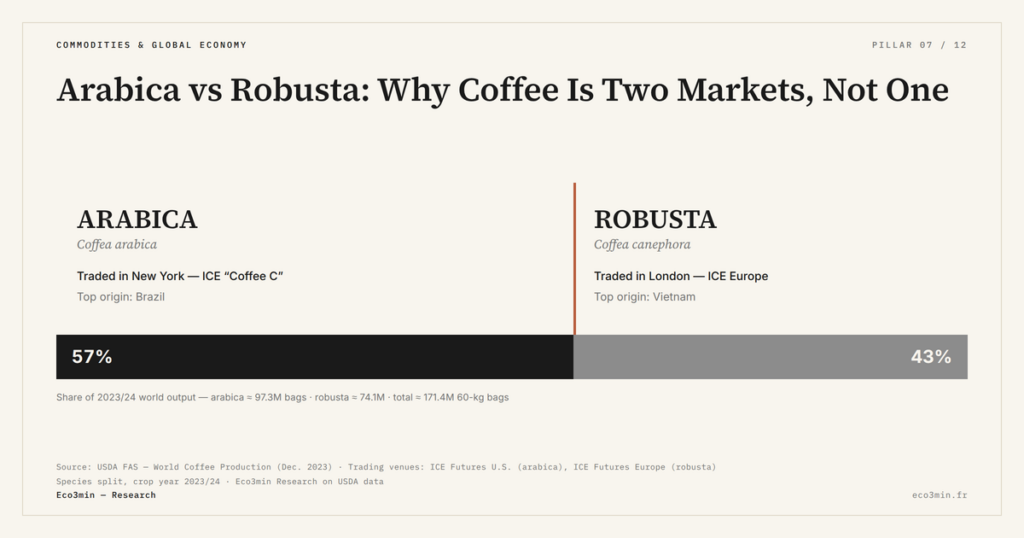
- For the 2023/24 crop year, world output reached about 171.4 million 60-kg bags, roughly 57% arabica and 43% robusta, the latter down 3.3% year on year (USDA Foreign Agricultural Service, December 2023).
Grasping this duality is the precondition for reading the coffee price: it is a distinction between two plants, two uses and two markets, not between two grades of a single bean.
1. Two species, not two grades
The most common error is to picture arabica and robusta as two grades of one product — one premium, one budget. The reality is different: these are two distinct botanical species, Coffea arabica and Coffea canephora, as far apart as two cultivated plants of the same genus can be. They do not grow in the same conditions, are not farmed the same way, do not share the same chemistry and do not serve the same uses. Coffee is not a product; it is a category that contains two.
This genetic distinction has immediate practical consequences. Arabica is a delicate species, harder to grow, more exposed to disease and to climatic hazards. Robusta, as its name suggests, is more rugged: it better withstands high heat, pests and difficult conditions. These opposite temperaments explain why the two coffees do not respond to the same shocks and why their prices can diverge durably — a mechanism analysed in detail through the price gap between the two coffees.
To reduce this duality to a quality hierarchy is to miss the point. Coffee belongs to the family of tropical products whose price depends on physical constraints far more than on any logic of product tiers, as the broader category of agricultural soft commodities makes clear. Within that family, coffee stands out precisely for this split into two species, which makes it a textbook case.
2. Opposite agronomic profiles
The most structuring difference between the two species lies in their growing requirements. Arabica is a highland plant: it is generally grown between 800 and 2,000 metres, in cool climates with moderate temperature swings. This dependence on altitude stems from its sensitivity: it tolerates high temperatures poorly, which disrupt its flowering and the development of its cherries. It is this fragility that makes it particularly exposed to a warming climate, as examined by arabica’s climate sensitivity.
Robusta occupies the other end of the agronomic spectrum. It thrives in hot, humid tropical lowlands, at low altitude, where arabica would not survive. Its heat tolerance and disease resistance make it a simpler and cheaper crop to produce. This ruggedness comes with a notable chemical counterpart: robusta contains nearly twice the caffeine of arabica — on the order of 2.7% against roughly 1.5%. This high content contributes to its more bitter taste, but also to its natural resistance to pests, caffeine acting as a repellent.
Disease vulnerability sharpens the divide further, and it is no historical footnote. Arabica is markedly more susceptible to coffee leaf rust, a fungal disease that has repeatedly devastated highland plantations and reshaped the geography of production; robusta’s greater resistance to that same disease is one of the reasons it became a commercial crop in the first place. This asymmetry of vulnerability means that a single pathogen can hit arabica supply hard while leaving robusta comparatively untouched, adding a biological dimension to the divergence between the two markets. Where arabica concentrates fragility — to heat, to altitude loss, to disease — robusta concentrates resilience, and that contrast runs through every aspect of how the two coffees are grown, priced and used.
2.1 Two production geographies
These opposite requirements draw two distinct production geographies. Arabica dominates in Latin America — Brazil, Colombia, Central America — and on the highland plateaus of East Africa. Brazil, the world’s largest producer across all species, supplies on its own about a third of the planet’s coffee, mostly as arabica. This geographic concentration makes Brazilian weather a leading determinant of the species’ price, a point developed by Brazil’s concentration in arabica.
Robusta, by contrast, has its epicentre in Asia. Vietnam became its leading world producer in a few decades, followed by other tropical origins such as Indonesia and several African countries. This Asian rise turned the long-secondary robusta market into a first-order variable — a trajectory traced by Vietnam’s robusta expansion. Each species thus has a dominant country: arabica hanging on Brazil, robusta on Vietnam.
3. Two taste profiles, two uses
The separation extends into the cup and into end-markets. Arabica offers a richer, more acidic and more complex aromatic range, sought by specialty roasting and quality coffee. It is the bean found in single-origin coffees, premium blends and most products where taste comes first. Robusta, with its more full-bodied, more bitter and earthier profile, long judged inferior on taste, feeds instant coffee, economy pods and mass-market blends, where its caffeine content and moderate cost outweigh finesse.
This division of uses carries an economic consequence: the two species serve partly distinct market segments that do not respond the same way to a price move. A specialty roaster, selling a differentiated product, can pass a rise in green-bean costs through more readily; an industrial blender, competing on price, will adjust the make-up of its recipes toward the cheaper species more quickly. This difference in pass-through and substitution capacity is one of the springs that link the two markets without merging them.
4. Two distinct financial markets
The botanical duality is doubled by a financial one, doubtless the least understood. The two species are not quoted on the same venue. Arabica trades primarily in New York, on the Intercontinental Exchange’s “Coffee C” contract (ICE Futures US), the global reference for the species. Each contract covers 37,500 pounds of green coffee and accepts physical delivery of beans from around twenty origin countries. Robusta, for its part, trades in London on ICE Europe, in a contract denominated in dollars per tonne.
Two exchanges, two pricing units, two reaction functions. This separation is not a mere market convenience: it reflects the fact that the two species absorb largely independent shocks. A frost on Brazil’s highland zones hits arabica without directly touching Vietnamese robusta; a drought on Vietnam’s Central Highlands tightens robusta supply without mechanically contracting arabica’s. The two quotes can therefore move distinctly, and it is the shifting space between them that forms the richest signal in the coffee market.
This pricing duality is no isolated peculiarity: it sits within the broader logic of commodity markets, where price formation obeys physical constraints — climate, productive geography, the harvest calendar — far more than any abstract financial logic. That is what the analysis of major commodities puts in perspective, and whose fundamentals coffee shares. Coffee’s peculiarity is to offer, within a single consumer product, two benchmark contracts on two continents, which makes reading supply through the price gap unusually legible. In practice, a coffee buyer does not trade a single asset but arbitrages between two markets, watching New York and London at once and calibrating purchases to the spread between them.
For the observer, this dual quotation is an opportunity rather than a complication: it makes the relative tension of the two supplies visible in real time, where a single-quote product would hide that information. The distinction between the two species is therefore not only agronomic or about taste; it is written into the very architecture of the coffee futures markets, which is why the gap between the two contracts can be read as a supply signal in its own right.
5. A volume split worth knowing
To place the two species against each other, production volumes give a useful benchmark. According to U.S. Department of Agriculture data (Foreign Agricultural Service, December 2023), world coffee production for the 2023/24 crop year stood at around 171.4 million 60-kilogram bags. Arabica accounted for roughly 97.3 million bags, a little under 57% of the total, and robusta for about 74.1 million bags, nearly 43%, down 3.3% year on year. Readers who wish to follow each market separately can consult the arabica price history and the robusta price series, which track the two quotes back over three decades.
This split — a majority of arabica, a strong minority of robusta — is not fixed. Robusta’s share has trended upward over the decades, driven by the rise of Asian production and its growing use in blends. Tracking the relative evolution of the two volumes, crop year after crop year, is among the indicators that illuminate the market’s balance and the deformation of the price gap between the two species.
This volume asymmetry overlaps a fragility asymmetry: arabica, in the majority but delicate, and robusta, in the minority but rugged. It is this combination — a dominant but exposed coffee, a secondary but resilient one — that structures the price dynamic and gives full meaning to the distinction between the two species.
- Arabica and robusta are two distinct botanical species (Coffea arabica and Coffea canephora), not two grades of one product.
- Their requirements are opposite: arabica is a cool, fragile highland plant; robusta is a hot-climate, rugged lowland plant with twice the caffeine.
- They trade on two separate exchanges — arabica in New York, robusta in London — and absorb largely independent shocks.
- Arabica accounted for roughly 57% of 2023/24 world production and robusta nearly 43% (USDA data, December 2023).
Last updated — 27 June 2026
Disclaimer – Financial Information: The analyses, commentary, and content published on eco3min.fr are provided for informational and educational purposes only. They do not constitute investment advice or a solicitation to buy or sell financial instruments. Past performance is not indicative of future results. All investment decisions involve risk and are the sole responsibility of the reader.
Read next
Full pillar →Reading the refinery utilisation rate: the threshold, the season, the turnarounds
A refinery runs full near ninety percent, not a hundred: the last slice of nameplate capacity is a…
IMO 2020: the regulatory shock that rewrote product spreads
An environmental rule on marine sulfur can move a refining spread more than a swing in crude. IMO…
The 2022–2023 refining golden age: anatomy of an episode
In 2022, refined fuel prices climbed faster than crude. That gap, measured by the 3-2-1 crack spread, reached…