Brazilian Coffee and the Weather: Why a Frost Moves the Global Arabica Price

Brazil supplies on its own about a third of the world’s coffee, mostly as arabica. That concentration makes its weather the leading determinant of the species’ price, which a localised frost or drought is enough to propel.
TL;DR
Brazil grows about a third of the world's coffee and Minas Gerais alone roughly 30% of its arabica, so one regional frost can move the global quote.
- Arabica has no natural geographic hedge: grains grown across several continents can offset one another, but arabica's dependence on a narrow set of Brazilian highland zones sends any localised shock straight to the world price.
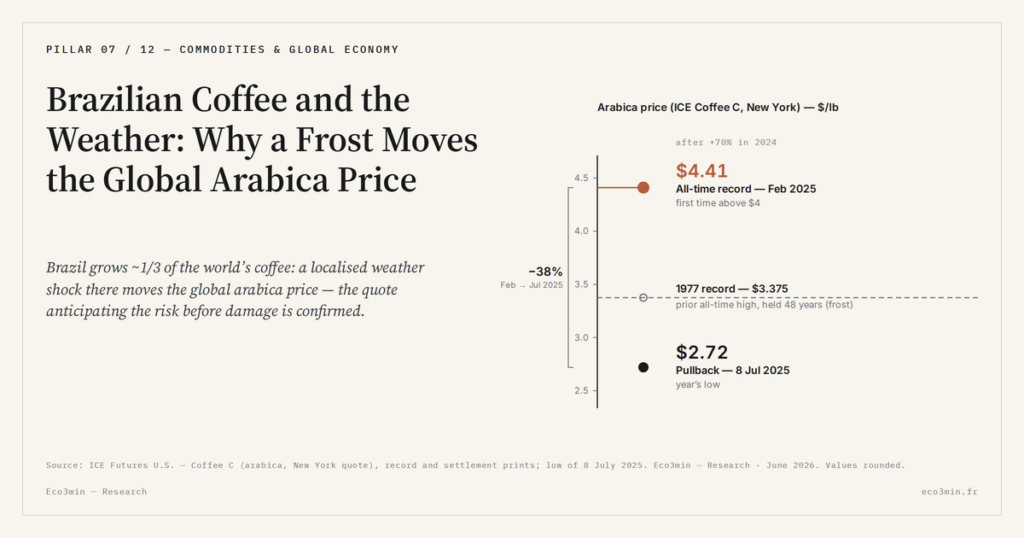
- The 2024-2025 episode showed the amplitude: water stress and cold alerts pushed New York arabica above $4 per pound for the first time in early February 2025, to roughly $4.41, beyond the 1977 high of $3.375, before the quote fell back to around $2.72 by early July 2025 as harvest prospects improved.
Understanding this transmission mechanism — from a regional weather event to a global quote — explains why arabica is one of the most volatile agricultural markets, and why a headline about a Brazilian frost moves prices.
1. Brazil, the arabica giant
No country weighs on a global agricultural market the way Brazil weighs on coffee. The leading producer and exporter, it supplies on its own roughly a third of world output, and a decisive share of the arabica traded across the planet. This dominance concentrates risk: the reaction function of the arabica price runs first through the skies of south-eastern Brazil. It is what sets this coffee apart from most other agricultural commodities, and what the broader commodities landscape puts in perspective.
The concentration is not only national, it is regional. The state of Minas Gerais alone accounts for about 30% of Brazil’s arabica crop. This geographic density means that a circumscribed weather event — a frost on the highland zones, a drought during flowering — can contract a whole crop year’s arabica supply. Where other agricultural markets spread risk across several continents, arabica concentrates it on a handful of Brazilian states. The consequence is amplified volatility: the slightest anomaly becomes a price shock.
The degree of concentration sets arabica apart even among agricultural commodities. Grains are grown across several continents, so a drought in one breadbasket can be partly offset by a good harvest in another. Arabica enjoys no such natural hedge: its dependence on a narrow set of Brazilian highland zones means that producing regions cannot offset one another, so a localised event propagates directly to the world price. This is why the same nominal weather risk carries a far larger price impact for arabica than for a more geographically diversified crop, and why the market scrutinises a single country’s forecasts so closely.
This dependence sits within a broader logic, that of commodity price formation, where the geography of supply matters as much as volumes. Brazil’s place in coffee thus illustrates the role of producing countries: when world supply rests on a small number of origins, the local conditions of those origins become global variables.
2. Two climate shocks, two timeframes
Brazilian climate risk takes two main forms, which share neither timing nor reversibility. The first is frost. A night of sub-zero temperatures on the highland zones can scorch foliage, even kill whole trees. The coffee tree is a perennial plant: a destroyed tree must be stumped or replanted, and reaches full bearing only after three to four years. Frost is therefore a durable stock shock, whose effects extend across several crop years.
The second form is drought. By disrupting flowering and cherry development, a water deficit reduces the coming crop’s yield without necessarily destroying the tree. It is a flow shock, often recoverable once the rains return. The distinction between these two mechanisms is essential: a market reacting to a frost alert is not anticipating the same loss as one reacting to a drought episode. This particular sensitivity of arabica to growing conditions sits at the heart of arabica’s fragility to warming, which explores its agronomic underpinnings.
This dual timeframe stems from a fundamental feature of coffee among the tropical agricultural products: it is a perennial crop, not an annual one. Where wheat or corn are replanted each season, the coffee tree bears for decades. This perennial nature explains the inertia of supply: production can neither be raised quickly in response to a price spike, nor rebuilt instantly after a shock. A frost that kills trees amputates productive capacity for years, and a replanting decision bears fruit only after several crop cycles. This supply rigidity is a structural amplifier: facing a shock, the coffee market has no fast adjustment on the production side, so the entire adjustment falls on price.
3. From local shock to world price: the transmission mechanism
The crux of the matter is transmission: how an event confined to a few Brazilian states propagates to the world quote in New York. The main spring is anticipation. Given Brazil’s weight, any weather information carries direct value for future supply. Traders therefore watch Brazilian weather with the attention others give to U.S. employment figures. Every drought forecast, every cold-snap alert triggers price moves, sometimes before damage is even confirmed.
A time lag adds a layer of uncertainty. A drought during flowering shows up in volumes only months later, at the next harvest; a frost can weigh on several crop years. The market must therefore anticipate on partial information, which is why prices often move before damage is confirmed, then correct once the true scale of the loss becomes clear. This dynamic of anticipation and revision is a structural source of volatility, distinct from fundamentals themselves.
Stocks could in principle cushion these shocks, buffering between a deficit harvest and consumption. But coffee keeps poorly over the long run, and world stocks remain limited relative to annual consumption. They are therefore insufficient to absorb a major supply shock: a Brazilian arabica deficit quickly drains available inventories, transmitting the tension to price rather than damping it. The absence of a sufficient stock buffer sharpens the market’s sensitivity to Brazilian weather, and explains why a deficit harvest translates so fast into rising quotes.
The 2024-2025 episodes offer a sharp illustration. Repeated water stress on Brazil’s coffee zones, combined with cold alerts, propelled the New York arabica quote above $4 per pound for the first time in its history in early February 2025, up to a record of roughly $4.41 per pound — more than double its level a year earlier, and well beyond the previous high of $3.375 dating from 1977. The quote had already risen about 70% over the course of 2024. This amplitude illustrates the sensitivity of the arabica price to the slightest tension in Brazilian supply, the raw record of which can be followed through the arabica futures record. How that world quote becomes a stress signal is precisely what is analysed in the supply signal carried by the price gap.
4. The memory of the great frosts
Coffee history keeps the trace of Brazil’s great frosts, and that memory sustains the market’s nervousness. The “black frost” of 1975, which devastated Paraná’s plantations, and the twin frosts of 1994 rank among the episodes that durably marked prices and redrew the production map. Following these shocks, Brazil shifted part of its coffee growing toward zones less exposed to frost, altering the geography of arabica supply.
Modern weather monitoring has improved the lead time on cold spells, but it has not removed the surprise. Frost is a local, fast-moving phenomenon: a single severe night on the wrong zones can do disproportionate damage, and forecasts carry their own margin of error. The market therefore cannot fully price the risk in advance, which is why each credible cold alert still moves the quote — and why a forecast that fails to materialise can prompt an equally sharp reversal. Uncertainty about both the event and its eventual yield impact keeps a structural risk premium in the arabica price during the Brazilian winter.
These precedents are a reminder that a localised climate accident can have multi-year effects on global supply. They also explain why the market reacts violently and pre-emptively to every cold alert: the materialisation of the risk is uncertain, but its potential cost is high. This pre-emptive reaction to an unconfirmed risk is a structural feature of arabica price formation, and it is compounded by a cyclical component proper to the coffee tree — alternate bearing — explored by the biennial production cycle.
5. The financial dimension of amplification
Part of the 2024-2025 rise owed to short-term factors grafted onto the agronomic constraint. Heavier positioning by financial players anticipating shortage, disruptions in trade flows, and stock-holding behaviour by producers amplified the peak beyond what fundamentals alone justified. The distinction matters: the Brazilian supply shock explains the direction of the rise; financial and commercial factors explain part of its intensity.
This financial amplification also has a flip side. When crop prospects improve, the correction can be just as fast. After the February peak, the arabica quote underwent a marked decline, falling to around $2.72 per pound in early July 2025, with several analysts citing flowering conditions judged more favourable and better prospects for the Brazilian harvest. This reversal illustrates that the arabica price incorporates anticipation before confirmation, and that Brazilian weather works both ways — toward tension as toward relief. The whole difficulty of reading it lies in this asymmetry between the anticipation of a risk and its actual materialisation, which presupposes first distinguishing the two species clearly, as the distinction between arabica and robusta sets out.
Reading a Brazilian weather alert as automatic confirmation of a lasting shortage is misleading. Prices react to the anticipation of a risk, before actual damage is assessed; a frost alert or a drought headline can propel the quote, then be belied by a rebound harvest — as in 2025. The price move precedes the agronomic tally; it does not validate it.
Last updated — 30 June 2026
Disclaimer – Financial Information: The analyses, commentary, and content published on eco3min.fr are provided for informational and educational purposes only. They do not constitute investment advice or a solicitation to buy or sell financial instruments. Past performance is not indicative of future results. All investment decisions involve risk and are the sole responsibility of the reader.
Read next
Full pillar →Reading the refinery utilisation rate: the threshold, the season, the turnarounds
A refinery runs full near ninety percent, not a hundred: the last slice of nameplate capacity is a…
IMO 2020: the regulatory shock that rewrote product spreads
An environmental rule on marine sulfur can move a refining spread more than a swing in crude. IMO…
The 2022–2023 refining golden age: anatomy of an episode
In 2022, refined fuel prices climbed faster than crude. That gap, measured by the 3-2-1 crack spread, reached…