Vietnamese Robusta: Why a Supply Deficit Drives the Coffee Price

Vietnam became the world’s leading robusta producer within a few decades. When its harvest falters, world supply of the species tightens and the price gap with arabica narrows.
TL;DR
Within a few decades Vietnam came to dominate robusta; its 2023-2024 drought then tightened world supply, lifted the species to record highs, and squeezed the spread with arabica toward parity.
- Vietnam has led world robusta since the Đổi Mới reforms (1986); USDA data (December 2023) put robusta near 74.1 million bags in 2023/24, almost 43% of world coffee output.
- Drought in the Central Highlands cut Vietnam's 2023/24 crop by about 20% to some 1.47 million tonnes, its smallest in four years; Volcafe (May 2024) saw 2024/25 near 24 million bags, the lowest in thirteen years.
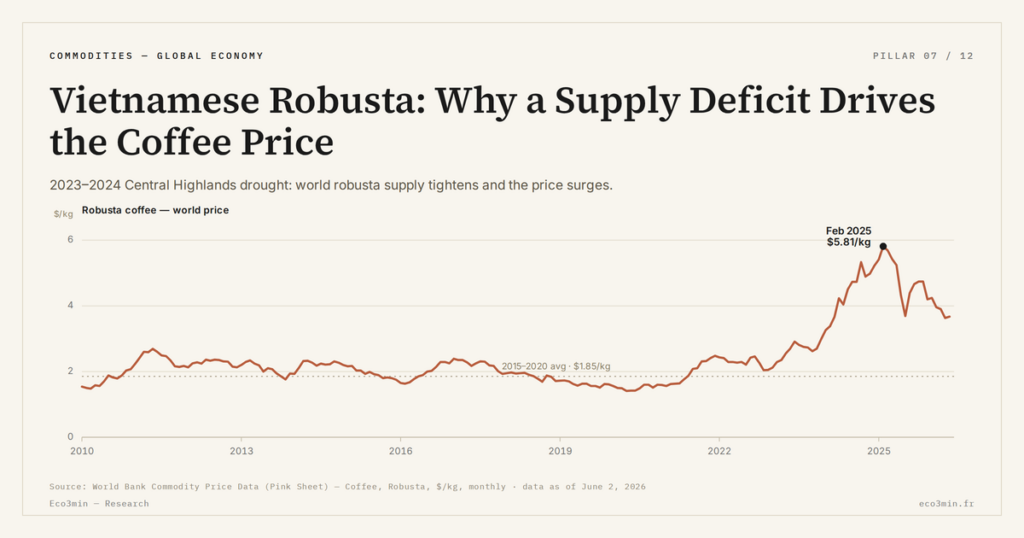
- With exchange stocks at record lows leaving no buffer, London robusta hit about $4,575 per tonne in April 2024 (a 45-year high), then roughly $5,821 per tonne in February 2025.
- Beyond weather, an ageing orchard, diversification into pepper and fruit, and the EU Deforestation Regulation (EUDR, full application delayed to December 2026) weigh on supply.
Understanding Vietnam’s robusta rise and the 2023-2024 deficit illuminates the often-neglected half of the coffee market — the half that moves the other leg of the price gap.
1. Vietnam, the robusta giant
If Brazil reigns over arabica, Vietnam reigns over robusta. In a few decades the country became the world’s leading producer of the rugged species, turning a marginal crop into a pillar of its export agriculture. This dominance gives Vietnam market power over robusta comparable to Brazil’s over arabica: when the Vietnamese crop falters, it is world robusta supply that tightens. It is this mechanic that illuminates what the arabica-robusta gap reveals, of which robusta forms the second side.
This dominance is recent on the scale of coffee history. Until the 1980s, Vietnam counted for little on the world coffee market. The Đổi Mới economic reforms, from 1986, liberalised agriculture and triggered a meteoric expansion of coffee growing in the country’s Central Highlands, around Dak Lak province. Within some fifteen years Vietnam became the world’s second-largest coffee producer across all species and the largest robusta producer. This rise structurally lowered the world average cost of robusta and broadened its use, to the point of making it the backbone of instant coffee and blends. According to U.S. Department of Agriculture data (December 2023), robusta accounted for roughly 74.1 million bags in the 2023/24 crop year, nearly 43% of world coffee production.
This geographic concentration makes robusta a textbook case of the role of large producing countries, on a par with the Brazilian arabica analysed by arabica’s dependence on Brazil. Each species has its dominant country, and the local conditions of that country become global variables — a parallel that structures the reading of the whole market.
2. The 2023-2024 deficit
The 2023-2024 deficit episode revealed that market power. Drought struck the Central Highlands, the main producing region, damaging flowering and cutting the crop. According to Vietnamese agriculture authority projections reported in spring 2024, the country’s coffee production for the 2023/24 crop year could fall by around 20% to some 1.47 million tonnes, its smallest harvest in four years. The trader Volcafe went further, estimating in May 2024 that the 2024/25 crop might reach only around 24 million bags, the lowest in thirteen years, owing to damage judged “irreversible” to the blossoms.
This deficit tightened the entire robusta market. Global inventories had already fallen to historically low levels — in late January 2024, robusta stocks on the benchmark exchanges had hit record lows. The combination of declining Vietnamese supply and depleted stocks propelled the robusta price toward its highs of 2024 and then 2025. Robusta, long the “poor relation” of coffee, thus became a price driver in its own right, capable of tightening the market without any help from arabica. Nor was this deficit isolated: several trading houses pointed to a fourth consecutive year of deficit for the species.
This run of deficit crop years is itself instructive. An isolated deficit may be a one-off weather accident; a sequence of closely spaced deficits raises a sharper question about a more durable supply tension, whether rooted in climate or in the structural fragilities of the Vietnamese orchard. It is this distinction between the passing accident and the underlying trend that guides the reading of the robusta market.
3. How robusta narrows the spread
The effect of this deficit on the arabica-robusta spread was striking. By driving robusta up faster than arabica through part of 2024, it compressed arabica’s traditional premium, to the point of inverting some of the trade’s reflexes. Roasters accustomed to arbitraging in favour of robusta for cost reasons saw that price advantage erode; some robusta lots approached parity with entry-grade arabicas. The spread, far from a constant, flattened under a purely robusta-specific tension.
This sequence validates the reading of the spread as a supply variable. A narrowing spread does not carry the same meaning as a widening one: the former points to a robusta tension — and therefore to Vietnam and the tropical lowlands — while the latter points to an arabica tension. On the price side, robusta printed a record of about $4,575 per tonne as early as April 2024 on the London exchange, a 45-year high at the time, before extending its rise to roughly $5,821 per tonne in February 2025. The deformation of the spread thus results from a localised shock on Vietnam’s lowlands, whose amplitude is measured in the tension between the two quotes — a mechanism that presupposes distinguishing the two coffees and their markets in the first place.
The narrowing also illustrates a restoring force that bounds the spread. As robusta rose toward parity with low-grade arabica, the cost incentive that normally steered blend roasters toward robusta faded, and some buyers shifted back toward arabica. That substitution, running in the opposite direction to the usual one, supports the cheaper species and caps how far the gap can compress. The robusta deficit therefore does not erase the structural distinction between the two coffees; it temporarily flattens the price hierarchy until supply tension recedes, after which arabica’s quality premium tends to reassert itself. The spread oscillates around a zone rather than drifting without bound, which is why an extreme narrowing is itself a readable signal of robusta stress.
The role of stocks deserves emphasis here, because it amplified the move. Robusta inventories down to record lows left no buffer to absorb the deficit, which shifted the entire tension onto price rather than damping it. This mechanism, observable beyond coffee alone, belongs to the role of inventories in prices: when stocks are low, a supply shock transmits all the faster and harder to quotes.
4. The structural fragilities of Vietnamese supply
Vietnamese dominance is not free of structural fragilities, which weigh on robusta supply beyond weather hazards alone. The Vietnamese coffee orchard is ageing: part of the plantings approaches or exceeds the age at which yield declines, and the replanting pace remains below what simple reconstitution of the productive capital would require. In parallel, the profitability of other crops — fruit, pepper — has prompted some growers to diversify away from coffee, shrinking acreage.
These fragilities stem in part from the very nature of coffee among the tropical agricultural markets: it is a perennial crop, whose supply adjusts with heavy inertia. Replanting an ageing orchard bears fruit only after several years, and a decision to diversify into other crops durably removes acreage from coffee. This rigidity means a robusta tension does not resolve in a single season: unlike an annual crop that can be quickly expanded, Vietnamese robusta cannot rebuild its productive capacity overnight. Supply inertia therefore prolongs imbalances and sharpens the price’s sensitivity to shocks.
To these tensions is added a new regulatory constraint. The European Union’s Deforestation Regulation (EUDR) directly concerns Vietnamese coffee, the EU being its leading outlet. According to the semi-annual report relayed in December 2025, the EU classified Vietnam as a “low-risk” country and delayed full application of the regulation to December 2026, giving exporters time to build their traceability systems. These elements — an ageing orchard, diversification, compliance — are so many supply factors independent of the weather, which can sustain robusta tension over time.
5. Robusta is not climate-immune
It would be wrong to portray robusta as climate-insensitive. More heat-tolerant than arabica, it is not for that immune: the Vietnamese deficits of 2023-2024 trace precisely to drought episodes on the Central Highlands. The difference between the two species is not that one suffers and the other thrives, but that robusta’s adaptation margins are wider — a broader thermal window, a productive geography less constrained by altitude.
This nuance matters for reading the spread over the long run. While robusta remains more resilient, the 2024 tension shows it too can suffer major supply shocks, and that the spread can narrow under a robusta fragility just as it can widen under an arabica one. Warming weighs on both coffees; it simply weighs more, and sooner, on arabica, as detailed by arabica’s climate exposure. This asymmetry of exposure, not any robusta immunity, is what underpins the hypothesis of a durable deformation of the spread. More broadly, coffee sits within the logic of commodity markets, whose price formation depends on physical constraints, as the study of commodity markets examines. Readers can follow the underlying series through robusta’s price history.
- Vietnam has been the world’s leading robusta producer since the Đổi Mới reforms (1986); robusta was nearly 43% of 2023/24 world production (USDA).
- The 2023-2024 drought cut the Vietnamese harvest by about 20%, tightening world supply and making robusta a price driver in its own right.
- A robusta deficit narrows the spread with arabica (near-parity reached in 2024), where an arabica deficit widens it.
- Robusta is more rugged but not climate-immune; its structural fragilities (ageing orchard, EUDR) also weigh on supply.
Last updated — 27 June 2026
Disclaimer – Financial Information: The analyses, commentary, and content published on eco3min.fr are provided for informational and educational purposes only. They do not constitute investment advice or a solicitation to buy or sell financial instruments. Past performance is not indicative of future results. All investment decisions involve risk and are the sole responsibility of the reader.
Read next
Full pillar →Reading the refinery utilisation rate: the threshold, the season, the turnarounds
A refinery runs full near ninety percent, not a hundred: the last slice of nameplate capacity is a…
IMO 2020: the regulatory shock that rewrote product spreads
An environmental rule on marine sulfur can move a refining spread more than a swing in crude. IMO…
The 2022–2023 refining golden age: anatomy of an episode
In 2022, refined fuel prices climbed faster than crude. That gap, measured by the 3-2-1 crack spread, reached…