Automotive Palladium: A Market Under Pressure That Could Tip
Automotive palladium: how falling prices, hybrids and electric vehicles are reshaping a key market for industry and investors. Why supply concentration, real rates and substitution dynamics matter more than the EV narrative alone.

Automotive palladium: how falling prices, hybrids and electric vehicles are reshaping a key market for industry and investors.
TL;DR
Automotive palladium has more than halved since its early-2022 peak near $2,700, sliding to roughly $1,100–1,200 by autumn 2025 even though Russia still supplies 35–40% of mined output. Related research: our study of commodities as macroeconomic regime signals.
- More than 70% of palladium demand comes from the automotive sector, mainly gasoline catalytic converters, so its price tracks the internal-combustion fleet more than headline EV-sales growth.
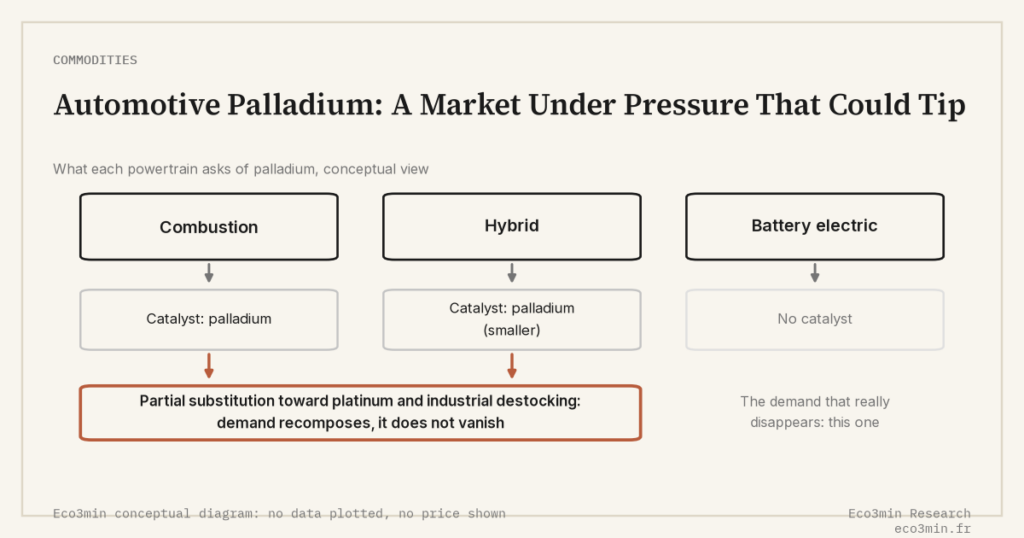
- The decline reflects substitution toward cheaper platinum in catalysts and industrial destocking to free up cash, as much as electric-vehicle adoption; demand is recomposing, not disappearing.
- Real rates rising from about −1% to +1–2% between 2022 and 2024 raised mining capital costs, leaving marginal projects fragile near $1,000 and seeding a possible end-of-decade tightening.
- Prices broke repeatedly below $1,000 in mid-2025, levels last seen in 2018, after exceeding $2,000 through 2021–2022, the first structural easing since the 2010–2020 decade of chronic tightness.
Automotive palladium: why this market still matters
Since the peak near $2,700/oz reached in early 2022, palladium has more than halved in price, falling back to roughly $1,100–$1,200/oz by autumn 2025. This sharp reversal contrasts with the 2010–2020 decade, marked by chronic tightness driven by emissions standards and palladium’s dominance in gasoline-engine catalytic converters.
Yet palladium remains a discreet but strategic link in the global economy of commodities at the heart of industrial activity: more than 70% of demand still comes from the automotive sector (catalytic converters), according to the major sectoral statistics. Its trajectory shapes part of the production cost base for carmakers and component suppliers — and, by extension, the margins and trade-offs across the value chain.
What is changing quietly: automotive demand is fragmenting between internal combustion, hybrid and electric, while mining supply remains concentrated in a handful of countries (Russia, South Africa). This combination produces a market in which price signals, physical flows and technological arbitrage no longer tell the same story.
Trigger event: a metal in free fall despite elevated geopolitical risk
Since the invasion of Ukraine in 2022, the logical risk would have been a sustained palladium repricing higher, given that Russia historically accounts for nearly 35–40% of global mine supply. Yet between mid-2023 and end-2025, prices fell by more than 50%.
The facts:
- 2021–2022: prices often above $2,000/oz, with peaks near $2,700/oz.
- End-2023: back below $1,400/oz — the first signal of structural easing.
- Mid-2025: repeated breaks below $1,000/oz, levels not seen since 2018.
Dominant narratives attribute this decline almost exclusively to the rise of electric vehicles, assumed to durably erode demand. Part of the consensus mainly anticipates a “gradual deratings” of palladium, treated as a metal in structural decline.
The alternative reading taking shape: the current dynamic owes at least as much to technological substitution (toward platinum in catalytic converters) and to inventory management across the industrial chain as it does to the rise of electric mobility. Put differently, automotive demand is not disappearing — it is being recomposed. Adjacent reading: the gold-silver ratio as a gauge.
Key mechanisms: how the auto sector drives palladium demand
Automotive palladium is used mainly in catalytic converters for gasoline engines, to reduce NOx and unburned hydrocarbon emissions. Demand depends on three macro-micro parameters:
- The registration mix: the share of gasoline, diesel, hybrid and electric in new vehicle sales.
- Emissions standards: such as Euro 6, then Euro 7 in Europe, or equivalent standards in China and the United States, which push metal loadings per vehicle higher.
- Industrial trade-offs: the palladium/platinum/rhodium dosage within catalytic converters, driven by relative costs and availability.
Over 2015–2021, the combination of “diesel decline + tighter standards + lower platinum prices” caused palladium consumption in gasoline drivetrains to surge. Between 2015 and 2019, global automotive palladium demand thus rose by several hundred thousand ounces, even as new vehicle sales stagnated.
Since 2022, flows have been reorienting:
- Pure battery electric vehicles are gaining share but very unevenly across regions (roughly 20–25% of new sales in Europe and China, markedly less in the United States in 2025).
- “Non plug-in” hybrids retain a strong share of gasoline engines, hence catalytic converters, but with more flexible metal strategies.
- Component suppliers are gradually rebalancing toward platinum — historically cheaper — as soon as the price spread becomes meaningful.
The result: palladium volumes per vehicle are slightly down across some segments, while total volumes are plateauing or declining depending on the region, despite a global vehicle fleet still overwhelmingly internal combustion.
Concentrated mine supply, under rate and currency constraint
On the supply side, palladium is mostly a by-product of platinum-group metals mining, and at times of nickel. The major basins are concentrated in Russia and South Africa — two zones exposed:
- to geopolitical risks (sanctions, logistics tensions, marine insurance);
- to currency and rate shocks.
When global real interest rates rose materially between 2022 and 2024 (from roughly −1% to roughly +1 to +2% on benchmark sovereign bonds, per the major central banks’ frameworks), the cost of capital for mining projects increased, as did return-on-investment thresholds.
In practice:
- Some marginal projects become less attractive when palladium hovers near $1,000/oz.
- South African producers must contend with a volatile local currency and elevated energy costs.
- Russian producers face constraints on access to international financing.
If this dynamic persists, the supply/demand balance could move from a transient surplus to a more diffuse tightness by the end of the decade — particularly if substitution toward platinum proceeds more slowly than expected.
What the market is starting to price in piecemeal
Mainstream projections assume that the rise of electric mobility will rapidly erase automotive palladium demand. The structural reading is more nuanced:
- The global vehicle fleet will remain predominantly internal combustion for many years. Even with 50% of new sales electrified, fleet inertia plays out over 10–15 years.
- Hybrid vehicles, very prevalent in Asia and Europe, continue to require high-performance catalytic converters.
- Substitution toward platinum is technically feasible but not unlimited: it depends on supply-chain stability, requalification costs and local emissions standards.
What recasts the conventional reading is the combination of these factors with the macro backdrop: a higher-rates cycle, global growth around 2.5–3% per year over 2024–2026 according to the major forecasting frameworks, and a reallocation of capital flows toward fixed-income assets is changing how industrials manage their metal inventories. Many are reducing “dormant” stocks to free up cash, which compounds short-term downward pressure on prices.
This palladium behaviour illustrates more broadly the logic of real commodity cycles and their macro transmission, in which prices reflect less an immediate end-demand than a trade-off between cost of capital, supply constraints and inventory adjustments along the industrial chain.
What users really want to know
The real question is not so much whether automotive palladium will “go up or down”, but whether the current low-price phase reflects a cycle ending or excess cyclical pessimism. Behind this question lies a concern: that the technological transition could render the metal obsolete before industrial actors have amortised their investments or adjusted their supply contracts.
Practical points for investors and corporates
Without constituting any recommendation, a few reading principles can help structure decisions:
- For diversified portfolios: a global exposure to industrial commodities of around 5–10% of the total portfolio is a rule frequently cited in diversified allocation frameworks. Within that block, palladium remains a niche segment.
- For automotive-chain corporates: the key is contractual flexibility. Long-term supply contracts can include adjustment clauses tied to the platinum/palladium spread.
- For households: tracking this market mainly helps to better understand the cost structure of internal combustion and hybrid vehicles, and thus anticipate list-price evolution.
A simple allocation rule frequently mentioned to limit concentration is, within the “commodities” block, not to exceed 20–30% on a single commodity or sub-segment (precious metals, energy, agricultural, etc.). This is not a prescription but an indicative bound to gauge specific risk.
To place these decisions in a broader framework, our reference page on the role of commodities in the global economy situates palladium alongside other metals and energy.
Indicators to track to understand what comes next
A few concrete KPIs help follow the automotive palladium file without being lost in daily noise:
- Platinum/palladium spread: when palladium trades sustainably well above platinum (as between 2018 and 2022), the incentive for substitution rises. A narrowing spread can signal that this move is reaching maturity.
- Hybrid and electric vehicle market share: registration data by drivetrain — particularly in China, Europe and the United States — illuminate the demand trajectory at 3–5 years.
- Inventory levels at major component suppliers: although rarely published in detail, quarterly earnings commentary often gives qualitative cues (elevated stocks vs. normalisation).
- Monetary policies: an environment of higher real rates weighs on non-yielding assets such as metals, but also fosters capital discipline on the mining side.
A useful synthetic indicator is the joint evolution of the palladium price and mining-cost indices (energy, wages, local currencies). A price sustainably close to marginal costs can foreshadow medium-term supply adjustments.
Common reading errors
- Confusing falling prices with disappearing demand: a price halved in three years does not necessarily mean industrial use is collapsing — often it reflects inventory destocking or a changing cost structure. Ignoring this nuance leads to over-reading the signal.
- Looking only at electric vehicle sales: focusing on the annual EV growth rate without tracking the entire fleet and the weight of hybrids gives a truncated picture of catalytic-converter needs.
- Forgetting the role of rates: analysing palladium as a pure physical supply-and-demand market, without accounting for the cost of capital and arbitrage between fixed-income and commodities, misses part of the price dynamic.
Two plausible trajectories for the coming years
What follows is not a forecast but two conditional scenarios, designed to illuminate the debate rather than to settle it.
Scenario 1: prolonged normalisation, “average” prices and pressure on mining margins
Assumptions: moderate global growth, continued rise of electric mobility, ongoing substitution toward platinum, monetary policies remaining restrictive relative to the 2010–2019 decade.
Within this frame, palladium prices remain confined to a mid-range band (for instance roughly $900–$1,300/oz, illustrative order of magnitude), sufficient to maintain existing supply but offering little incentive for new projects. Automotive demand declines slowly, partially offset by niche uses.
Scenario 2: gradual tightening, return of tightness if supply contracts
Assumptions: slowdown in new mining projects, persistent geopolitical constraints, real pace of electrification slower than expected, tighter emissions standards in emerging markets.
If this dynamic materialises, the reduction of marginal capacity and the inertia of the internal-combustion fleet could tighten the market by the end of the decade. The market does not fully price this possibility today, still favouring the idea of a linear demand decline.
Several elements could invalidate these scenarios: a technological breakthrough accelerating substitution toward other materials, a durable recessionary shock cutting registrations, or, conversely, a sharper drop in real rates re-energising metals broadly.
Concrete implications by profile
For investors: automotive palladium illustrates above all the need to distinguish long-term signal (fleet transition) from short-term noise (inventory management, platinum/palladium arbitrage). Within a “commodities” block, a diversification approach (energy, industrial metals, precious metals) limits the impact of an extreme scenario on a single metal.
For corporates: component suppliers and carmakers can strengthen their flexibility by multiplying technical options (platinum vs. palladium) and contractual ones (renegotiation clauses). Tracking regulatory decisions — Euro 7 equivalents in Europe, tighter standards in China — becomes as important as tracking the spot price.
For households: understanding these mechanisms helps interpret the pricing arguments around internal combustion and hybrid vehicles. Part of future price increases may come from regulation and material choices, not only from labour or electronics costs.
To place these trade-offs in a broader view of economic cycles, our analyses of macroeconomic and global geopolitical context offer a useful complement.
Questions readers often ask
- Is palladium still strategic as electric mobility advances?
Yes, as long as the global internal-combustion fleet remains dominant and hybrids hold a large share. Demand may decline, but more gradually than some narratives suggest. - Can substitution toward platinum eliminate palladium from catalytic converters?
Technically, partial substitution is possible, but it requires requalification, investment, and depends on a sustainable price differential. A complete switch appears unlikely in the near term. - Why is the price falling while geopolitical risk remains elevated in Russia?
Because inventory adjustments, financial flows and inter-metal arbitrage can temporarily dominate physical constraints. Prices imperfectly integrate that risk, particularly when the market anticipates falling demand over the long run. - How relevant is daily price tracking to understand this market?
Following the broader trend and a few key indicators (platinum/palladium spread, drivetrain market shares, regulatory announcements) is generally more informative than watching daily volatility.
3 takeaways
- Automotive palladium is not disappearing: demand is being recomposed across internal combustion, hybrids and substitution toward platinum, in a global fleet that remains overwhelmingly internal combustion.
- The price decline since 2022 reflects inventory management and technological arbitrage as much as the rise of electric vehicles.
- The combination of “concentrated supply + higher real rates + evolving emissions standards” creates a quiet risk of medium-term market tightening, still under-priced.
Last updated — 20 September 2026
Disclaimer – Financial Information: The analyses, commentary, and content published on eco3min.fr are provided for informational and educational purposes only. They do not constitute investment advice or a solicitation to buy or sell financial instruments. Past performance is not indicative of future results. All investment decisions involve risk and are the sole responsibility of the reader.
Read next
Full pillar →Reading the refinery utilisation rate: the threshold, the season, the turnarounds
A refinery runs full near ninety percent, not a hundred: the last slice of nameplate capacity is a…
IMO 2020: the regulatory shock that rewrote product spreads
An environmental rule on marine sulfur can move a refining spread more than a swing in crude. IMO…
The 2022–2023 refining golden age: anatomy of an episode
In 2022, refined fuel prices climbed faster than crude. That gap, measured by the 3-2-1 crack spread, reached…