Cocoa, Coffee and Sugar: the Compared Cycles of Tropical Softs

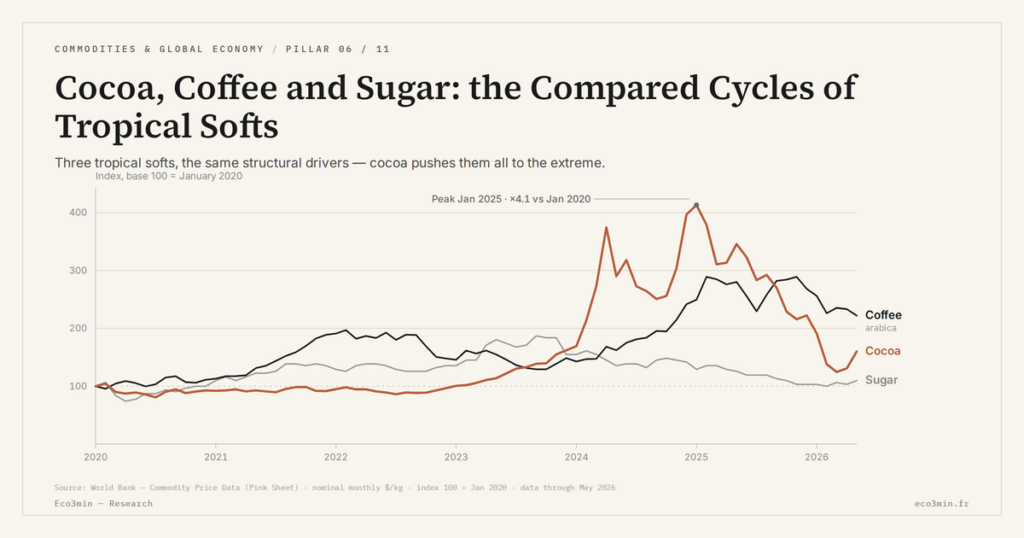
Cocoa belongs to the family of tropical agricultural commodities. Compared with coffee and sugar, it shares climate sensitivity, supply rigidity and financialization, but stands out for extreme concentration and administered prices — which explains the singular violence of its 2024 cycle.
TL;DR
Cocoa, coffee and sugar share the same structural fragilities; cocoa pushes them furthest, with West African concentration, administered prices and disease pressure driving the singular violence of its 2024 cycle.
- The softs share five structural traits: climate sensitivity, perennial-crop supply rigidity, geographic concentration, financialization on futures markets and short-run inelastic demand, whose conjunction tightened several crops together in 2023-2024.
- Sugar sits at the flexible end (annual beet, broadly spread production, cane convertible to sugar or ethanol depending on fuel prices); coffee in the middle (perennial, Brazil-concentrated); cocoa at the rigid extreme.
- Cocoa's singularity comes from two added factors: an overwhelming West African share that turns any regional shock into a world shock, and farmgate prices administered by state bodies, compounded by disease pressure such as swollen shoot.
This article situates cocoa among the tropical softs, comparing its cycle with those of coffee and sugar, in order to distinguish the structural vulnerabilities common to this family from what is specific to cocoa.
The cocoa move of 2024 has sometimes been presented as an isolated, almost anecdotal phenomenon. Placing it back within the family of tropical agricultural commodities changes the reading: cocoa is not an exception, but the most marked version of a pattern shared by several crops. Understanding what cocoa has in common with coffee and sugar, and what sets it apart, sheds light on both its behaviour and that of a whole category of markets.
A family of commodities: the tropical softs
Cocoa, coffee and sugar form, with a few others, what markets call the softs: tropical agricultural goods traded on international futures markets. Beyond this commercial definition, these products share a set of structural traits that predispose them to the same kinds of cycles. Recognising them helps explain why these markets surge and reverse along neighbouring logics.
The first common trait is climate sensitivity. Grown in precise tropical or subtropical bands, these crops depend closely on rainfall and temperature patterns, and a weather event in one major producing region is enough to disrupt world supply. The second is a certain supply rigidity: for perennial crops like cocoa and coffee, years pass between planting and production, so that supply cannot respond quickly to a price rise. This characteristic, which we analysed regarding the rigidity of agricultural supply, is common to perennial plantations and explains much of the amplitude of their cycles.
The third trait is geographic concentration: the production of each of these crops is dominated by a small number of countries, which deprives the market of a counterweight in the event of a regional shock. The fourth is financialization: all these products trade on futures markets where commercial hedgers and financial players coexist, so that capital flows and positioning dynamics can amplify physical moves. The fifth is a demand relatively inelastic in the short run, whether for indulgence products or staple ingredients, so that the price must vary considerably to adjust consumption. It is the conjunction of these traits that produced, in 2023 and 2024, an episode of food inflation in which several softs tightened simultaneously.
The softs are not the only agricultural commodities to share this logic. Grains such as wheat and maize, though grown and traded somewhat differently, display related dynamics: weather-driven supply shocks, concentrated export geographies and active futures markets. What unites this broader agricultural complex is that supply is set by biology and climate rather than by a factory’s output, which makes it slow and uncertain to adjust. The tropical softs simply represent the sharper end of this agricultural reality, with cocoa sharper still.
Coffee and sugar: variations on a theme
Coffee closely illustrates the kinship with cocoa. It is, like cocoa, a perennial crop — the shrub, whether arabica or robusta, takes several years to reach full production — which gives it the same supply rigidity. Its geography is concentrated, Brazil alone accounting for a considerable share, followed by Vietnam and Colombia, even if this concentration remains less extreme than cocoa’s. Coffee is also highly sensitive to climate: a frost or drought in Brazil can cut a harvest and propel prices. The coffee market did, over the same period as cocoa, see its own records, driven by disappointing harvests and robust demand. The mechanism is familiar: rigid supply, concentrated geography, climate shock, and a price that soars for want of being able to adjust quantities. For the broader picture: the FAO index as an instability gauge.
Sugar, for its part, offers an instructive contrast. It is produced from two very different plants: cane, grown in the tropics, and beet, grown in temperate zones. This duality, and the fact that beet is an annual crop, give sugar a more flexible supply than cocoa or coffee: a poor harvest can be offset more, and acreage adjusted more quickly. Its geography is also broader — Brazil, India and Thailand are the pillars, but production is widely spread. Sugar does, however, have a peculiarity of its own: in Brazil, cane can be turned into either sugar or ethanol depending on the relative prices of fuel, so that part of the sugar supply depends on the energy market. Its cycles thus respond to a mix of factors — climate, public policy, the trade-off with ethanol — that set it apart from a purely agricultural soft.
From this comparison a spectrum emerges. At one end, sugar, whose supply is relatively flexible and production widely spread, and whose cycles owe as much to policy and energy as to climate. In the middle, coffee, a perennial crop with rigid supply and concentrated geography, but less so than cocoa. At the other end, cocoa, the most rigid and most concentrated of the family. The further one moves toward this end, the more the market loses its shock absorbers and the more violent its moves become.
The 2023-2024 period offered a real-life illustration of this kinship. Several softs tightened more or less simultaneously: cocoa broke its records, but coffee and sugar also saw high prices, driven by disappointing harvests and sustained demand. This concurrence is no accident: unfavourable climatic conditions in the tropical belts, combined with inelastic demand and financial flows drawn by the rise, struck at the same time markets sharing the same structure. It is this bundle of parallel tensions that was grouped under the term food inflation, and cocoa was its most spectacular manifestation without being its only one.
What sets cocoa apart
If cocoa shares the family’s grammar, it pushes its traits to their extreme, and that is what makes it a case apart. The first distinguishing factor is the intensity of geographic concentration. Where coffee and sugar count several large producing basins, cocoa depends on West Africa for an overwhelming share of world supply. This extreme concentration of supply deprives the market of any counterweight: a regional shock immediately becomes a world shock, with no other origin able to offset it.
The second distinguishing factor is price administration. Cocoa is one of the few softs whose farmgate price is set by state bodies in the main producing countries, with forward sales of the crop made in advance. Coffee and sugar are, at origin, more exposed to market prices. This administered system, combined with a heavy disease burden such as swollen shoot, adds to cocoa constraints that its cousins do not face to the same degree. The combination of biologically rigid supply, extreme concentration, administered prices and disease pressure makes cocoa the family member most devoid of valves — which explains why its 2024 move was the most violent of the softs.
The comparison thus restores cocoa to its rightful place: neither an inexplicable anomaly nor an ordinary case, but the extreme tip of a shared pattern. Cocoa sheds light on the family of softs by showing its purest version, and the family sheds light on cocoa by revealing that its fragility is not unique, only sharper. This perspective extends to other agricultural commodities, whose cycles obey neighbouring springs. It is the cocoa case in particular that, by its intensity, displays most clearly the springs common to the whole category.
This reading carries a value beyond cocoa alone. Faced with any agricultural commodity, identifying the degree of supply concentration, the rigidity of the production cycle, sensitivity to climate and the possible existence of administered prices makes it possible to gauge the market’s predisposition to large amplitudes — not the direction or timing of a move, but its capacity to surge when a shock occurs. The more these factors accumulate, the fewer shock absorbers the market has, and the more violent its cycles are likely to be. Cocoa, by combining these traits at their highest degree, provides the textbook case of this common grammar.
Understood this way, the cocoa episode is less a curiosity than a lesson about an entire class of markets, and a reminder that the same structural forces shape the coffee and the sugar that sit beside it on the shelf. The family resemblance is not a coincidence but a consequence of how these crops are grown, traded and consumed.
- Cocoa, coffee and sugar form the family of tropical softs, sharing climate sensitivity, supply rigidity, concentration, financialization and inelastic demand.
- Coffee is very close to cocoa — a perennial crop, rigid supply, concentrated geography — and saw its own records over the same period.
- Sugar has a more flexible supply (annual beet, widely spread production) and cycles tied also to policy and the trade-off with ethanol.
- Cocoa pushes the family’s traits to the extreme: the strongest concentration, administered prices, disease pressure — hence the singular violence of its cycle.
- Placed among the softs, cocoa is not an anomaly but the sharpest tip of a shared structural pattern.
Last updated — 12 July 2026
Disclaimer – Financial Information: The analyses, commentary, and content published on eco3min.fr are provided for informational and educational purposes only. They do not constitute investment advice or a solicitation to buy or sell financial instruments. Past performance is not indicative of future results. All investment decisions involve risk and are the sole responsibility of the reader.
Read next
Full pillar →Reading the refinery utilisation rate: the threshold, the season, the turnarounds
A refinery runs full near ninety percent, not a hundred: the last slice of nameplate capacity is a…
IMO 2020: the regulatory shock that rewrote product spreads
An environmental rule on marine sulfur can move a refining spread more than a swing in crude. IMO…
The 2022–2023 refining golden age: anatomy of an episode
In 2022, refined fuel prices climbed faster than crude. That gap, measured by the 3-2-1 crack spread, reached…