Cocoa, Food Inflation, Chocolate Price Transmission and the CPI

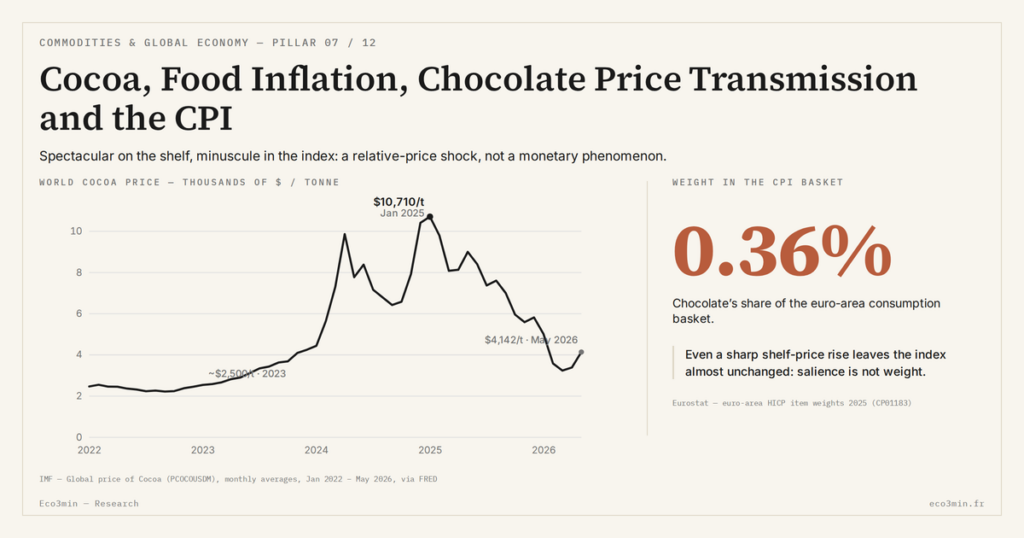
The cocoa surge made chocolate a visible inflation item, but its tiny weight in the consumption basket means it shifted the perception of inflation more than its measure. A relative-price shock, not a monetary phenomenon.
TL;DR
Chocolate became a vivid cost-of-living symbol, yet confectionery's tiny basket weight kept its inflation contribution to a few hundredths of a point, the relative-price shock central banks look through.
- Households weight frequently bought, saliently priced goods (food especially) far above their budget share when judging inflation, so a visible chocolate rise dents perceived inflation while the official index barely moves, feeding distrust of the measure.
- Central banks look through such relative-price shocks toward core inflation (excluding food and energy) but watch for second-round wage effects, as cocoa sat within a run of food-commodity tensions (coffee, sugar, olive oil) that none alone durably shifted the price level.
This article examines how the cocoa shock transmitted to food inflation and the price index, why its measured impact stayed small despite its visibility, and how central banks read this kind of shock. Directly related: the food-price speed signal.
When a commodity doubles or triples in price, a macroeconomic observer’s first question is whether the move will feed inflation. For cocoa, the answer is instructive: yes, the price of chocolate rose on the shelf, but the effect on the general price index stayed marginal, even as the subject dominated conversations. This gap between real impact and the impression produced sheds light on an important mechanism in the formation of inflation expectations, and it is through this that cocoa joins the broader macro-financial themes.
From the world quote to the price index
The transmission of the cocoa quote to the consumer price index passes through a chain of several links, each of which dampens the signal. The world bean quote first feeds the raw-material cost for processors and chocolate makers; this cost then passes, in part, into the wholesale price of chocolate products; that wholesale price finally translates, with a lag, into a retail shelf price, which enters the index calculation. At each step, the initial shock is diluted.
The first dilution is the place of cocoa in the finished product. As we detail regarding the breakdown of a chocolate bar’s price, the bean represents only a fraction of a bar’s cost, the rest split between sugar, milk, packaging, processing, distribution and marketing. A doubling of the bean price therefore translates into a much more moderate rise in the bar’s price, the weight of the other components remaining stable.
The second dilution is temporal and behavioural. As we saw regarding the transmission to retail chocolate prices, manufacturers buy their cocoa in advance, sell down stocks and reformulate their recipes, so that part of the rise is absorbed or deferred rather than passed through in full. The retail price of chocolate did rise, but less, and later, than the surge in the bean quote suggested. At the end of the chain, chocolate’s contribution to measured inflation is real but modest.
The order of magnitude is worth stating. At the height of the episode, retail chocolate prices rose by the order of several tens of percent in some countries, a spectacular increase at the product level. But set against the full consumption basket, in which confectionery represents a fraction of a percent, this surge translates into a contribution of only a few hundredths of a point to overall inflation. The contrast between the scale of the rise at the product level and its near-invisibility at the index level captures the whole paradox of this item: highly visible, barely weighty.
Basket weight against salience
Here intervenes the most instructive distinction of this episode, and the most relevant in macroeconomic terms. The consumer price index is a weighted average: each good weighs in proportion to its share in household spending. Yet chocolate and confectionery represent only a minute share of the basket. Mechanically, even a sharp rise in the price of chocolate moves the general index by only a few hundredths of a point, a contribution lost in the whole.
And yet the episode left a mark far beyond this statistical weight. The reason lies in the product’s salience: chocolate is a frequent, visible purchase whose price and format are immediately perceptible to the consumer. The goods one buys often and whose price one knows by heart — food above all — shape the perception of inflation disproportionately to their actual place in the budget. A repeated rise in the price of a bar, or the visible reduction of its format, weighs more on the sense of inflation than a heavier but less noticed item.
This phenomenon is well documented in surveys of household inflation expectations, where food and energy prices play an outsized role. Households overweight, in their estimate of inflation, the goods they buy frequently and whose price is saliently displayed, and underweight heavier but less frequent items such as housing or durable goods. Chocolate, bought regularly and whose unit price is immediately legible, belongs typically to the first category, which explains its imprint on sentiment.
This asymmetry between measured weight and perceived salience is a powerful driver in the formation of expectations. Households do not compute a weighted average of prices; they retain the rises that strike them daily. A shock concentrated on visible products can thus worsen the sense of inflation, and therefore expectations, without weighing heavily on the official index. Cocoa offers a stark illustration: a spectacular move on a minute item, which fed the conversation about the cost of living far more than it moved the figures.
For anyone following inflation, this distinction is essential. Confusing an item’s salience with its weight leads to overstating the macroeconomic effect of a sectoral shock. Pricier chocolate is a tangible reality for the consumer; it is not, for all that, a driver of general inflation. Holding both statements together is the mark of a correct reading of the phenomenon.
This divergence between perceived and measured inflation is not without consequence. When the most visible prices soar while the official index rises moderately, part of the public comes to doubt the measure itself, suspecting the statistics of understating the reality of the cost of living. This gap feeds distrust, and it complicates the communication of monetary authorities, who must explain why inflation would recede when households’ daily experience seems to say the opposite. Pricier chocolate, like other food-basket items, thus becomes a symbol of the cost of living far beyond its real weight.
Relative-price shock or general inflation?
Beyond the question of weight lies that of the nature of the shock. The cocoa surge is a supply shock specific to one commodity: a change in relative price, which makes chocolate more expensive relative to other goods, not a general and lasting rise in the price level. This distinction governs how central banks interpret such a move. Faced with a relative-price shock that is probably transitory, they tend to “look through” it, that is, not to react, focusing on core inflation, which excludes the most volatile components such as food and energy.
The logic is as follows: a rise in cocoa, caused by poor harvests, says nothing about the overall monetary dynamic. Responding to it by tightening policy would amount to fighting a phenomenon that will correct itself once harvests recover. That is precisely what happened: chocolate’s contribution to inflation, which rose with the bean quote, faded as that quote receded. Even cocoa’s inflationary footprint made the round-trip, mirroring the 2024-2026 cocoa price cycle.
The central banks’ “looking through” has a limit, however, and that is what makes food shocks less innocuous than they appear. If a succession of visible rises un-anchors inflation expectations, second-round effects can set in: wage demands meant to offset lost purchasing power, which in turn feed a broader and more durable inflation. It is precisely this channel — not the direct rise in chocolate, but its effect on expectations — that the authorities watch. A relative-price shock can thus, by ricochet, contribute to a deeper macroeconomic problem, even if its direct impact on the index remains negligible.
This does not mean such shocks are unimportant. Cocoa was part of a run of tensions on food commodities — coffee, sugar, olive oil — which, added together, sustained a climate of elevated food inflation. Each is idiosyncratic, but their accumulation can weigh on expectations and complicate the task of monetary authorities, especially when the memory of recent inflation remains vivid. The border between a series of relative-price shocks and a more durable inflationary regime is not always clear, and it is this ambiguity that makes interpretation delicate. Placing cocoa among resources in the world economy helps distinguish what belongs to a one-off shock from what belongs to an underlying trend. These surges are recurrent, and none has durably altered the general price level.
The episode is therefore a useful reminder for reading inflation data: a vivid, widely reported price rise is not automatically a macroeconomic event. The discipline lies in separating what is salient from what is significant, and a one-off relative-price move from a shift in the underlying price level. Cocoa, spectacular at the product level and negligible at the index level, is a near-perfect case study in that distinction. Reading it correctly means resisting the pull of the most visible number on the shelf, and asking instead what the broad price level is actually doing.
It is readily concluded that the cocoa surge significantly fed inflation. This confuses salience with weight: chocolate accounts for only a minute share of the consumption basket, so its impact on the general index stayed marginal. The shock mainly worsened the perception of inflation, not its measure.
Last updated — 12 July 2026
Disclaimer – Financial Information: The analyses, commentary, and content published on eco3min.fr are provided for informational and educational purposes only. They do not constitute investment advice or a solicitation to buy or sell financial instruments. Past performance is not indicative of future results. All investment decisions involve risk and are the sole responsibility of the reader.
Read next
Full pillar →Reading the refinery utilisation rate: the threshold, the season, the turnarounds
A refinery runs full near ninety percent, not a hundred: the last slice of nameplate capacity is a…
IMO 2020: the regulatory shock that rewrote product spreads
An environmental rule on marine sulfur can move a refining spread more than a swing in crude. IMO…
The 2022–2023 refining golden age: anatomy of an episode
In 2022, refined fuel prices climbed faster than crude. That gap, measured by the 3-2-1 crack spread, reached…