From World Price to Retail: Why Shelf Coffee Doesn’t Track the Exchange

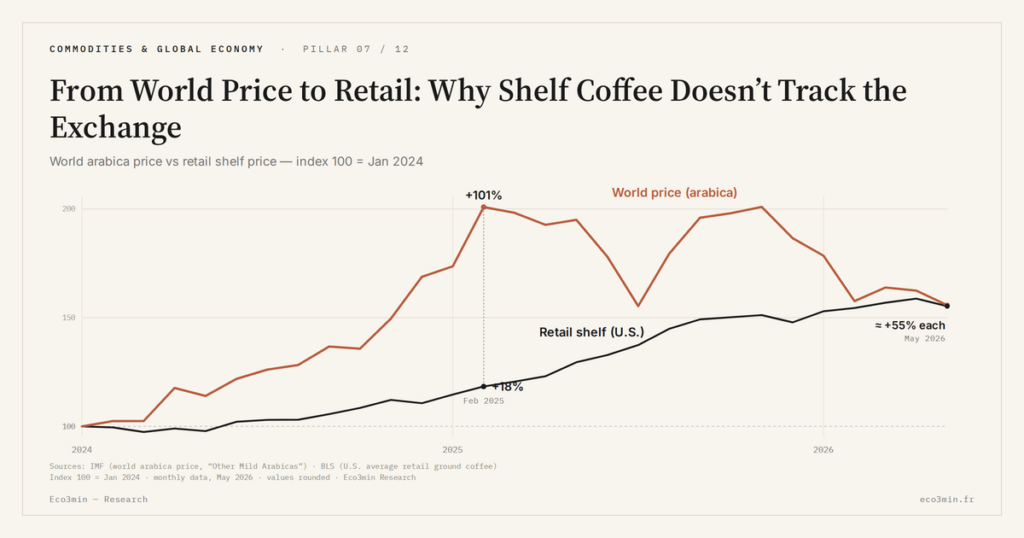
The world coffee price can jump by half without the shelf price of a pack moving in the same proportion or at the same moment. Between the bean quoted on the exchange and the cup, a long chain absorbs and delays the move.
TL;DR
Arabica futures swung from below $2 to above $4 and back toward $2.72 in eighteen months, yet the supermarket shelf barely registered the move.
- The green bean is only a minority share of the shelf price; roasting, packaging, distribution and taxes, none indexed to the quote, stay put when the bean soars.
- Roasters buy ahead and hedge for months, so a shock reaches the shelf only as old hedges expire and renew at higher levels.
- What the arabica-robusta spread measures is upstream supply, a wholesale signal, not the retail price the consumer eventually pays.
Understanding this partial, lagged transmission explains a daily paradox, and clarifies what the price gap actually measures: a wholesale signal, not a retail one.
1. The bean-to-shelf paradox
One fact regularly puzzles the consumer: the world coffee price can double in a few months, or collapse just as fast, without the price of a pack of coffee at the supermarket moving in the same proportion or at the same pace. In February 2025, arabica crossed $4 per pound in New York for the first time, after a rise of about 70% in 2024; the price paid at the shelf, by contrast, moved only partially and with a lag. This gap is not an anomaly: it stems from the very structure of the chain, between the green bean quoted on the exchange and the ready-to-drink coffee.
The contrast is stark when the numbers are placed side by side. Over a single eighteen-month span, the arabica futures price moved from below $2 per pound to above $4 and then back toward $2.72 by mid-2025 — a round trip of remarkable amplitude. Few consumers experienced anything resembling that swing at the supermarket. The shelf price drifted up modestly during the surge and showed little inclination to fall back when the quote corrected. This mismatch between a violently mobile wholesale quote and a comparatively sticky retail price is the everyday signature of the transmission chain, and it is the reason a headline about record coffee futures rarely matches the experience at the till.
This paradox is the concrete flip side of what the futures market measures. The quote in New York or London reflects the tension on green-bean supply, in bulk and in the moment; the shelf price incorporates a multitude of other factors and moves far more slowly. Grasping this difference is essential to avoid over-reading a price record as an imminent surge in the cost of coffee, and that means returning to what the arabica-robusta price gap actually measures.
2. The value chain between bean and cup
To understand the transmission, one must break down what separates the green bean from the finished coffee. The price of green coffee is only a fraction of the price paid at the shelf. Between the two sits a long chain: trading and logistics, hedging on the futures markets, roasting, packaging, distribution, the retailer’s margins, not to mention taxes. Each link adds a value whose amount does not depend on the world price of the bean.
The detail of these costs illuminates the mechanism. Roasting consumes energy and labour; packaging draws on materials whose price follows its own logic; transport and logistics depend on freight and fuel costs; distribution bears commercial rents, wages and margins; and taxation takes its share. None of these components is indexed to the green-bean quote. When the latter soars, they stay stable, which mechanically dilutes the raw material’s impact in the final price. Conversely, these same line items can rise — under wage or energy inflation — even as the coffee quote falls, blurring the link between the futures market and the till receipt.
The arithmetic consequence is direct: if green coffee makes up only a minority share of the final price, then even a doubling of its quote translates into only a muted rise at the shelf, the rest of the chain staying stable. This is why a spectacular move on the futures market shows up as a far more moderate change at the checkout. This cost structure sets coffee apart within the world of agricultural commodities, where the share of the raw material in the final price varies widely from one product to another. The make-up of the finished product also matters: a blend mixing the two species sees its cost depend on the arabica-robusta ratio, as the two coffees and their uses details.
3. Hedging and forward buying: the cushioning effect
A second mechanism explains the time lag: roasters do not buy at the spot price of the day. They buy ahead and hedge on the futures markets, locking in a purchase price for months. When a shock propels the quote, part of their supply is already secured at the old price; the rise therefore passes through only with a lag, as the old hedges expire and are renewed at higher levels.
The horizon of these hedges explains the size of the lag. Depending on their buying policy, roasters often secure their needs several months in advance, sometimes more for the largest. The longer that horizon, the more a shock’s transmission to the retail price is delayed, because the bean consumed today was bought yesterday, at a price that no longer reflects the current quote. This mechanism smooths the bumps: a brief peak in the world quote, if followed by a correction before the hedges expire, may never fully reach the shelf. It is only a durable tension, surviving the renewal of hedges, that ultimately passes through to the price paid.
This cushioning effect works both ways, but not always symmetrically. When the quote falls, roasters who had hedged at high levels keep paying dearly for their beans for a while, which delays the fall in retail prices. Studies of price transmission do observe a tendency for retail prices to rise faster than they fall, without that finding being a universal law; it depends on products, markets and the intensity of competition. This lag and this asymmetry belong more broadly to the way a commodity quote passes through to the prices paid, a subject that how prices pass through to inflation illuminates.
4. What the spread measures, what the consumer pays
This partial, lagged transmission has a corollary for reading the market: what the arabica-robusta spread measures is the state of supply upstream, on physical and futures markets, not the price paid at the end of the chain. The spread is a wholesale signal, not a retail one. Conflating the two would lead one to expect the shelf to reflect supply tensions instantly, which it does not.
This differentiated transmission does not affect every actor the same way. For the producer, it is the world quote that largely determines the revenue drawn from a harvest, hence a direct exposure to the futures market’s swings. For the roaster, the bean quote is one cost among others, managed through hedging and passed on gradually; the margin depends on the capacity to absorb or transmit variations. For the consumer, finally, the shelf price results from an aggregate in which the bean weighs little and late, so that a price record is felt less, and later, than one might imagine. Describing these distinct channels, without drawing any prescription from them, is enough to understand why the same price move is experienced very differently depending on one’s position in the chain.
This practical distinction matters. A high world quote signals a tension on green-bean supply, useful to anyone tracking the coffee market; it says little, in the short run, about the price the consumer will pay, which depends as much on the processing and distribution chain as on the bean itself. Conversely, a fall in the quote does not guarantee a rapid drop at the shelf. This is why upstream variations, dictated by Brazilian weather or by the coffee tree’s production cycle, read first as supply signals, not as forecasts of retail prices. This transmission logic sits more broadly within how commodity markets work, where the wholesale price and the price paid by the end user obey distinct dynamics and rarely move in lockstep.
That leaves the question of the record itself. A price peak exerts a misleading fascination, all the more so since it reaches the shelf only in muted and delayed form. Reading a record as the announcement of an imminent surge in the cost of coffee amounts to conflating the wholesale signal with the retail price — an error that the caution a price record demands illuminates. The world quote and the shelf price tell two linked but distinct stories, separated by the entire thickness of the value chain. Following one without understanding the other risks attributing to coffee what belongs to roasting, transport or distribution — and reading in an exchange record a price promise the shelf will keep only partly, and later.
Believing that a doubling of the world quote means a doubling of the shelf price is misleading. The green bean is only a fraction of the final price: roasting, packaging, distribution and margins, which do not depend on the quote, make up most of it. A spectacular surge on the futures market therefore shows up only as a muted and delayed rise at the checkout — and a fall in the quote does not guarantee a rapid drop, since most of the shelf price reflects costs that never touched the exchange.
Last updated — 9 July 2026
Disclaimer – Financial Information: The analyses, commentary, and content published on eco3min.fr are provided for informational and educational purposes only. They do not constitute investment advice or a solicitation to buy or sell financial instruments. Past performance is not indicative of future results. All investment decisions involve risk and are the sole responsibility of the reader.
Read next
Full pillar →Reading the refinery utilisation rate: the threshold, the season, the turnarounds
A refinery runs full near ninety percent, not a hundred: the last slice of nameplate capacity is a…
IMO 2020: the regulatory shock that rewrote product spreads
An environmental rule on marine sulfur can move a refining spread more than a swing in crude. IMO…
The 2022–2023 refining golden age: anatomy of an episode
In 2022, refined fuel prices climbed faster than crude. That gap, measured by the 3-2-1 crack spread, reached…