The 2025 Coffee Price Record: Why a Peak Is Not a Forecast

A price record exerts a misleading fascination: it suggests that the rise which produced it will continue. Coffee history teaches the opposite — a peak is the dated symptom of a tension, not a forecast.
TL;DR
Arabica's 2025 record corrected by nearly a third within months, just as observers had forecast, leaving open whether the spike was a passing cycle or a structural fragility.
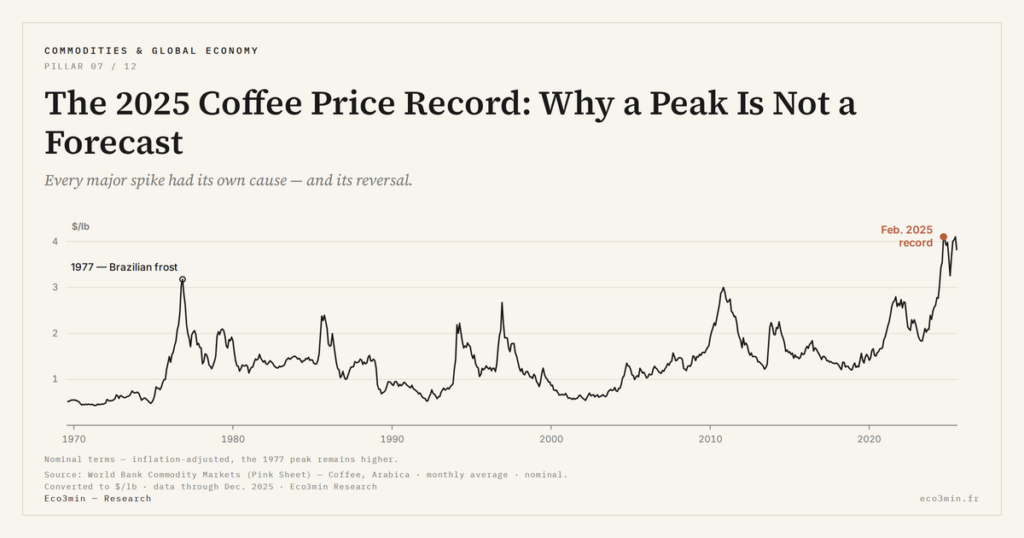
- Arabica first crossed $4 per pound in February 2025 and peaked near $4.41, beyond the 1977 frost-driven high of $3.375 that had stood for nearly half a century.
- Part of the swing was financial: players built positions ahead of the feared shortage, then unwound them as Brazilian crop prospects improved, amplifying both the rise and the fall beyond fundamentals.
- Whether the spike is cyclical or structural is read over crop years through the depth of arabica deficits, the spread's low point each cycle, and robusta's share of output and blends, not from any single peak.
Reading the 2025 record with caution means separating what a peak reveals from what it does not, and keeping open the question of cycle versus trend.
1. A record is not a forecast
A price peak captures attention and feeds a common reading error: believing that the momentum which carried the price to a record will persist. Yet a record contains no reliable information about the future trajectory. It reflects a tension on supply at a given moment; what follows depends on the next harvest’s weather, the ratio between the two species, demand and stocks — variables that a past peak does not illuminate. Conflating the symptom with the prognosis forgoes the caution that reading the coffee market demands, and which begins with the gap between arabica and robusta prices.
This caution is not a posture but an empirical lesson. Commodity markets are accustomed to peaks followed by corrections, and coffee is no exception. A record signals that an imbalance has set in; it does not say how long it will last, nor at what level the price will settle. It is this discipline — separating what a price reveals from what one would like it to say — that distinguishes a rigorous reading from an extrapolation.
Coffee history offers a telling precedent. The 1977 record, long unsurpassed at $3.375 per pound, was born of a devastating Brazilian frost; it was followed, once supply was rebuilt, by a long decline. Nearly half a century separated that peak from the one in 2025, a reminder that a record does not necessarily inaugurate an era of high prices. Each great coffee peak has had its one-off cause and its reversal; reading the 2025 high in the light of these precedents invites caution rather than excitement.
2. The 2025 record and its correction
The 2025 episode illustrates this mechanic almost didactically. In February 2025, arabica crossed $4 per pound in New York for the first time in its history, up to a record of roughly $4.41 per pound — more than double its level a year earlier, and well beyond the previous high of $3.375 dating from 1977. Robusta printed a record of about $5,821 per tonne in London at the same time. Every ingredient of a catastrophist reading was in place.
What followed tempered that reading. After the February peak, the arabica price underwent a marked correction, falling to around $2.72 per pound in early July 2025, down nearly a third from its spring high, before recovering partially through the summer and autumn. The World Bank anticipated for 2025 a fall in the coffee price index on the order of 9%, and a Reuters poll published in late 2024 pointed to an arabica decline that could approach 30% by the end of 2025. The post-record reversal was therefore widely anticipated by market observers — which underlines, in hindsight, the misleading nature of extrapolating the peak.
The path it took, however, deserves nuance, for the correction was no linear collapse. After the July trough, the arabica price recovered in part over the summer and autumn of 2025, moving in fits and starts rather than a straight line. This choppy trajectory is itself instructive: neither extrapolating the record nor anticipating a durable collapse captured the reality, which was one of oscillation. The price neither held at its peak nor fell back without return; it swung, with each successive revision of crop prospects. It is precisely this volatility, rather than a clean directional move, that characterises the coffee market around a record. The full sweep is visible in the arabica price record in context.
3. Why a record corrects
The correction is no accident; it is explained by known mechanisms. The first is the mean reversion proper to the coffee tree. With the tree bearing in alternation, a low-crop year is often followed by a rebound, which rebuilds supply and eases prices. This mechanism, detailed in the biennial cycle’s mean reversion, acts as a natural stabiliser: a deficit often calls forth a surplus.
The second mechanism is the supply response, however slow. High prices encourage expanding acreage and tending crops carefully, and better weather is sometimes enough to reverse the trend. In 2025, the improvement in Brazilian crop prospects precisely fed the easing of prices. The concentration of arabica supply on Brazil makes the market highly sensitive to Brazilian weather hazards, on the downside as on the upside. A peak born of bad weather can thus unwind as soon as conditions improve, with no structural crisis at stake.
A third, financial factor often amplifies both a record and its correction. When a supply shock looms, financial players build positions in anticipation of shortage, amplifying the rise beyond what fundamentals alone would justify. But that positioning then unwinds: as prospects improve or expectations normalise, the unwinding of those positions accelerates the fall. Part of a record’s amplitude, upward as downward, therefore stems from this financial component, distinct from the agronomic fundamental. Distinguishing it avoids attributing to physical supply what belongs to market flows — a nuance that, here too, argues against over-reading a peak.
4. A record is not a trend
One must, however, guard against the symmetric error: concluding from a correction that the record meant nothing. Caution cuts both ways. If a correction disproves the bullish extrapolation, it does not thereby refute the hypothesis of an underlying structural fragility, which operates on a longer time scale. Several trading houses pointed in summer 2025 to a global arabica deficit on the order of 8.5 million bags for the 2025/26 crop year, which, if confirmed, would mark a fifth consecutive year of deficit. These projections remain scenarios, dated and revisable; they establish neither a trajectory nor a price level.
The whole challenge is to hold together two readings that operate on different scales: a short-run cyclical oscillation, which explains the correction, and a possible long-run structural drift, tied to the climate constraint on arabica. The first does not exclude the second. Favouring the cycle over the prognosis — observing the series over time rather than commenting on a peak — is a discipline that reading cycles over time horizons illuminates more broadly. It is the same discipline that applies across the agricultural commodities sector, where an isolated record is rarely the right vantage point.
5. The cautious reading of a peak
What, then, remains of a record? A dated symptom, to be interpreted for what it is. A price peak indicates that a supply tension manifested at a moment; it invites one to seek its origin — frost, drought, deficit, cyclical trough — rather than to extrapolate its sequel. The relevant question is not “how high will the price go?” but “does this tension belong to the cycle or to the trend?” — a question that is not settled on a single peak, but on the patient observation of several crop years.
What such observation looks like, in practice, is descriptive rather than predictive. Several series, watched together over successive crop years, frame the question without resolving it: the depth and frequency of arabica deficits relative to robusta’s, the low point of the spread from one cycle to the next, and the robusta share of world production and of blends. A drift in these markers would tilt the reading toward the structural; their stability would favour the cyclical. None of them is a verdict on its own, and none warrants extrapolation from a single observation. They are simply the dials worth watching — a way of registering, season after season, whether the weight of evidence is shifting, without any of them dictating where the price will go next.
That question remains open. The 2024-2025 records may belong to a passing cycle, set to correct with the rebound harvest, or to the rise of a structural fragility in arabica against the climate. The mechanism of that fragility is established; the pace at which it will translate into a price trend is not. Tracking the arabica-robusta spread crop year after crop year, within the wider commodity context, amounts to watching that hypothesis tested in real time. In the meantime, a record remains a symptom to date, not a trajectory to extend — a peak to read for what it reveals about a moment, and no more.
- A price record reflects a supply tension at a given moment; it contains no reliable information about the future trajectory.
- Arabica’s February 2025 record (around $4.41 per pound) was followed by a marked correction (to around $2.72 in July), widely anticipated by observers.
- The correction is explained by the biennial cycle’s mean reversion and by the supply response, however slow; it does not, however, refute a possible long-run structural fragility.
- The cycle-versus-trend question is not settled on a single peak: a record is a dated symptom, to be observed over time, not a forecast.
Last updated — 30 June 2026
Disclaimer – Financial Information: The analyses, commentary, and content published on eco3min.fr are provided for informational and educational purposes only. They do not constitute investment advice or a solicitation to buy or sell financial instruments. Past performance is not indicative of future results. All investment decisions involve risk and are the sole responsibility of the reader.
Read next
Full pillar →Reading the refinery utilisation rate: the threshold, the season, the turnarounds
A refinery runs full near ninety percent, not a hundred: the last slice of nameplate capacity is a…
IMO 2020: the regulatory shock that rewrote product spreads
An environmental rule on marine sulfur can move a refining spread more than a swing in crude. IMO…
The 2022–2023 refining golden age: anatomy of an episode
In 2022, refined fuel prices climbed faster than crude. That gap, measured by the 3-2-1 crack spread, reached…