DGS10 Meaning: 10-Year Treasury Yield and the Constant Maturity Calculation


The DGS10 published daily by the Federal Reserve is not the yield of an identifiable Treasury bond but a statistical construction called Constant Maturity Treasury, readable only with its method.
TL;DR
Reconstructed each business day by cubic-spline interpolation, DGS10 gives a continuous 64-year Treasury series since 1962, at the cost of smoothing liquidity stress its method cannot see.
- DGS10 prices no tradable bond: the Fed reads an interpolated on-the-run curve at exactly 10 years, and the 1980 cubic-spline revision, refined in 2005 and applied only prospectively, leaves small methodological breaks in the H.15 series.
- The method masks what it smooths: in March 2020 the on-the-run versus off-the-run 10-year gap reached nearly 25 bps while published DGS10 showed 8-10 bps, and a 4% level can hold 2% real plus 2% breakeven or 0.5% real plus 3.5% breakeven, so rigorous reading adds the MOVE Index, TBAC auction reports and the DGS10/DFF spread.
Understanding CMT plumbing separates the analyst who reads the 10-year yield from the one who merely recites it — the method carries its own biases and blind spots.
1. Why DGS10 has no direct bond counterpart
When FRED displays DGS10 = 4.28% on 16 May 2026, this number does not denote an existing Treasury bond an investor could buy at exactly that yield. For the detailed treatment, see why the 10-year yield anchors valuations. It is the theoretical yield of a hypothetical Treasury whose residual maturity is precisely 10 years. This precision is conceptually impossible with any actual security: a bond issued one year ago with a 10-year original maturity now has 9 years of residual maturity, and tomorrow will have 8 years and 364 days. No Treasury remains perpetually at 10 years from maturity. A complementary angle appears in the budgetary spring behind structural gold demand.
The Federal Reserve resolves this problem through interpolation: it constructs each business day a smoothed curve from secondary-market quoted Treasuries, then reads the value at exactly 10 years on that curve. The result is published in the H.15 Selected Interest Rates release, series DGS10. The method, called Constant Maturity Treasury (CMT), has been in place in its current form since 1980, following a Treasury Department methodological revision that replaced the older linear regression with cubic splining. A second revision in 2005 refined the treatment of curve pivot points. Directly related: our reading of transmission to the income statement.
This construction guarantees temporal comparability. A bond issued in 2015 cannot be compared to itself in 2025 since its residual maturity has changed. But DGS10 in 2015 and DGS10 in 2025 both describe the yield of a 10-year residual Treasury — exactly the same conceptual maturity. This methodological stability allows for a continuous series since January 1962, 64 years of history without a break in definition. The context of DGS10 as a macro reference signal rests entirely on this continuity.
The historical evolution of the method deserves recall. Before 1962, the Fed published Treasury rates by coarse maturity buckets without systematic interpolation. The creation of the H.15 release in 1962 institutionalized daily publication of Constant Maturity yields at the main maturities, jointly driven by the Treasury Department and the Federal Reserve Board. Initial standardization rested on piecewise linear regression between quoted Treasuries — a rudimentary method that produced CMT yields sensitive to individual Treasuries in the basket.
The major 1980 revision replaced this regression with cubic splining, motivated by the need to produce stable yields as the dispersion of outstanding Treasuries grew considerably after the issuance waves of the 1970s. The more technical 2005 revision refined the interpolation around pivot maturities and improved the treatment of very short yields (1M, 3M, 6M) whose dynamics differ from those of longer yields. Both revisions were applied prospectively: historical series were not back-calculated, implying a slight methodological discontinuity in 1980 and 2005 that long-term analyses should know about.
2. The detailed calculation method
The Treasury Department’s CMT algorithm, applied daily by the Federal Reserve, rests on three steps. First step: collection of quoted yields on the secondary market for on-the-run Treasuries at the curve’s pivot maturities — typically 1 month, 3 months, 6 months, 1 year, 2 years, 3 years, 5 years, 7 years, 10 years, 20 years and 30 years. On-the-run Treasuries are the most recent issuance at each maturity, concentrating most of the daily liquidity.
Second step: construction of a quasi-monotone cubic spline connecting these pivot points. The spline is calibrated to pass through each observed yield while guaranteeing that the resulting curve is continuous and differentiable. This mathematical property avoids calculation artifacts at intermediate maturities between pivot points.
Third step: reading the interpolated curve at exactly 10 years. For DGS10, the 10-year maturity is itself a pivot point — the reading is therefore close to the on-the-run 10-year yield, with marginal smoothing to reconcile the local curve with neighboring maturities (7Y and 20Y). The published DGS10 can therefore differ from the on-the-run 10-year yield by a few bps during episodes where the local curve is stressed.
A concrete example illuminates the algorithm. On 16 May 2026, suppose the following on-the-run yields: 7Y = 4.05%, 10Y = 4.28%, 20Y = 4.52%. The cubic spline connecting these three points will produce an interpolated 10-year yield very close to the directly quoted 4.28%, with marginal adjustment to ensure differentiable continuity with the 7Y-10Y and 10Y-20Y segments. If the secondary market closed that day with the on-the-run 10-year at 4.30%, but the spline calculates 4.28% consistent with neighboring segments, the published DGS10 will be 4.28%. The 2 bps gap is precisely the methodological smoothing inherent in CMT.
The market fixings used are those of 15:30 New York time, the official end of the Treasury market session. The retained yield is not a last price but a median of composite yields published by the main primary dealers, reducing DGS10 sensitivity to unrepresentative end-of-day moves.
3. Measurement limits and blind spots
The CMT method has three limits every user should know. First limit: DGS10 smooths the liquidity gap between on-the-run and off-the-run Treasuries. Off-the-run Treasuries, being older, are structurally less liquid and trade at slightly higher yields. DGS10 reflects mainly on-the-run pricing, underestimating the effective yield available on the secondary market in the off-the-run segments.
This gap is generally small — a few bps — but can widen significantly during stress episodes. In March 2020, the on-the-run versus off-the-run 10-year gap reached almost 25 bps before the Fed intervention of 15 March 2020. The DGS10 published during this episode reflected only about 8 to 10 bps of that stress, smoothing part of the market tension.
Second limit: DGS10 does not capture the quality of recent Treasury auctions. When the Treasury Department issues a new 10-year line, the primary allocation reflects the appetite of indirect bidders (foreign central banks, international institutions), primary dealers and direct bidders. A significant auction tail — where the allocation yield exceeds the pre-auction indicative yield — signals demand stress. This information does not appear in the published DGS10, which simply records the post-allocation secondary yield. The corporate transmission framework illustrates the consequences of these demand tensions on the cost of capital.
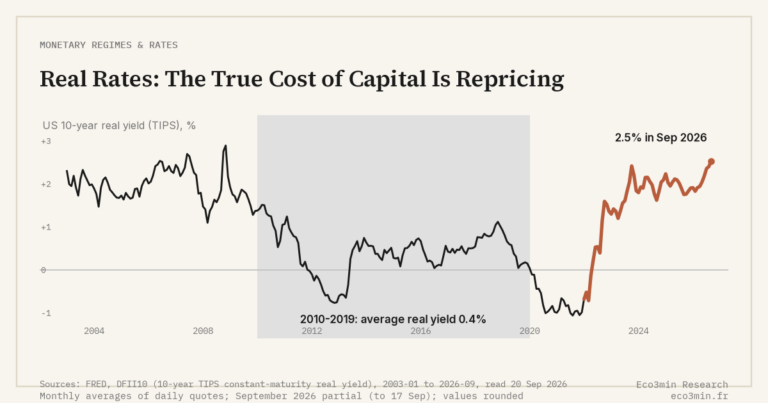
Third limit: the CMT method does not capture the yield’s components — that is, the decomposition between real rate, inflation expectations and term premium. DGS10 is a composite number that aggregates several distinct explanatory factors. To analyze them separately requires cross-referencing DGS10 with DFII10 (10-year TIPS) and T10YIE (breakeven). This decomposition is the subject of the DGS10 = TIPS + breakeven identity. For the broader picture: The copper/gold ratio read alongside real yields.
Fourth, subtler limit: the CMT method assumes that on-the-run Treasuries at different maturities are homogeneous comparison points. But some maturities are more liquid than others. The 10-year is traditionally the most liquid Treasury segment, followed by the 2-year and 5-year. The 7-year and 20-year are structurally less liquid, which can introduce local distortions in the interpolated curve. The Fed partially compensates this asymmetry by weighting pivot points by their liquidity, but the smoothing remains imperfect during market stress phases.
The indiscriminate aggregation of these components explains why two numerically identical DGS10 values can correspond to radically different macroeconomic configurations. A 4% DGS10 composed of 2% real and 2% breakeven describes a cyclically balanced economy; a 4% DGS10 composed of 0.5% real and 3.5% breakeven describes an economy under inflation stress. The CMT method, by construction, does not distinguish these two cases.
4. Cross-referencing DGS10 with other indicators
Rigorous use of DGS10 implies cross-referencing it with complementary indicators able to fill the identified blind spots. Three cross-references deserve systematization.
First, the MOVE Index published by ICE BofA, which measures implied volatility on 1-month Treasury options. When MOVE rises above 130-140 points, Treasury liquidity deteriorates and the published DGS10 becomes an increasingly noisy signal. MOVE touched 199 on 21 March 2023 during the post-SVB stress, close to its historical peak of 217 reached in October 2008.
Second, the quarterly reports of the Treasury Borrowing Advisory Committee (TBAC), which publish the breakdown of auction allocations by buyer cohort and the bid-to-cover ratios. Persistent deterioration of these metrics typically precedes a visible DGS10 repricing by a few weeks.
Third, the DFF series (Effective Fed Funds Rate) also published by the Fed, which allows calculation of the DGS10/DFF spread. This spread isolates the term structure component of DGS10. The articulation between these two series sheds light on the DGS10 historical series since 1962 by distinguishing phases where the DGS10/DFF slope is positive (steepening), negative (inversion) or flat (regime change).
A fourth cross-reference, accessible directly, is the daily DGS10 series with methodological notes which provides the full series with download capability and methodological notes maintained by the Federal Reserve Economic Data team.
- DGS10 is not the yield of an identifiable Treasury but the yield of a hypothetical bond with exactly 10 years of residual maturity, reconstructed each business day by cubic spline interpolation on the on-the-run curve.
- The CMT method in place since 1980 guarantees temporal comparability of a continuous 64-year series, but smooths on-the-run versus off-the-run liquidity gaps and partially masks Treasury stress episodes (March 2020, October 2023).
- The published DGS10 remains a composite number: it aggregates real yield (DFII10), inflation expectations (T10YIE) and term premium; two numerically identical DGS10 values can describe opposing macroeconomic configurations.
- Rigorous use cross-references DGS10 with the MOVE Index, TBAC auction reports, and the DGS10/DFF spread to reconstruct what the CMT method, by construction, aggregates.
Last updated — 12 July 2026
Disclaimer – Financial Information: The analyses, commentary, and content published on eco3min.fr are provided for informational and educational purposes only. They do not constitute investment advice or a solicitation to buy or sell financial instruments. Past performance is not indicative of future results. All investment decisions involve risk and are the sole responsibility of the reader.
Read next
Full pillar →Real Rates: The True Cost of Capital Is Repricing
Why real rates are reasserting themselves as markets' anchor and how to recalibrate investment and financing decisions facing…
Real Interest Rates: The Quiet Signal Reshaping Markets
Real interest rates: why their persistence in positive territory in 2026 is reshaping the rules for bonds, equities,…
OAT-Bund Spread: A Quiet Gauge of French Sovereign Risk
OAT-Bund spread: how this yield gap has become a key signal on French sovereign risk, fiscal policy and…