Down Payment and LTV: How Equity Shapes Mortgage Borrowing Power

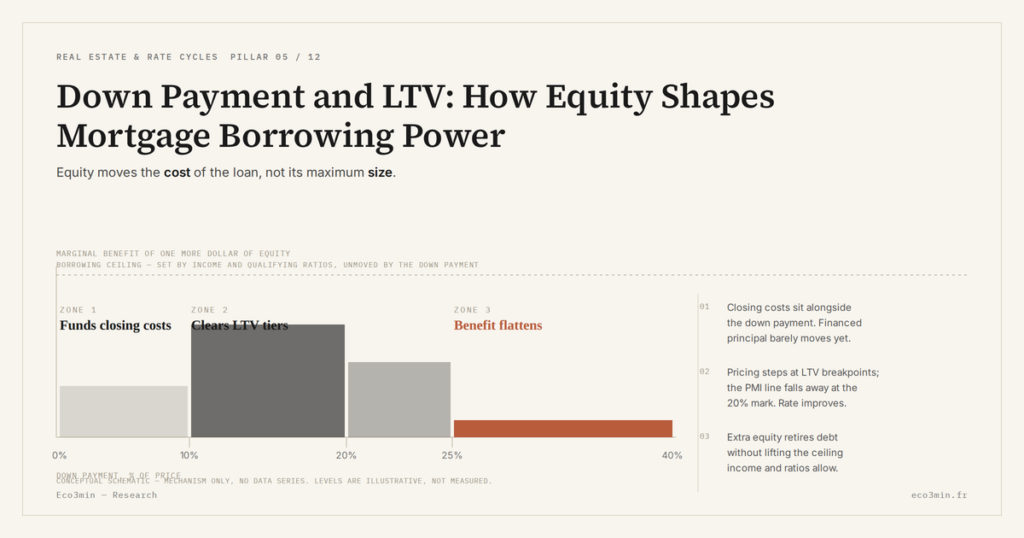
The down payment is treated as the engine of budget: the more you put down, the bigger the house. The mechanics say otherwise. Its first effect is not on how much you can borrow, but on what that borrowing costs.
Confusing the down payment with capacity inflates the first. Equity rarely buys a larger home; it buys the same loan on better terms.
The down payment mainly moves the loan-to-value ratio, the PMI threshold, the rate and total cost, and only indirectly the loan a given income supports.
- Below 20% down, a conventional loan carries private mortgage insurance, cancelled by request at 80% LTV and automatically at 78%.
- PMI runs roughly 0.46% to 1.5% of the loan a year, scaled by credit score and loan-to-value.
- Beyond the 20% mark, more equity mainly lowers the rate and the balance, not the borrowing ceiling.
LTV, defined
The loan-to-value ratio is the loan divided by the property’s value, and it is the number the down payment actually sets. Put 20% down and the LTV is 80%; put 5% down and it is 95%. That single figure drives more of the loan’s economics than the down payment’s headline size, because lenders price and insure against LTV, not against the dollars a borrower brings. The down payment does not buy more house; it buys the same loan for less.
This unseats the common belief that a bigger down payment means a bigger budget. The maximum loan stays governed by income and by how the back-end ratio caps the loan, which the down payment does not move directly. Its effect on capacity is indirect, routed through the rate and the insurance the LTV triggers, a hierarchy set out in how income maps to a loan.
Lenders read LTV in tiers, not on a smooth line. Conventional pricing steps at familiar breakpoints, commonly around 80%, 85%, 90% and 95%, so crossing a threshold matters more than a marginal dollar of down payment. A buyer just above 80% LTV can sometimes gain more by nudging the down payment over the line than by adding cash elsewhere. The appraisal complicates this: because LTV uses the lower of price and appraised value, a low appraisal raises the effective LTV and can pull a borrower back below a pricing or PMI threshold they thought they had cleared, an outcome the down payment alone does not control. The practical lesson is to target the LTV that clears the nearest threshold rather than an arbitrary percentage, since the loan’s cost turns on which side of the line the ratio lands.
Down payment versus financed principal
Not every dollar of the down payment reduces the loan. Closing costs, typically 2% to 5% of the price, come out of cash at the table alongside the down payment, so a buyer must fund both. Conventional loans allow as little as 3% down, and FHA loans 3.5%, which lets buyers enter with modest equity while accepting a higher LTV and its consequences.
The distinction between how much you put down and how much you borrow is where confusion sets in. A larger down payment lowers the financed principal one for one, which lowers the payment and the interest, but it does not raise the income-driven ceiling on the loan. It changes the split between cash now and debt later, not the size of the box the ratio allows. That is why two buyers with the same income can bring very different down payments and still face the same maximum loan.
Where the cash comes from matters as much as its size. Conventional and government programs allow documented gift funds from family toward the down payment, within limits, so a borrower’s own savings need not supply every dollar. Seller concessions can cover part of the closing costs, freeing cash that effectively raises the down payment. And lenders separate the down payment from reserves, the months of payments a borrower must show after closing; draining savings into a larger down payment can leave a file short on reserves, which can matter more to approval than the extra equity. The down payment is one input among several, not a single dial.
At the low end, the floor is not always 3%. VA loans for eligible veterans and USDA loans in designated rural areas allow zero down, trading the down payment for a funding or guarantee fee. These paths show the down payment is a lever, not a gate: a qualified borrower can hold a loan with no equity at all, provided the program and the ratios permit it. What the smaller down payment costs shows up later, in insurance, fees or rate, rather than in a lower borrowing ceiling.
The PMI threshold and its cost
The sharpest effect of the down payment sits at the 20% line. Below it, a conventional loan requires private mortgage insurance, an added monthly cost that protects the lender, not the borrower. PMI runs roughly 0.46% to 1.5% of the loan amount a year, scaled by credit score and LTV, so a weaker profile at 95% LTV pays materially more than a strong one at 90%.
PMI is not permanent. Under the Homeowners Protection Act, a borrower can request cancellation at 80% LTV and the servicer must cancel automatically at 78%, based on the original amortization schedule. That contrasts with FHA mortgage insurance, which generally lasts the life of the loan when the down payment is under 10%, a gap that can outweigh a lower headline rate. Structures like an 80/10/10 piggyback loan exist precisely to keep the first lien at 80% LTV and sidestep PMI, and starting in tax year 2026 mortgage insurance premiums are again treated as deductible interest within income limits. The threshold, not the down payment’s absolute size, is what changes the monthly cost.
PMI also comes in forms the monthly figure hides. Borrower-paid monthly PMI is the default, but a single-premium option folds the cost into an upfront payment at closing, and lender-paid PMI removes the line item in exchange for a permanently higher rate. Each shifts where the cost lands rather than removing it, and the lender-paid version can persist long after a borrower would otherwise have cancelled at 78% LTV, since it is baked into the rate. Reading the down payment through the PMI lens therefore means asking not only whether insurance applies, but in which form and for how long.
The FHA comparison sharpens the point. FHA loans carry both an upfront mortgage insurance premium and an annual one, and when the down payment is under 10% that annual premium runs for the life of the loan rather than falling away at an equity threshold. A borrower with a strong credit score often pays less over time with conventional PMI that cancels than with an FHA loan that does not, even when the FHA rate looks lower at closing. The down payment thus interacts with the loan program: the same 5% down means a cancellable cost on one path and a permanent one on another, so the equity decision cannot be read apart from the program it sits inside.
How equity moves the rate
Beyond insurance, equity moves the rate itself. Conventional pricing applies loan-level adjustments tied to LTV and credit, so a lower LTV generally earns a lower rate. Through the same non-linearity that governs the payment, a fraction of a point off the rate feeds back into the loan a payment supports and, more sharply, into total interest, as traced in how the term changes total interest.
These gains fade. The rate improvement from more equity flattens past roughly 20% to 25% down, once the file clears the main pricing tiers. Because those adjustments are tiered rather than continuous, the rate benefit arrives in steps as the down payment crosses each level and then stalls between them; once a borrower sits inside the best tier, additional equity buys almost no further rate improvement. Beyond that, an extra dollar of down payment mostly retires debt rather than lowering the rate, and it carries an opportunity cost: cash locked in equity is cash not held in reserve, which underwriting itself values. Committing an extra $40,000 past the useful threshold buys little rate benefit while removing a buffer the same lender wants to see after closing. The sensible frame is not maximum equity but the point where the down payment has covered closing costs, cleared the PMI threshold, captured most of the rate improvement, and left a cushion. Past that, equity reduces the loan without expanding what the income can carry, feeding the wider the mortgage credit cycle.
- The down payment sets the LTV, which drives pricing and insurance; the loan ceiling stays income-driven.
- The 20% line governs PMI, cancelled at 80% LTV by request and 78% automatically under the HPA.
- Rate gains from equity flatten past about 20% to 25% down, after which more cash mostly retires debt.
A lever on terms, not budget
The down payment is a lever on terms far more than on budget. It sets what the loan costs, rarely its maximum size, which income and the debt ratio bound. Read that way, it discourages draining every dollar of savings for a rate gain that fades, and it reframes the shopping question toward the thresholds that actually move money: the PMI line, the pricing tiers, the reserves a lender wants to see. Equity earns its place in the mechanism as a lever on terms, not a way to lift the ceiling the income sets, developed across the rates and capacity sub-pillar.
Last updated — 3 August 2026
Disclaimer – Financial Information: The analyses, commentary, and content published on eco3min.fr are provided for informational and educational purposes only. They do not constitute investment advice or a solicitation to buy or sell financial instruments. Past performance is not indicative of future results. All investment decisions involve risk and are the sole responsibility of the reader.
Read next
Full pillar →US Rental Property Real Yield: What Cap Rate and NOI Actually Leave You
A rental listing leads with a yield. Divide the annual rent by the price and the number looks…
Cap Rate Spread: What Rental Yield Pays Over the 10-Year Treasury
A 5% cap rate sounds attractive. But 5% against what? A risk-free 10-year Treasury yields near 4.5% in…
US Rental NOI, Line by Line: What Net Operating Income Really Subtracts
A US rental yield is advertised gross: annual rent over price. Between that number and the income an…