Earnings Surprises and Financial Regime Shifts
Earnings surprises reveal far more than a quarterly miss. They are an early indicator of the shift from a tolerant environment to a more constrained financial regime, often well before any visible index correction.

Equity markets regularly move through phases where indices appear stable, even resilient, while microeconomic signals deteriorate. Among those signals, earnings surprises occupy a particular place. They sit within the broader frame covered by the Valuations and earnings sub-pillar. They are often perceived as one-off events, tied to quarterly releases or temporary forecast adjustments. That reading understates their analytical reach.
TL;DR
Aggregated earnings surprises track the equity cycle's internal state, and as the financial regime tightens, the same misses markets once shrugged off become leading signals of fragility.
- An earnings surprise is the gap between reported results and aggregated market expectations; isolated it looks anecdotal, but aggregated across companies it tracks the equity cycle's internal dynamics.
- In permissive phases of abundant liquidity and strong nominal growth, misses are downplayed; as the regime tightens, markets revert to immediate criteria like cash-flow generation, balance-sheet structure and self-financing capacity.
- Repetition and diffusion carry the signal: when negative surprises become more frequent and transversal, they mark a tightening financial framework, often before classic macro indicators turn.
In reality, the trajectory of earnings surprises reflects far more than a simple gap between expectations and realizations. It informs about the underlying financial regime, about the market’s tolerance for operational risk, and about the way margins, cash flows and balance sheets are repriced through the cycle.
What earnings surprises actually measure
An earnings surprise corresponds to the gap between earnings actually reported by a company and aggregated market expectations. Taken in isolation, such surprises can look anecdotal. Aggregated across a broad set of companies, they become a revealing indicator of the internal dynamics of the equity cycle. This internal dynamic is also examined through the lens of earnings revisions as a false signal of stability.
When surprises are predominantly positive, that typically reflects an environment in which nominal growth, financing conditions and cost structure allow companies to beat expectations that were already favorable. Conversely, a rise in negative surprises signals growing difficulty in defending margins and profitability, even without any visible macroeconomic shock. Related material: how buybacks and dividends differ as shareholder returns.
From a tolerant environment to a constrained regime
The most permissive market phases are characterized by a high tolerance for temporary performance gaps. This temporal lens is integrated into the broader analysis offered by our Equities and ETFs pillar. Investors then place more weight on long-term narratives than on immediate results. This shift sheds light on the declining dependence of indices on corporate performance. Negative surprises are downplayed, sometimes even ignored, as long as liquidity and aggregate growth remain abundant.
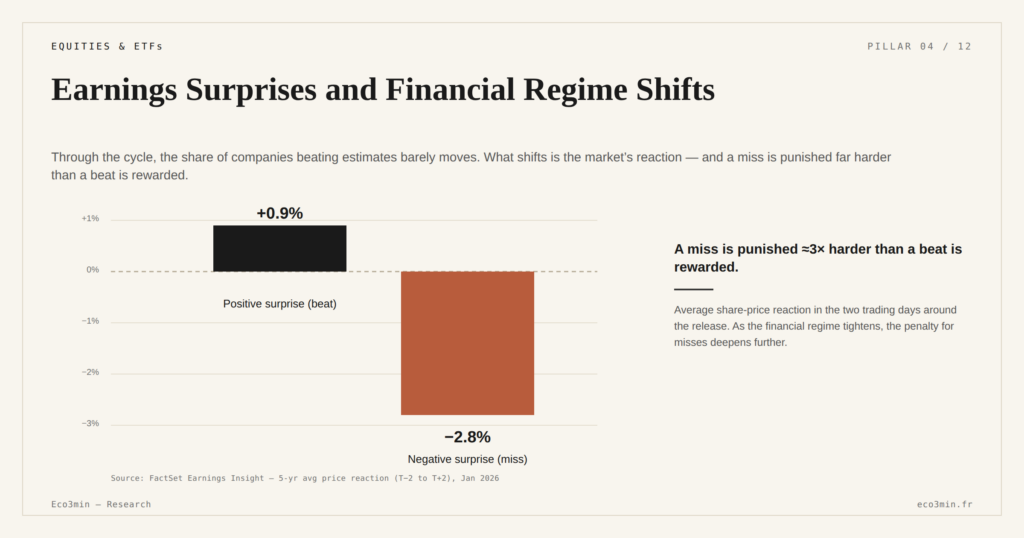
As the financial regime tightens, that tolerance fades. The asymmetry is measurable: over five years, a miss has been punished by an average −2.8% in the two sessions around the release, against +0.9% for a beat (FactSet Earnings Insight, January 2026); in Q1 2026 the average penalty reached −4.9% (FactSet, May 2026). Misses become more punishing, not because they are more spectacular, but because they reveal a gradual erosion of fundamentals. Markets stop reasoning in terms of future promises and revert to more immediate criteria: cash-flow generation, balance-sheet structure, self-financing capacity. A related perspective: reading earnings surprises through cash flow, margins and guidance.
Why indices can mask this transition
A common error equates index stability with the absence of risk. Yet aggregate indices can remain unchanged while internal performance dispersion widens. Some companies keep delivering positive surprises, offsetting the deterioration of a growing number of more fragile players.
This phenomenon sits at the heart of selective market phases, where performance does not disappear but concentrates. Negative earnings surprises accumulate in specific segments without triggering an immediate index correction, reinforcing the illusion of a still-favorable environment.
The limits of a purely aggregate reading
Watching only index levels or the average of reported earnings leads to underestimating the reach of microeconomic signals. Earnings surprises do not necessarily flag an abrupt reversal, but rather a shift in the market’s operating regime. More context: the forward signals inside quarterly earnings.
That transition is often silent. It takes place before classic macroeconomic indicators turn and before any marked revision of growth expectations. Companies most exposed to financing costs, demand cyclicality or competitive pressure see their margins compress first.
When dominant narratives become misleading
Under a tolerant environment, structural-growth narratives tend to dominate the analysis. Earnings misses are interpreted as temporary accidents. In a more constrained regime, those same misses are re-read as leading signals of fragility.
The difficulty for the observer is that this regime change is never announced explicitly. It manifests through a gradual evolution in how the market processes earnings surprises, well before any visible correction.
From individual surprise to regime signal
It is not the earnings surprise itself that matters, but its repetition and diffusion. When negative surprises become more frequent, more transversal and harder to explain through idiosyncratic factors, they indicate a tightening of the financial framework. A broader view: what real rates change for equity valuation.
This dynamic illuminates the link between microeconomics and the equity cycle. It helps explain why a market can appear stable while becoming structurally more demanding for companies.
Reading earnings surprises in greater depth
For a more detailed analysis of the mechanisms linking earnings revisions and equity reactions, an in-depth read of the article on earnings revisions and market reactions places these signals back into a cycle perspective.
This approach fits within a broader reading of the growing selectivity of equity markets, already explored in the analysis of performance dispersion and the increasingly discriminating nature of the equity cycle.
Conclusion — A discreet but structural signal
Earnings surprises are neither statistical anomalies nor mere accidents along the way. They are one of the earliest indicators of the shift from a tolerant environment to a more constrained financial regime.
As long as aggregate indices hold, this signal often remains underestimated. Yet it is precisely during these phases of apparent stability that careful reading of earnings surprises delivers a finer understanding of the cycle underway.
In a market that has become more selective, what sustains valuations durably is no longer promises but the demonstrated capacity to generate margins and cash flows under a less forgiving financial framework.
Last updated — 20 September 2026
Disclaimer – Financial Information: The analyses, commentary, and content published on eco3min.fr are provided for informational and educational purposes only. They do not constitute investment advice or a solicitation to buy or sell financial instruments. Past performance is not indicative of future results. All investment decisions involve risk and are the sole responsibility of the reader.
Read next
Full pillar →Equal-Weight ETFs: The Quiet Signal Behind Rising Indices
Equal-weight ETFs reveal the true health of the equity market behind mega-cap-driven indices. Their gap with cap-weighted ETFs…
Smart Beta ETFs: The Hidden Risk Behind Factor Performance
Smart beta ETFs now hold ~15-20% of global equity ETF assets. Stacking factor exposures often rebuilds hidden concentration…
Equity Profit Warnings: Risk and Opportunity After the Alert
Profit warnings have become accelerated stress tests in a higher-cost-of-capital regime. How equity risk reconfigures and where structural…