Energy, Metal, and Agricultural Commodities: Structural Differences
Energy, metal, and agricultural commodities follow distinct logics: physical nature, storage costs, demand elasticity, and financial depth shape divergent cycles within a single complex.


Macro analysis of the structural differences between energy, metal, and agricultural commodities and their effects on prices.
TL;DR
Physical nature governs commodity prices: storage cost, supply-adjustment speed, and financial-market depth explain why energy, metals, and agriculture diverge under the same macroeconomic shock. This pattern is contextualised in our study of commodity price formation.
- Energy commodities like oil, gas, and coal are consumed continuously and stored at high cost, so prices react sharply to short-term supply shocks; metals are durable and recyclable, absorbing volatility through stocks.
- Energy demand tracks industrial activity and transport, metals demand follows investment and construction cycles with longer lags, and food demand stays relatively stable across the cycle.
- Derivatives let capital flow rapidly into energy and metals, so their deeper financial markets can show volatility that does not reflect an immediate material imbalance, while less-liquid agricultural markets see weaker amplification.
- Since late 2025, with global growth running around ≈2.5–3% and regionally uneven, energy demand held in some zones while cyclical metals tied to industrial investment softened, and extreme weather added agricultural uncertainty.
Commodities are often grouped under a single analytical label. Yet their price dynamics follow profoundly different logics depending on their physical nature. Energy, metals, and agricultural products do not respond to the same production constraints, the same adjustment lags, or the same macroeconomic shocks. Treating these categories as one leads to partial interpretations of the cycles observed in commodity markets.
This distinction has become more visible recently, as geopolitical tensions, supply constraints, and inflections in global demand have affected each segment asymmetrically. Understanding these differences allows for a sharper reading of price moves, without reducing them to a single explanation.
Physical constraints that shape distinct cycles
These differences between energy, metals, and agriculture fit within a broader dynamic specific to commodity markets, where physical constraints, adjustment lags, and the heterogeneity of uses play a central role. This analytical grid is developed across the pillar page Commodities and the global economy, which places these segments within their global macroeconomic role.
The first dividing line lies in the very nature of the assets. Energy commodities — oil, natural gas, coal — are characterized by immediate and continuous consumption. The argument is developed step by step in this dedicated note on agricultural commodity cycles. They can only be stored at high cost, with strong logistical constraints. By contrast, industrial and precious metals are durable, recyclable, and storable over long periods. Agricultural commodities sit in an intermediate position, dependent on biological and climatic cycles that cannot be compressed. Stretch those cycles across several bad seasons and the result looks like the contraction of the US cattle herd.
This difference translates directly into price formation. Energy markets react strongly to short-term supply shocks, since production adjustment is slow and demand is inelastic. Metals can absorb more volatility thanks to existing stocks and recycling. Agricultural products, in turn, are exposed to seasonal and climatic variations that create occasional but recurrent tensions. A complementary angle appears in the mapping of mine supply and its low elasticity.
Why macro signals do not transmit the same way
Part of the consensus considers that commodities react primarily to the same macroeconomic variables: global growth, inflation, financial conditions. That reading is incomplete. The transmission channel differs by category.
For energy commodities, demand is closely tied to industrial activity, transport, and electricity generation. A global slowdown rapidly translates into an inflection of consumption, even when supply remains constrained. For metals, demand depends more on investment cycles, infrastructure, and construction, with longer transmission lags. The question is examined at length in iron ore as a China barometer. Agricultural commodities, in turn, are less sensitive to short-term cyclical conditions, as food demand remains relatively stable. For the broader picture: How the electricity mix shifted.
These differences explain why, within the same macroeconomic context, certain commodities can appreciate while others stagnate or correct.
This heterogeneity becomes particularly visible during inflationary phases. Depending on their physical nature, mode of storage, and demand elasticity, commodities do not react uniformly to a price acceleration. This mechanism is analyzed in greater depth in the article on the differentiated reaction of commodities to inflation, which shows why energy, metals, and agriculture transmit inflationary shocks through distinct channels.
Financial reading versus physical reality
Divergence across categories is amplified by the role of financial flows. Derivatives markets allow rapid and large-scale exposure to certain commodities, particularly energy and metals. Agricultural products are often less liquid financially, which limits the purely financial amplification of price moves. Companion analysis: what sets copper apart within the metals complex.
This distinction echoes the reading developed in the reference analysis of the contrast between physical supply and financial demand in price formation. Commodities whose financial markets are deepest tend to display higher volatility, which does not always reflect an immediate material imbalance.
What is changing in the current context
Since late 2025, several weak signals have reinforced these gaps. Global growth has been running around ≈2.5–3% according to aggregated projections, with strong regional heterogeneity. This configuration supports energy demand in certain zones while weighing on cyclical metals exposed to industrial investment. In parallel, extreme weather conditions have raised uncertainty in agricultural markets, independently of the economic cycle.
These developments reinforce the point that commodities do not constitute a homogeneous block in the face of recent macroeconomic shocks.
What readers are really looking for
Behind this distinction often lies a simpler question: why does an economic or inflationary shock not produce the same effects on all commodities? The real question is not whether “commodities are rising or falling,” but which specific constraints dominate at a given moment and prevent a uniform reading. Related coverage: cocoa’s recent price trajectory.
Common reading errors
Confusing the commodity cycle with the energy cycle. The conflation is misleading, since energy responds to specific supply and storage constraints that do not apply to metals or agriculture.
Over-interpreting an isolated price move. A rise or fall in one segment does not necessarily reflect a generalized dynamic across the commodity complex.
Ignoring the time factor. Supply adjustment lags vary sharply across categories, distorting short-term comparisons.
Key variables to monitor by category
- For energy: available production capacity, strategic inventory levels, geopolitical constraints.
- For metals: mining investment, recycling rates, demand tied to infrastructure and industry.
- For agriculture: weather conditions, yields, storage and subsidy policies.
What the market has not yet settled
This is not the central scenario today, but a persistent divergence across categories could take hold if global growth remains fragmented. Markets do not fully price the hypothesis of a lasting disconnect between energy, metals, and agriculture, often preferring an aggregated reading. The risk is less visible than others — and therefore easier to ignore — even as it conditions how upcoming price cycles will be read.
As physical constraints regain prominence over global narratives, the distinction between energy, metal, and agricultural commodities becomes an unavoidable analytical frame, rather than a mere classification detail.
Last updated — 11 August 2026
Disclaimer – Financial Information: The analyses, commentary, and content published on eco3min.fr are provided for informational and educational purposes only. They do not constitute investment advice or a solicitation to buy or sell financial instruments. Past performance is not indicative of future results. All investment decisions involve risk and are the sole responsibility of the reader.
Read next
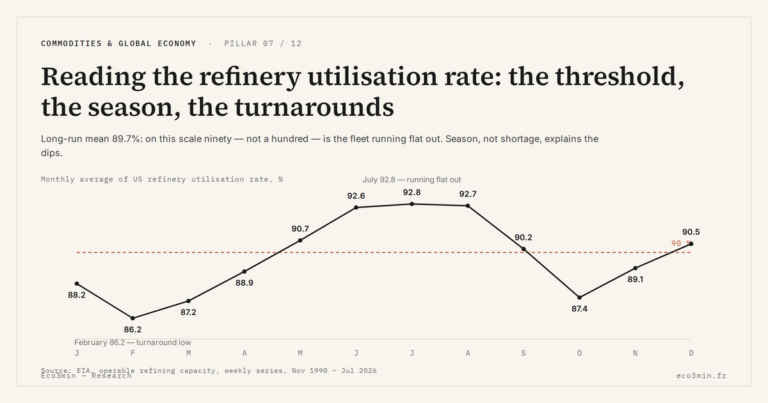
Full pillar →Reading the refinery utilisation rate: the threshold, the season, the turnarounds
A refinery runs full near ninety percent, not a hundred: the last slice of nameplate capacity is a…
IMO 2020: the regulatory shock that rewrote product spreads
An environmental rule on marine sulfur can move a refining spread more than a swing in crude. IMO…
The 2022–2023 refining golden age: anatomy of an episode
In 2022, refined fuel prices climbed faster than crude. That gap, measured by the 3-2-1 crack spread, reached…