Did Expensive Gas Deindustrialize Europe? The Energy-Intensive Sectors at Risk

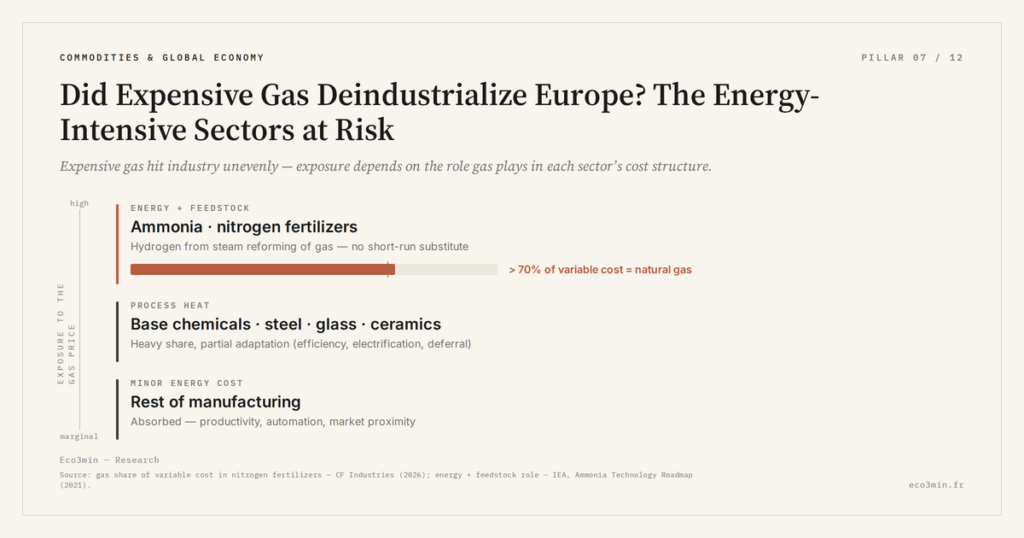
Gas durably dearer than in the US strikes industry unevenly: the sectors where it is both energy and feedstock — ammonia, fertilizers, base chemicals, heat-based metallurgy — see their break-even threshold shift.
TL;DR
Expensive gas struck European industry unevenly, hitting hardest where gas serves as chemical feedstock, in ammonia and nitrogen fertilizers, and shifting those sectors' break-even threshold.
- Ammonia and nitrogen fertilizers are the extreme case: gas is both the process energy and the feedstock, since hydrogen comes from steam reforming of natural gas, so production cost tracks the gas price almost proportionally with no short-run substitute.
- From 2022, many European ammonia units cut or halted output and imported the product instead, shutdown proving more rational than producing at a loss during the TTF surge.
- The decisive distinction is temporary adjustment versus lasting relocation: an idled unit restarts when economics allow, whereas new investment redirected toward cheap-energy regions shifts the industrial centre of gravity for years.
The question is not whether energy matters, but where the threshold lies and which sectors cross it. This piece separates the exposed industries and distinguishes temporary adjustment from lasting relocation.
Why some sectors are exposed
Not all industries are equal before the price of gas. For most activities, energy is only a modest fraction of costs, easily absorbed or offset by other factors — productivity, automation, proximity to markets. For these sectors, a gas-price gap between Europe and the US stays marginal. The competitiveness differential becomes decisive only where energy weighs heavily in the cost structure.
Two exposure mechanisms coexist. The first is energy-based: some outputs consume enormous quantities of heat or electricity, and gas — directly or through the marginal price of electricity — determines a substantial share of the cost. The second is more radical: for a few sectors, gas is not only the energy of the process but the feedstock itself, the basic chemical input. There, the economics of production track the gas price almost mechanically. It is this intensity — of energy or of feedstock — that sets the energy competitiveness gap at the level of a given sector.
Measuring that exposure means returning to the price gap itself. That is precisely what the transatlantic energy cost gap captures: for a manufacturer, what matters is not the absolute level of gas but its position relative to a competitor on the other side of the Atlantic. The more energy weighs in its cost, the more directly that gap translates into a competitive disadvantage.
One further factor sharpens the picture: the carbon cost. European producers also bear the price of emission allowances, which adds a wedge on top of the energy gap for the most carbon-intensive processes. For heat-based industries already exposed to gas, this layer compounds the differential, widening the gap with regions that price carbon lightly or not at all. The competitive question is therefore not gas alone, but the full delivered cost of energy plus carbon — a combination that bears hardest on exactly the sectors already most exposed to the gas price.
Ammonia and fertilizers: the extreme case
The most exposed sector is ammonia and nitrogen fertilizers. The reason is structural: ammonia is synthesized from hydrogen, itself produced mostly from natural gas by steam reforming. Gas is there both the energy source of the process and the feedstock from which hydrogen is extracted. It thus enters for a dominant share of production cost — often the larger part.
The consequence is direct. When the European gas price soars, the production cost of ammonia follows almost proportionally, with no offsetting lever. A producer cannot substitute another feedstock for gas in the short run, nor absorb a doubling of the main input’s cost through productivity gains. That is why, from 2022, many ammonia production units in Europe cut or halted activity, importing part of the ammonia and fertilizers they previously made. The economics of the sector made shutdown more rational than producing at a loss.
This case illustrates a useful distinction: the difference between an energy-consuming industry and an industry whose energy is the feedstock. The latter is far more vulnerable, because it has no room for adaptation. For ammonia, the gas price is not one cost among others; it is the central determinant of viability.
Chemicals, steel, glass: exposure through heat
Beyond ammonia, a broader set of sectors is exposed through the thermal intensity of their processes. Base chemicals, which transform hydrocarbons into intermediate products, consume gas both as energy and sometimes as input. Heat-intensive metallurgy — steel, foundries — requires high temperatures that gas often supplies directly. Glass and ceramics, whose furnaces run continuously at very high temperature, are among the largest gas consumers per unit produced.
For these industries, exposure is real but less absolute than for ammonia. Energy weighs heavily without being the whole cost, and margins for adaptation exist: process efficiency, partial switching to electricity, deferred production. But these adjustments have physical limits and a capital cost. A glass furnace is not reconverted in a few months, and electrifying high-grade heat remains, for many processes, technically difficult. The gas-price gap therefore translates, for these sectors, into a gradual erosion of margin rather than an abrupt shutdown.
The diversity of these situations explains why the effect of expensive gas does not read uniformly. Between ammonia, whose economics tip with the gas price, and a production where energy is just one cost among others, lies a whole gradient of exposure. The same price shock produces very different consequences depending on each sector’s position on that gradient — a point that blanket deindustrialization diagnoses tend to erase.
This gradient also shapes the policy response. Measures aimed at shielding industry — energy subsidies, capacity payments, carbon-cost relief — tend to target the most exposed sectors precisely because uniform support would be both costly and poorly aimed. The same logic that makes ammonia the extreme case makes it the natural focus of any industrial-energy policy: the narrower the band of truly exposed activities, the more targeted the intervention can be, and the clearer the trade-off between protecting output and the public cost of doing so.
Temporary adjustment or lasting relocation?
This is where the most important distinction lies, and the most often overlooked. Not all the production shutdowns seen in 2022-2023 carry the same meaning. Two phenomena that the term “deindustrialization” conflates must be separated.
The first is a temporary adjustment to the price peak. A unit reduces or suspends production while the gas price recedes, then restarts when the sector’s economics allow it again. It is a cyclical response to a transitory shock, with no lasting displacement of the productive apparatus. Part of the 2022 closures, occurring at the height of the TTF surge, fell under this logic: production halted, then resumed once prices normalized.
The second is lasting relocation. New investment — capacity expansion, plant construction — heads toward regions with abundant, cheap energy, with no plan to return. This is not a temporary halt but a shift in the industrial center of gravity, measured over years and committing long-term decisions. For the most exposed sectors, the persistence of the transatlantic price gap may have turned an investment trade-off in favor of other regions. This horizon, where gas redraws the map of locations, overlaps with the question of natural gas in the energy transition and of long-term energy choices.
Every production halt in 2022-2023 is often equated with permanent deindustrialization. That conflates two distinct phenomena: the temporary adjustment to the price peak, followed by a restart, and the lasting relocation of investment toward cheap-energy regions. Overstating the first dramatizes a cyclical shock; ignoring the second hides a real structural shift for the most exposed sectors.
What deindustrialization really covers
The thesis of a European deindustrialization driven by expensive gas is frequently asserted, more rarely measured with precision. It deserves careful handling, because it can lead to two symmetric errors. The first is to generalize: to conclude, from shutdowns concentrated in a few energy-intensive sectors, that there is an overall industrial decline, when most of industry is not determined by the gas price. The second is to minimize: to deny any structural effect on the grounds that prices receded, when for sectors where energy is the feedstock, the price signal may well have durably redirected investment.
An economy’s competitiveness does not reduce to the price of gas. It depends on productivity, human capital, market access, the depth of value chains, the speed at which other energy sources can take over. Gas is one factor among others; what changed is that it became, for a whole zone and for certain sectors, a visible and differentiating factor, where it was previously a stable, shared cost. Deindustrialization, if the term means anything here, is sectoral and graded, not general and abrupt. This reading joins the broader analysis of resource geoeconomics, where energy becomes again a determinant of industrial location.
It is worth situating this diagnosis against supply-side readings. One strand of analysis insists on the risk of future supply tensions in gas, which could revive price pressures. That perspective is forward-looking and concerns the availability of the resource; the present argument is retrospective and concerns the industrial response already observed. The two complement each other: one sheds light on what might return, the other on what has already adjusted.
Expensive gas did not empty Europe of its industry, but it shifted the break-even threshold of its most exposed sectors, and with it part of investment decisions. The stake, for these sectors, goes beyond the price level at a given moment: it bears on duration. As long as the transatlantic gap persists, the question is no longer whether energy matters, but how long a manufacturer can wait for a return to conditions that, for some, may not come back. In this respect, gas shares with oil the same role of a constraint on activity, which the oil burden on growth documents.
Last updated — 28 June 2026
Disclaimer – Financial Information: The analyses, commentary, and content published on eco3min.fr are provided for informational and educational purposes only. They do not constitute investment advice or a solicitation to buy or sell financial instruments. Past performance is not indicative of future results. All investment decisions involve risk and are the sole responsibility of the reader.
Read next
Full pillar →Reading the refinery utilisation rate: the threshold, the season, the turnarounds
A refinery runs full near ninety percent, not a hundred: the last slice of nameplate capacity is a…
IMO 2020: the regulatory shock that rewrote product spreads
An environmental rule on marine sulfur can move a refining spread more than a swing in crude. IMO…
The 2022–2023 refining golden age: anatomy of an episode
In 2022, refined fuel prices climbed faster than crude. That gap, measured by the 3-2-1 crack spread, reached…